article Creativity without
Compromise
Creativity without
Compromise
Isabelle Guyer speaks with Samson Bakare about
creative influences, brand collaborations, and
the hidden blessings of solitary work.
creative influences, brand collaborations, and
the hidden blessings of solitary work.
Isabelle Guyer speaks with Samson Bakare about
creative influences, brand collaborations, and
the hidden blessings of solitary work.
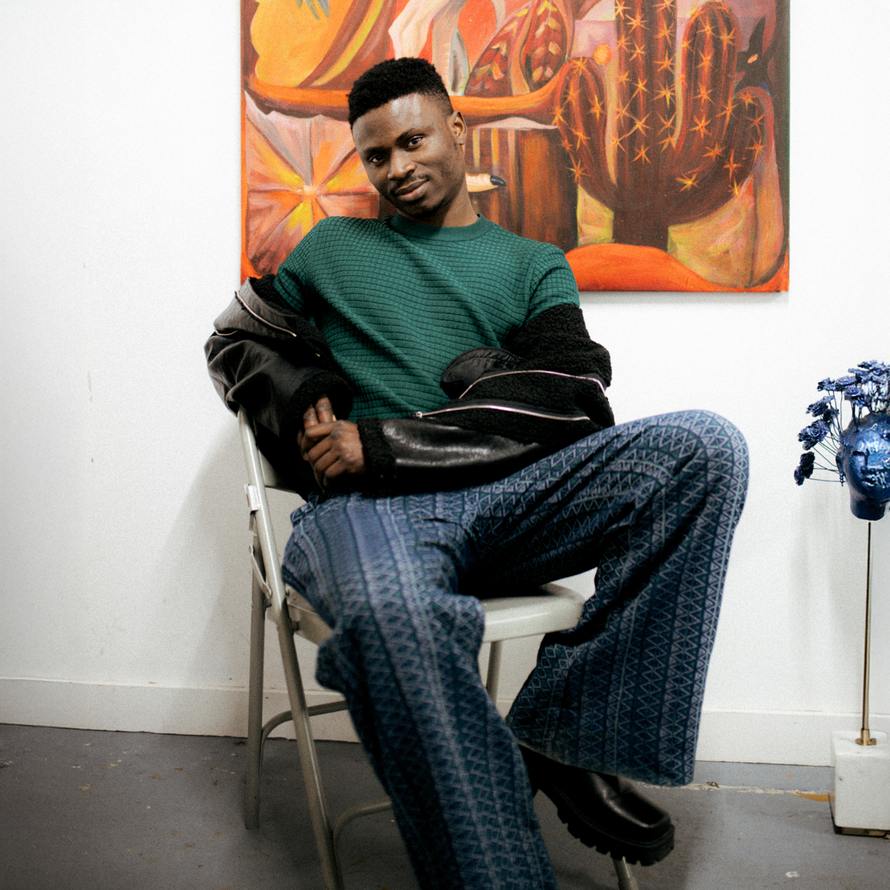
Samson Bakare is a multidisciplinary artist whose work navigates black identity across historical, contemporary, and speculative contexts. His practice is defined by bold colour, stylised form, and deep meaning.
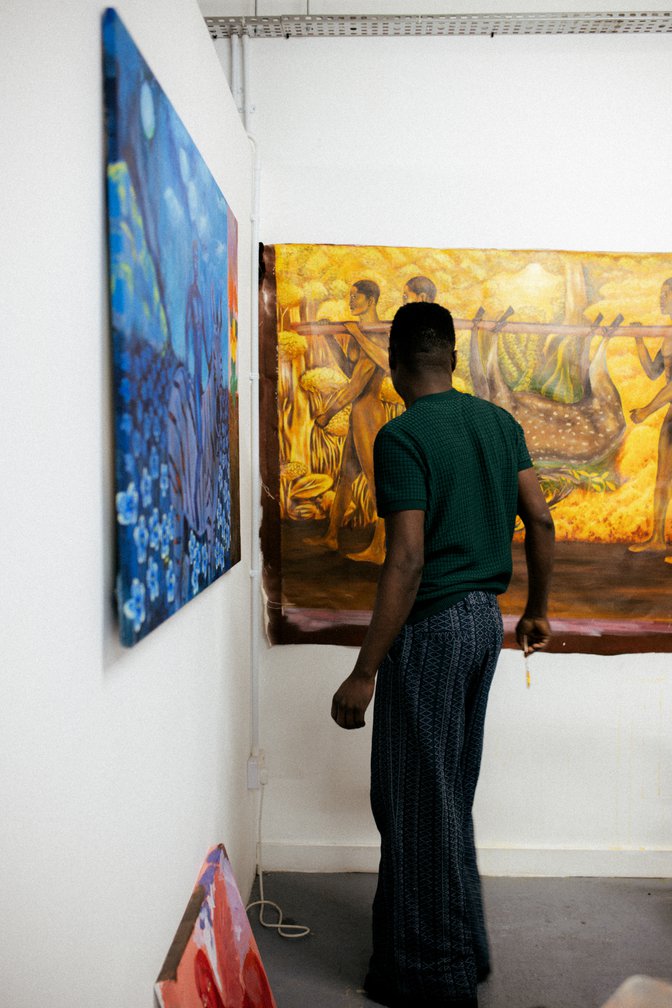
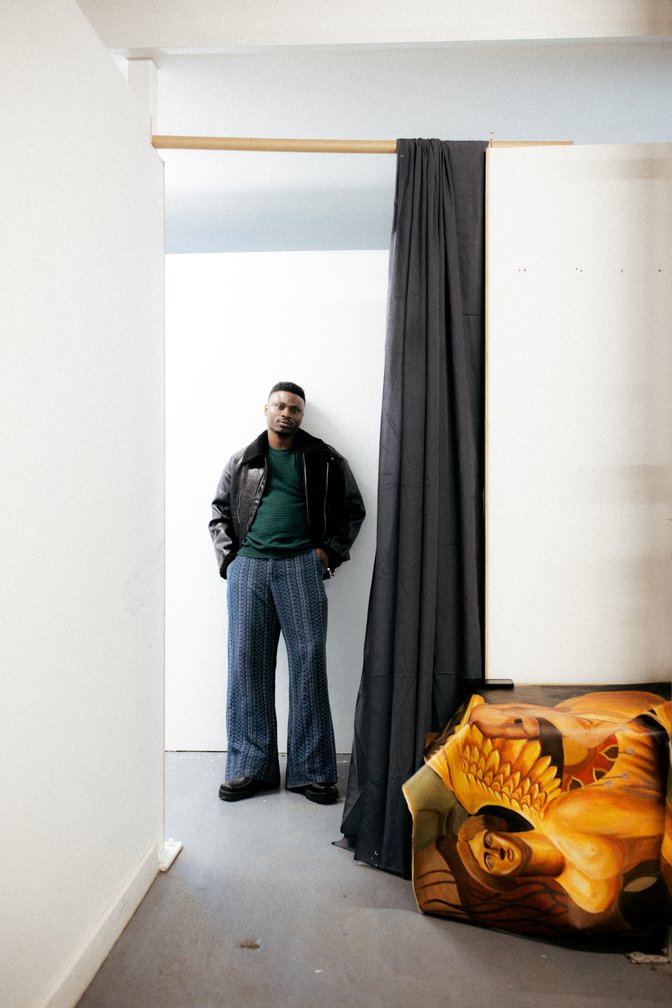
We meet Samson at his studio in Bow, East London, nestled within an arts collective among a corridor of studios. He welcomes us with coffee, sweetened with condensed milk, before giving us the grand tour. With the sun beating down by the riverside, hinting at the arrival of spring, we settled in the studio to discuss his career, journey to London from Lagos, the brand collaborations that have broadened his horizons, and, of course, what’s next?
A self-proclaimed maximalist with something to say, Samson talked us through his creative journey, from painting Black Renaissance figures and exploring the relationship between identity and fashion (a theme evident in his own style), to his current focus on the soul. Driven by curiosity, Samson explains that “knowledge is composite” and he sees the influence of all he’s learned in every work.
We meet Samson at his studio in Bow, East London, nestled within an arts collective among a corridor of studios. He welcomes us with coffee, sweetened with condensed milk, before giving us the grand tour. With the sun beating down by the riverside, hinting at the arrival of spring, we settled in the studio to discuss his career, journey to London from Lagos, the brand collaborations that have broadened his horizons, and, of course, what’s next?
A self-proclaimed maximalist with something to say, Samson talked us through his creative journey, from painting Black Renaissance figures and exploring the relationship between identity and fashion (a theme evident in his own style), to his current focus on the soul. Driven by curiosity, Samson explains that “knowledge is composite” and he sees the influence of all he’s learned in every work.
Isabelle You’ve been a full-time practicing artist for over five years now, with several solo shows and brand collaborations under your belt. Do you remember your earliest introduction to art?
Samson As a child I was lucky to have a mother who liked watching cartoons with us. I remember loving the simplicity and humour of Cartoon Network characters as well as DC, Marvel and Disney. I was intrigued by how cartoonists illustrated their characters by either minimising, exaggerating, or stylising their forms and elements. I saw the colours, the gestures and a bit of the fantasy which inspired me to create my personal comic drawings during my formative days.
Isabelle Your father is an architect and a great source of inspiration for you. How did this shape your decision to pursue art and who were your other great sources of inspiration growing up? Have those influences changed over time?
Samson Before the digital revolution in architectural design, I watched my dad make intricate lines and geometric drawings with technical equipment like protractors, French curves, pencils and more. His craftsmanship and studio dedication were impressive, he generated a creative energy that was contagious. At the age of six, I made my first 3D Model of a house crafted with paper and board for my class assignment. The experience introduced me to spatial management and allowed me to think about the ability to improvise with resources and materials that were available.
Samson As a child I was lucky to have a mother who liked watching cartoons with us. I remember loving the simplicity and humour of Cartoon Network characters as well as DC, Marvel and Disney. I was intrigued by how cartoonists illustrated their characters by either minimising, exaggerating, or stylising their forms and elements. I saw the colours, the gestures and a bit of the fantasy which inspired me to create my personal comic drawings during my formative days.
Isabelle Your father is an architect and a great source of inspiration for you. How did this shape your decision to pursue art and who were your other great sources of inspiration growing up? Have those influences changed over time?
Samson Before the digital revolution in architectural design, I watched my dad make intricate lines and geometric drawings with technical equipment like protractors, French curves, pencils and more. His craftsmanship and studio dedication were impressive, he generated a creative energy that was contagious. At the age of six, I made my first 3D Model of a house crafted with paper and board for my class assignment. The experience introduced me to spatial management and allowed me to think about the ability to improvise with resources and materials that were available.
Isabelle You’re not afraid to embrace new experiences and opportunities, if anything you thrive on it. Did this fuel your decision to become a full-time artist during covid? You describe a revolution in this time?
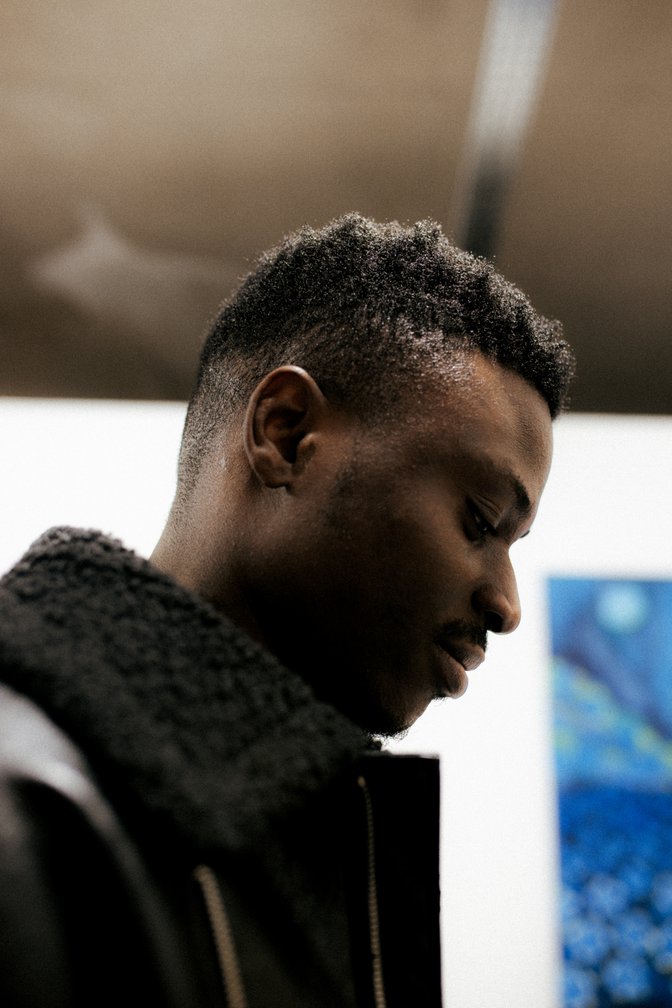
Samson During the pandemic lockdown, there was nowhere else to go, nothing much to do, but art saved me, just as art saves humanity. The world was in huge depression and fear, but art restored my sanity; it was a doorway to escape the chaotic world. I remember how I would paint from dawn to dusk till my fears were confronted. I was once again reminded of the futility of life itself, and this made me place a degree of urgency into developing my work. The noise was over, and I could listen to my inner self; my consciousness was heightened as there were little distractions. Solitude is truly a blessing at times.
Isabelle Prior to being a full-time artist, you worked as an art teacher. Did that experience influence your approach to making art yourself?
Samson Teaching art opened me to the necessity to equip myself with art history and critical thinking. I believe in the notion that a person cannot give what they do not have, therefore it was a privilege to impact others with the knowledge I’ve gained empirically. I knew I had to prepare because my students were so smart. Aside from the fact that teaching enhanced my public speaking skills, it also allowed me to theorise my ideologies about art. The kids made me realise the need for the world to rethink art education in an unconventional manner. Most importantly, my students taught me how to lead and how to love. Love is the ultimate power.
Samson During the pandemic lockdown, there was nowhere else to go, nothing much to do, but art saved me, just as art saves humanity. The world was in huge depression and fear, but art restored my sanity; it was a doorway to escape the chaotic world. I remember how I would paint from dawn to dusk till my fears were confronted. I was once again reminded of the futility of life itself, and this made me place a degree of urgency into developing my work. The noise was over, and I could listen to my inner self; my consciousness was heightened as there were little distractions. Solitude is truly a blessing at times.
Isabelle Prior to being a full-time artist, you worked as an art teacher. Did that experience influence your approach to making art yourself?
Samson Teaching art opened me to the necessity to equip myself with art history and critical thinking. I believe in the notion that a person cannot give what they do not have, therefore it was a privilege to impact others with the knowledge I’ve gained empirically. I knew I had to prepare because my students were so smart. Aside from the fact that teaching enhanced my public speaking skills, it also allowed me to theorise my ideologies about art. The kids made me realise the need for the world to rethink art education in an unconventional manner. Most importantly, my students taught me how to lead and how to love. Love is the ultimate power.
Isabelle I’m interested in the brand collaborations you’ve done in your career so far. Is this something you envisioned happening?
Samson When I started out in my career as a very young artist, I imagined cross-industry collaborations. I envisaged how art could transform all kinds of sectors: media, tech, corporate, education, medicine. I’m glad that so far, I’ve been able to contribute my creative prowess in a range of sectors, from luxury products and hospitality spaces, to music, entertainment and fashion industries, as well as the education and medical fields. Some of these collaborations entail creating an album cover for a musician, using my art as a form of healing therapy for hospital patients, and sometimes creating a hybrid of fashion and art. I consider each of these acts as pushing the boundaries and breaking down rigid demarcations between diverse fields and cultures. My collaboration with Gucci, WeTransfer, Novotel and many others is a testament of my appetite for art inclusion in every sphere of life.
Isabelle Does it feel different when creating works for brand collaborations?
Samson Yes! Working with brands made me understand the dynamics of negotiations and shifting of grounds. I will explain: brands often have a core idea they want to communicate to the public and I have the duty as an artist to express my own thoughts through the projects while also making space for the brand’s message to come through. I find the most compelling way for their ideas to find reflection in the project. Brand collaboration is a higher calling, away from my safe zone, now I must interpret briefs, engage in business conversation, listen to every unsaid word in order to make a mind-blowing innovation. On the contrary, some people have the notion that an artist who collaborates with brands are commercial. I do not believe so. These organisations have the financial power to sponsor the execution of innovative artistic ideas.
Samson When I started out in my career as a very young artist, I imagined cross-industry collaborations. I envisaged how art could transform all kinds of sectors: media, tech, corporate, education, medicine. I’m glad that so far, I’ve been able to contribute my creative prowess in a range of sectors, from luxury products and hospitality spaces, to music, entertainment and fashion industries, as well as the education and medical fields. Some of these collaborations entail creating an album cover for a musician, using my art as a form of healing therapy for hospital patients, and sometimes creating a hybrid of fashion and art. I consider each of these acts as pushing the boundaries and breaking down rigid demarcations between diverse fields and cultures. My collaboration with Gucci, WeTransfer, Novotel and many others is a testament of my appetite for art inclusion in every sphere of life.
Isabelle Does it feel different when creating works for brand collaborations?
Samson Yes! Working with brands made me understand the dynamics of negotiations and shifting of grounds. I will explain: brands often have a core idea they want to communicate to the public and I have the duty as an artist to express my own thoughts through the projects while also making space for the brand’s message to come through. I find the most compelling way for their ideas to find reflection in the project. Brand collaboration is a higher calling, away from my safe zone, now I must interpret briefs, engage in business conversation, listen to every unsaid word in order to make a mind-blowing innovation. On the contrary, some people have the notion that an artist who collaborates with brands are commercial. I do not believe so. These organisations have the financial power to sponsor the execution of innovative artistic ideas.
Isabelle You use a range of materials in your work. What is it about a particular material that draws you in? What do you look out for?
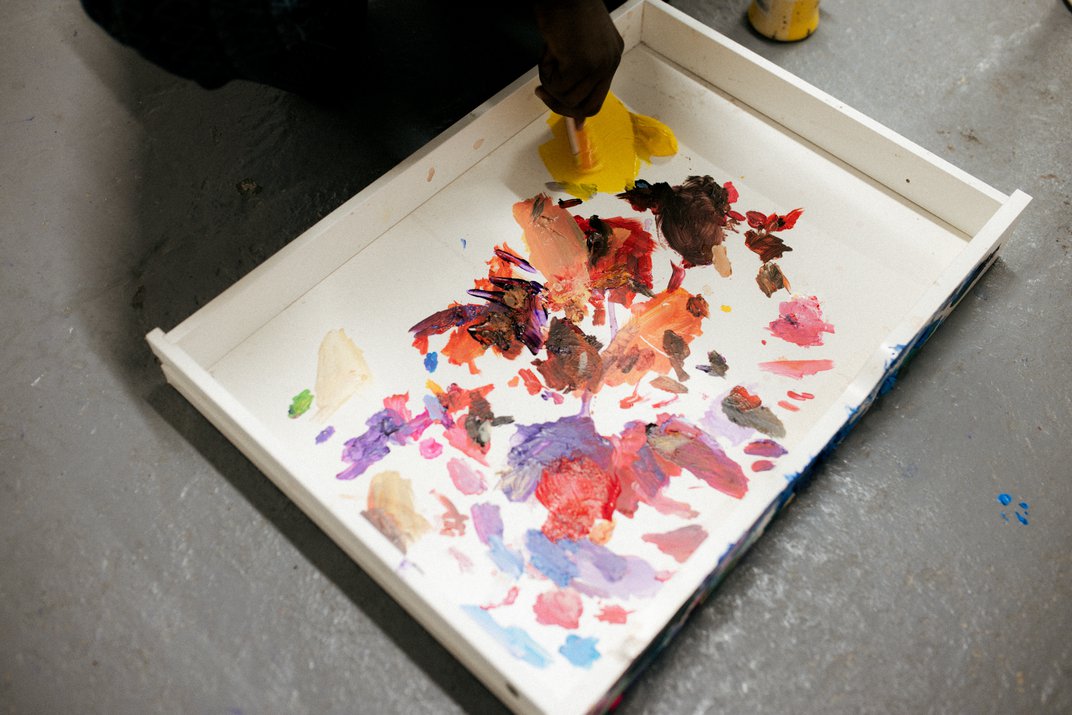
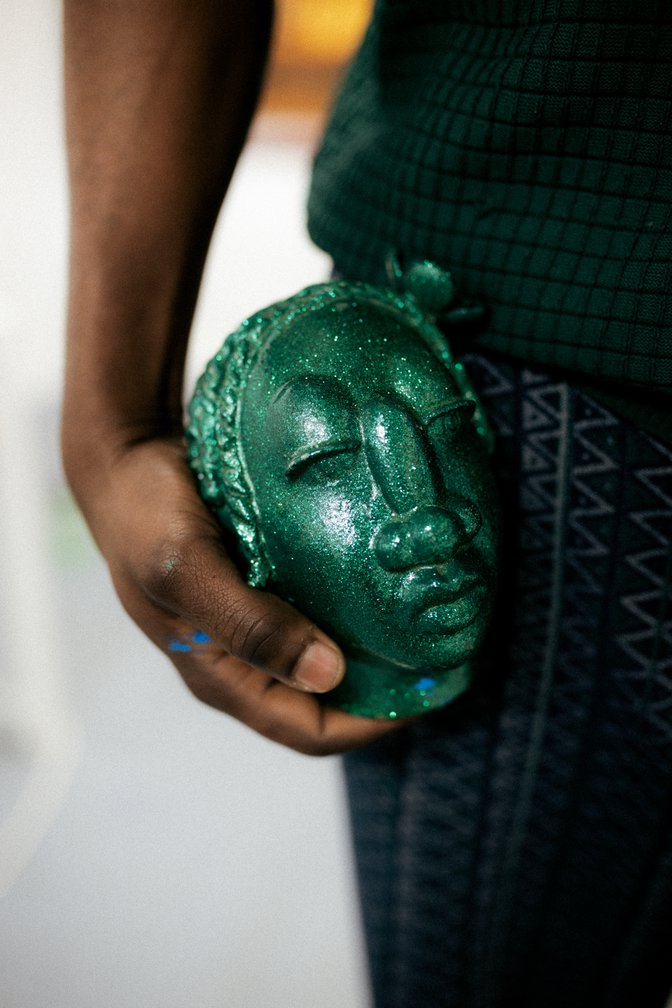
Samson The discovery of acrylic paints has been a major aid to my practice. As someone with ADHD, I find it difficult to work with oil paints and slow dry mediums due to my hyperactive mind and inability to concentrate on a particular task for a long period of time. Art reflects the attributes and characteristics of its maker; this is why my acrylic medium has helped me manage my spontaneous personality. I also enjoy the plasticity of acrylics, the vividness, the luminosity, and most importantly the time-saving advantage.
Isabelle Looking forward at what’s next for you, are there any new materials you’re excited to experiment with as you move more into large-scale public sculpture?
Samson For a long time in my career, I had always been keen on material experimentations. I look forward to working with copper, zinc, marbles, and precious stones. Speaking of public art, I do not believe in gatekeeping art; almost every other aspect of life and industry has been created exclusively for classes and nobility. I wish to democratise art because art is the power of the people. It’s an agency through which societal values can either be changed, replaced or maintained. On this note, I admire the impact of Daniel Arsham, Anish Kapoor, Thomas J Price, and Yayoi Kusama. I look forward to unveiling my large sculpture in London and Lisbon.
Isabelle Thinking about your practice as a whole from the position of the viewer, what do you hope people take away from your work?
Samson I intend to remind my viewers of the importance of depth in a shallow world. As a maximalist, I believe in essence, I’m of the school of thought that “more is more”. My primary message mostly is about time and mortality. It is my hope that my work reminds my viewers on the brevity of life itself and how art can act as a guide that leads us through our time on this earth, using metaphors and stylisation, through which these messages are shared.
Samson The discovery of acrylic paints has been a major aid to my practice. As someone with ADHD, I find it difficult to work with oil paints and slow dry mediums due to my hyperactive mind and inability to concentrate on a particular task for a long period of time. Art reflects the attributes and characteristics of its maker; this is why my acrylic medium has helped me manage my spontaneous personality. I also enjoy the plasticity of acrylics, the vividness, the luminosity, and most importantly the time-saving advantage.
Isabelle Looking forward at what’s next for you, are there any new materials you’re excited to experiment with as you move more into large-scale public sculpture?
Samson For a long time in my career, I had always been keen on material experimentations. I look forward to working with copper, zinc, marbles, and precious stones. Speaking of public art, I do not believe in gatekeeping art; almost every other aspect of life and industry has been created exclusively for classes and nobility. I wish to democratise art because art is the power of the people. It’s an agency through which societal values can either be changed, replaced or maintained. On this note, I admire the impact of Daniel Arsham, Anish Kapoor, Thomas J Price, and Yayoi Kusama. I look forward to unveiling my large sculpture in London and Lisbon.
Isabelle Thinking about your practice as a whole from the position of the viewer, what do you hope people take away from your work?
Samson I intend to remind my viewers of the importance of depth in a shallow world. As a maximalist, I believe in essence, I’m of the school of thought that “more is more”. My primary message mostly is about time and mortality. It is my hope that my work reminds my viewers on the brevity of life itself and how art can act as a guide that leads us through our time on this earth, using metaphors and stylisation, through which these messages are shared.
Isabelle Thank you so much Samson. Finally, what’s your favourite colour?
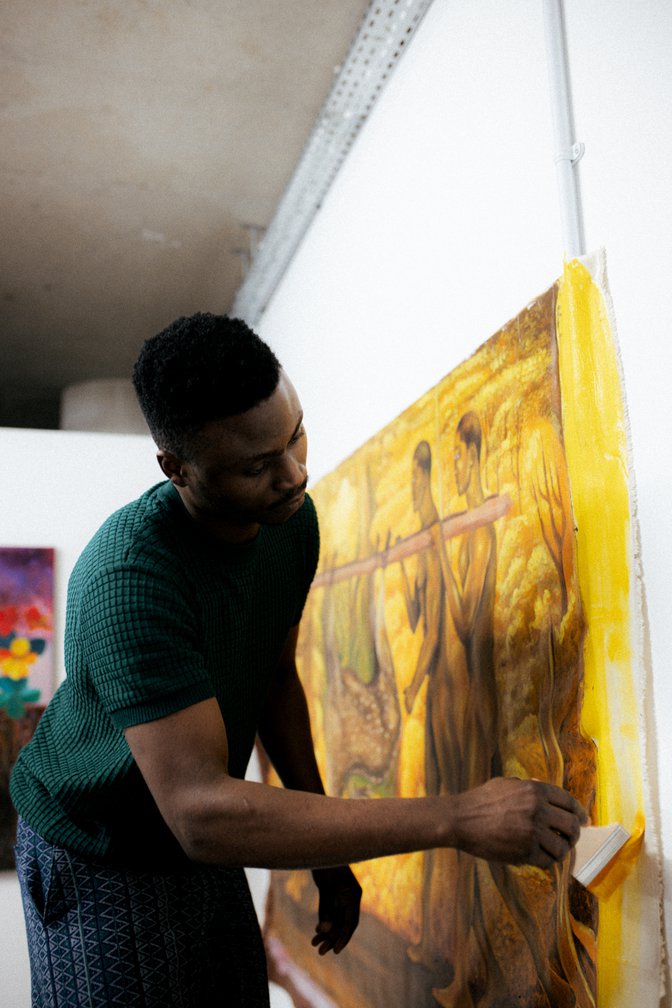
Samson GREEN.
Isabelle Guyer, Senior Curator at Artiq
Photography by Damilola Ayo-Vaughan, Curator at Artiq
Samson GREEN.
Isabelle Guyer, Senior Curator at Artiq
Photography by Damilola Ayo-Vaughan, Curator at Artiq