article Hive Mind
Hive Mind
From social justice to economic renewal,
this is a call to action for the creative industries.
this is a call to action for the creative industries.
From social justice to economic renewal,
this is a call to action for the creative industries.
The UK’s creative industries are a global powerhouse, fuelling growth, shaping culture, and inspiring change. But they’re also under pressure: undervalued in policy, underfunded in education, and under strain from shifting economic, technological and political tides.
In response, we brought together a hive mind of leaders from across the sector to reflect on what’s working, what’s broken, and what’s next. What emerged is a compelling picture of an industry bursting with potential but held back by systemic barriers—from class and access to rigid funding models and outdated perceptions of value. Their insights reveal the urgent need for new frameworks: ones that recognise creativity’s full impact, not just its market value. Ones that nurture diverse talent, reform education, and challenge the persistent notion that being creative is just “playing”, a hobby rather than a serious career path.
Across the board, contributors call for deeper cross-sector collaboration, from health to AI, where creativity is already driving radical innovation and public good.
This is more than a sector — it’s an ecosystem. And if we want it to thrive, we need bold, joined-up thinking and long-term investment. From social justice to economic renewal, this is a call to action — for reform, recognition, and a reimagined future powered by creativity.
In response, we brought together a hive mind of leaders from across the sector to reflect on what’s working, what’s broken, and what’s next. What emerged is a compelling picture of an industry bursting with potential but held back by systemic barriers—from class and access to rigid funding models and outdated perceptions of value. Their insights reveal the urgent need for new frameworks: ones that recognise creativity’s full impact, not just its market value. Ones that nurture diverse talent, reform education, and challenge the persistent notion that being creative is just “playing”, a hobby rather than a serious career path.
Across the board, contributors call for deeper cross-sector collaboration, from health to AI, where creativity is already driving radical innovation and public good.
This is more than a sector — it’s an ecosystem. And if we want it to thrive, we need bold, joined-up thinking and long-term investment. From social justice to economic renewal, this is a call to action — for reform, recognition, and a reimagined future powered by creativity.

Caroline Norbury
Founder and CEO of Creative UK
Artiq Creative UK is the leading network supporting and championing the UK’s creative industries, advocating for policy change, funding opportunities, and industry growth. AI is an unavoidable part of any conversation about the future of the creative industries, here in the UK and around the world, given the ongoing debate around AI and copyright, how can policymakers strike a fair balance between fostering innovation and protecting creators’ rights? Is an opt-out system a viable solution, and what alternative approaches should be considered?
Caroline This is a complex and divisive debate. Should policymakers move forward with a proposed rights reservation mechanism (aka an opt-out) which is intended to balance rights holders’ ability to safeguard their work? Or, in plainer terms – should AI developers be able to access data such as scripts, media, music, visual art to train their models, unless the rights owner specifically says no?
Impassioned arguments are frequently set up as binary, with AI presented as either the ‘bad guy’ or the saviour of every industry from healthcare through to tech. This approach simply does not reflect the reality of the situation at hand. The UK Government, and many in the Creative Industries perceive AI as a core driver of economic expansion. Whilst the potential is undeniable, one thing is clear: that growth cannot come at the expense of the creators who fuel the entire system.
The challenge we face is not AI itself. The cultural and creative sectors are already embracing AI in exciting ways – from streamlining production processes to pioneering new art forms. The issue is how AI developers access, use and monetise creative content; and whether creators receive fair compensation for their work.
Without a robust and enforceable copyright framework, we risk an extractive model where creative labour is devalued and AI innovation is built on unlicensed, uncompensated content.
Founder and CEO of Creative UK
Artiq Creative UK is the leading network supporting and championing the UK’s creative industries, advocating for policy change, funding opportunities, and industry growth. AI is an unavoidable part of any conversation about the future of the creative industries, here in the UK and around the world, given the ongoing debate around AI and copyright, how can policymakers strike a fair balance between fostering innovation and protecting creators’ rights? Is an opt-out system a viable solution, and what alternative approaches should be considered?
Caroline This is a complex and divisive debate. Should policymakers move forward with a proposed rights reservation mechanism (aka an opt-out) which is intended to balance rights holders’ ability to safeguard their work? Or, in plainer terms – should AI developers be able to access data such as scripts, media, music, visual art to train their models, unless the rights owner specifically says no?
Impassioned arguments are frequently set up as binary, with AI presented as either the ‘bad guy’ or the saviour of every industry from healthcare through to tech. This approach simply does not reflect the reality of the situation at hand. The UK Government, and many in the Creative Industries perceive AI as a core driver of economic expansion. Whilst the potential is undeniable, one thing is clear: that growth cannot come at the expense of the creators who fuel the entire system.
The challenge we face is not AI itself. The cultural and creative sectors are already embracing AI in exciting ways – from streamlining production processes to pioneering new art forms. The issue is how AI developers access, use and monetise creative content; and whether creators receive fair compensation for their work.
Without a robust and enforceable copyright framework, we risk an extractive model where creative labour is devalued and AI innovation is built on unlicensed, uncompensated content.
“The UK Government, and many in the Creative Industries perceive AI as a core driver of economic expansion. Whilst the potential is undeniable, one thing is clear: that growth cannot come at the expense of the creators who fuel the entire system.”
The UK Government’s preferred option (to introduce an opt-out system for text and data mining (TDM) which would give AI developers license to ingest and train on copyrighted content by default – unless creators actively opt out) is framed as a balanced solution: a system where AI developers can innovate, whilst creators retain a mechanism to protect their work.
But let’s be clear: this is not balance. It is a significant economic power shift away from creators and towards large technology platforms. We are being presented with a false choice: either weaken copyright protections to foster AI growth, or risk stifling innovation. This is a flawed and unnecessary trade-off.
Instead, we need a framework that enables responsible AI development, whilst ensuring that creators are fairly compensated. That means licensing, not opt-outs; mandatory transparency and stronger enforcement of copyright protections.
The UK has an opportunity to lead, here: not by weakening copyright, but by setting a gold standard for AI-creator partnerships. That means designing a system where licensing creative content is the norm, transparency is mandated and creators share in the economic value that AI generates from their work.
The decisions we make today will define the future of both AI and the creative economy. We must get this right–not just for the artists, writers, musicians and creators of today, but for the future of the UK’s cultural and creative industries as a whole.
But let’s be clear: this is not balance. It is a significant economic power shift away from creators and towards large technology platforms. We are being presented with a false choice: either weaken copyright protections to foster AI growth, or risk stifling innovation. This is a flawed and unnecessary trade-off.
Instead, we need a framework that enables responsible AI development, whilst ensuring that creators are fairly compensated. That means licensing, not opt-outs; mandatory transparency and stronger enforcement of copyright protections.
The UK has an opportunity to lead, here: not by weakening copyright, but by setting a gold standard for AI-creator partnerships. That means designing a system where licensing creative content is the norm, transparency is mandated and creators share in the economic value that AI generates from their work.
The decisions we make today will define the future of both AI and the creative economy. We must get this right–not just for the artists, writers, musicians and creators of today, but for the future of the UK’s cultural and creative industries as a whole.

Jon Datta
Head of University Access & Digital at The Sutton Trust
Artiq The Sutton Trust has long highlighted social mobility challenges across various sectors, but class diversity in the creative industries often receives less attention than other forms of representation. What does the data tell us about the extent of the issue? Why does class remain such a systemic barrier, and what is the creative sector losing by failing to include more working-class talent?
Jon Class diversity in the creative industries has long been overlooked compared to other forms of representation, yet new research from the Sutton Trust highlights the significant barriers facing working-class talent.
Our report, A Class Act, reveals that just 16% of those working in acting, music, and writing come from working-class backgrounds—despite this group making up nearly a third of the UK workforce. Younger adults from working-class backgrounds are also four times less likely to work in the creative industries compared to their middle-class peers, reinforcing the stark inequalities in access and progression.
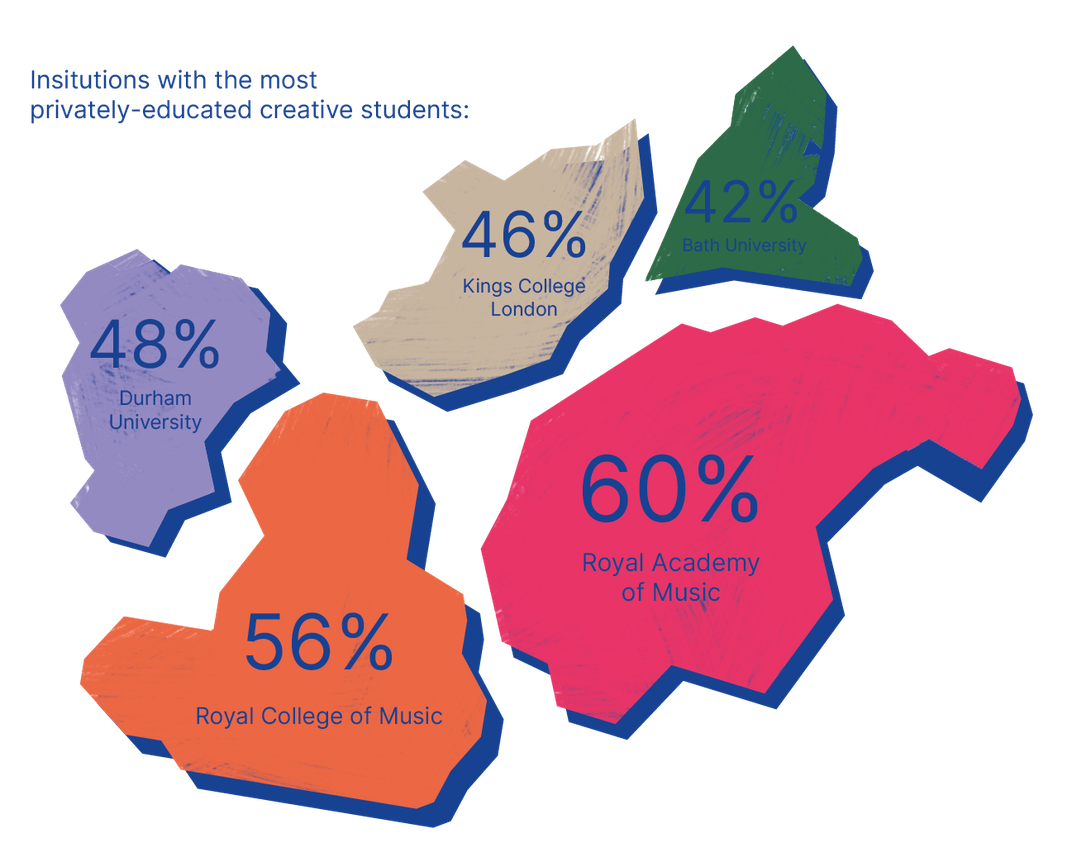
The imbalance begins in education. At elite institutions such as Oxford, Cambridge, King’s College London, and Bath, over half of creative students come from upper-middle-class backgrounds, while only 4–7% are from working-class backgrounds. The divide is even greater in specialist institutions like conservatoires, where over 50% of music students are privately educated. These statistics reflect a broader pattern of exclusion that persists throughout creative careers.
Beyond education, financial barriers further entrench inequality. The prevalence of unpaid internships and insecure freelance work makes it difficult for those without financial support to sustain a career. Unpaid roles remain a widespread entry point, effectively shutting out talented individuals who cannot afford to work for free.
A lack of access to arts education in state schools limits early engagement with creative careers. The exclusion of creative subjects from the English Baccalaureate (EBacc) and cuts to arts funding have disproportionately affected disadvantaged students. Our research also shows that participation in extracurricular arts activities is strongly linked to household income, further restricting opportunities for those from lower socio-economic backgrounds.
However, a recent government announcement signals a potential shift. The Department for Education has pledged “to support the delivery of high-quality arts education through a new online training offer for teachers, promoting opportunities for children and young people to pursue their artistic and creative interests in school,” with an emphasis on boosting access for disadvantaged pupils. While this is a positive step, sustained funding and targeted interventions will be necessary to ensure this investment translates into long-term improvements in social mobility within the sector.
Head of University Access & Digital at The Sutton Trust
Artiq The Sutton Trust has long highlighted social mobility challenges across various sectors, but class diversity in the creative industries often receives less attention than other forms of representation. What does the data tell us about the extent of the issue? Why does class remain such a systemic barrier, and what is the creative sector losing by failing to include more working-class talent?
Jon Class diversity in the creative industries has long been overlooked compared to other forms of representation, yet new research from the Sutton Trust highlights the significant barriers facing working-class talent.
Our report, A Class Act, reveals that just 16% of those working in acting, music, and writing come from working-class backgrounds—despite this group making up nearly a third of the UK workforce. Younger adults from working-class backgrounds are also four times less likely to work in the creative industries compared to their middle-class peers, reinforcing the stark inequalities in access and progression.
The imbalance begins in education. At elite institutions such as Oxford, Cambridge, King’s College London, and Bath, over half of creative students come from upper-middle-class backgrounds, while only 4–7% are from working-class backgrounds. The divide is even greater in specialist institutions like conservatoires, where over 50% of music students are privately educated. These statistics reflect a broader pattern of exclusion that persists throughout creative careers.
Beyond education, financial barriers further entrench inequality. The prevalence of unpaid internships and insecure freelance work makes it difficult for those without financial support to sustain a career. Unpaid roles remain a widespread entry point, effectively shutting out talented individuals who cannot afford to work for free.
A lack of access to arts education in state schools limits early engagement with creative careers. The exclusion of creative subjects from the English Baccalaureate (EBacc) and cuts to arts funding have disproportionately affected disadvantaged students. Our research also shows that participation in extracurricular arts activities is strongly linked to household income, further restricting opportunities for those from lower socio-economic backgrounds.
However, a recent government announcement signals a potential shift. The Department for Education has pledged “to support the delivery of high-quality arts education through a new online training offer for teachers, promoting opportunities for children and young people to pursue their artistic and creative interests in school,” with an emphasis on boosting access for disadvantaged pupils. While this is a positive step, sustained funding and targeted interventions will be necessary to ensure this investment translates into long-term improvements in social mobility within the sector.
Moreover, networks and cultural capital play a crucial role in securing jobs in the sector. As our report outlines, creative careers often rely on personal connections and informal recruitment practices, favouring those with family support and industry contacts. By failing to include more working-class talent, the creative industries miss out on diverse perspectives that could drive innovation and cultural relevance.
Working-class artists bring authentic narratives and lived experiences that challenge mainstream storytelling, ensuring that art, music, film, and theatre better reflect society as a whole. Initiatives such as the Social Mobility Commission’s Creative Industries Toolkit demonstrate how inclusive practices can lead to groundbreaking work. However, these efforts must be scaled up across the sector to create lasting change.
Working-class artists bring authentic narratives and lived experiences that challenge mainstream storytelling, ensuring that art, music, film, and theatre better reflect society as a whole. Initiatives such as the Social Mobility Commission’s Creative Industries Toolkit demonstrate how inclusive practices can lead to groundbreaking work. However, these efforts must be scaled up across the sector to create lasting change.
“Just 16% of those working in acting, music, and writing come from working-class backgrounds-despite this group making up nearly a third of the UK workforce.”
Addressing class inequality in the creative industries requires structural reform. The Sutton Trust is calling for action such as the creation of an ‘arts premium’ in schools to fund arts education, the removal of audition fees at publicly funded conservatoires, and the inclusion of socio-economic diversity as a condition for arts funding.
Without these changes, the sector risks perpetuating privilege, limiting artistic expression, and disconnecting from broader audiences. Ensuring fair access to creative careers isn’t just about equity—it’s about safeguarding the future vibrancy of the UK’s cultural landscape.
Without these changes, the sector risks perpetuating privilege, limiting artistic expression, and disconnecting from broader audiences. Ensuring fair access to creative careers isn’t just about equity—it’s about safeguarding the future vibrancy of the UK’s cultural landscape.

Fran Sanderson
CEO of Figurative
Artiq Over the past few years, the UK’s creative industries have contributed an average of £126 billion a year to the economy, eclipsing many traditional sectors. Between 2010 and 2022, the sector’s GVA grew by 50.3%, more than double the overall UK economy’s growth of 21.5% in the same period. Clearly, there’s money to be made. And yet, access to funding remains a huge challenge for creative entrepreneurs. Why? Is it a systemic misunderstanding of creative business models and their value? Is it greed, a 10x exit vs a 4x sustainable business. How can investment in the sector be reshaped to support creative growth?
Fran Driving effective returns on capital is about growth and efficiency. However, the creative industries have a big dispersion of business models in numerous subsectors, making the sector harder to grasp and more challenging for investors to navigate. Gaining a full understanding takes time, contradicting the desire for immediate returns. A significant gap in knowledge also exists around how the creative industries generate revenue. Many don’t know the difference between a West End theatre and a local theatre, let alone their economic models. While it’s widely known that major national museums are free, few consider how they are funded. Instead of engaging with the complexities of the mixed-model economy and funding structures, people often stop thinking about it altogether. Even if this is a slight generalisation at the public level, it has major implications for how creative businesses and artistic output are financed.
Another challenge is how creative work is valued. Even within the sector, it is often significantly underpriced. When I started working in the City, learning economics through a Chicago School, highly capitalist lens, I was married to an architect. I remember thinking, this is crazy, architects are structurally massively underpaid. What they bring has been badly priced, and now they’re stuck in a cycle where low fees became the norm. I wonder if a similar structural issue exists across the creative industries. Have creatives historically just been worse at talking about money, leading to undervaluation over time? Whatever it is, the contribution of the entire sector is undervalued, and this reinforces the perception that creative work is not a viable financial investment.
One of the biggest challenges for investors is scale. How do you take an idea and scale it effectively? What are the major economies of scale? This is where investors make their money—through mass-market opportunities. However, the creative industries consist of a large number of small organisations, which makes them less attractive to investors focused on large-scale growth.
Gaming is an interesting case study because it scales visibly. It attracts investment precisely because of its scalability and mass-market appeal. However, I worry that the rapid growth statistics of the creative industries—particularly contributions from film, TV, and gaming—might give policymakers a misleading impression of the sector’s overall health. If you strip out gaming and tech, the numbers look very different.
CEO of Figurative
Artiq Over the past few years, the UK’s creative industries have contributed an average of £126 billion a year to the economy, eclipsing many traditional sectors. Between 2010 and 2022, the sector’s GVA grew by 50.3%, more than double the overall UK economy’s growth of 21.5% in the same period. Clearly, there’s money to be made. And yet, access to funding remains a huge challenge for creative entrepreneurs. Why? Is it a systemic misunderstanding of creative business models and their value? Is it greed, a 10x exit vs a 4x sustainable business. How can investment in the sector be reshaped to support creative growth?
Fran Driving effective returns on capital is about growth and efficiency. However, the creative industries have a big dispersion of business models in numerous subsectors, making the sector harder to grasp and more challenging for investors to navigate. Gaining a full understanding takes time, contradicting the desire for immediate returns. A significant gap in knowledge also exists around how the creative industries generate revenue. Many don’t know the difference between a West End theatre and a local theatre, let alone their economic models. While it’s widely known that major national museums are free, few consider how they are funded. Instead of engaging with the complexities of the mixed-model economy and funding structures, people often stop thinking about it altogether. Even if this is a slight generalisation at the public level, it has major implications for how creative businesses and artistic output are financed.
Another challenge is how creative work is valued. Even within the sector, it is often significantly underpriced. When I started working in the City, learning economics through a Chicago School, highly capitalist lens, I was married to an architect. I remember thinking, this is crazy, architects are structurally massively underpaid. What they bring has been badly priced, and now they’re stuck in a cycle where low fees became the norm. I wonder if a similar structural issue exists across the creative industries. Have creatives historically just been worse at talking about money, leading to undervaluation over time? Whatever it is, the contribution of the entire sector is undervalued, and this reinforces the perception that creative work is not a viable financial investment.
One of the biggest challenges for investors is scale. How do you take an idea and scale it effectively? What are the major economies of scale? This is where investors make their money—through mass-market opportunities. However, the creative industries consist of a large number of small organisations, which makes them less attractive to investors focused on large-scale growth.
Gaming is an interesting case study because it scales visibly. It attracts investment precisely because of its scalability and mass-market appeal. However, I worry that the rapid growth statistics of the creative industries—particularly contributions from film, TV, and gaming—might give policymakers a misleading impression of the sector’s overall health. If you strip out gaming and tech, the numbers look very different.
“For the creative industries to truly attract investment, we need to bridge the gap between financial expectations and the unique nature of creative work.”
I wonder if this is part of the broader issue around money—do creative businesses struggle to attract investment because they simply aren’t cash-hungry enough? Or is the investment gap not large enough? Perhaps their ambitions aren’t geared towards aggressive scaling, or they prioritise the work itself over expansion. Perhaps the creative industries don’t have capitalism at their core in the same way other sectors do—whether for better or worse.
Venture capital often feels like a game of flipping businesses for resale rather than building something of lasting value. Where’s the heart in that? Who actually cares whether the business does well in the long run? It’s more about fattening a calf for sale than creating something meaningful and sustainable. Maybe this is why the creative industries don’t fit neatly into the traditional VC model.
Right now, investment is challenging. We are seeing some expansion in consumer models—new business income streams that are still relatively unproven but promising. There is growth in areas like courses, straightforward B2C revenue, and diversification beyond traditional “bums on seats” models. It would be great to see more platforms and marketplace creation, as these offer significant efficiencies. However, for the creative industries to truly attract investment, we need to bridge the gap between financial expectations and the unique nature of creative work.
Venture capital often feels like a game of flipping businesses for resale rather than building something of lasting value. Where’s the heart in that? Who actually cares whether the business does well in the long run? It’s more about fattening a calf for sale than creating something meaningful and sustainable. Maybe this is why the creative industries don’t fit neatly into the traditional VC model.
Right now, investment is challenging. We are seeing some expansion in consumer models—new business income streams that are still relatively unproven but promising. There is growth in areas like courses, straightforward B2C revenue, and diversification beyond traditional “bums on seats” models. It would be great to see more platforms and marketplace creation, as these offer significant efficiencies. However, for the creative industries to truly attract investment, we need to bridge the gap between financial expectations and the unique nature of creative work.

Amie Corry
Chair of Hospital Rooms
Artiq In a world where success and value are predominantly measured through data and financial returns, how can we shift the conversation to fully recognise the intangible yet transformative impact of art, both in society at large and specifically within healthcare and mental wellbeing? In striving to make this impact more measurable, how does Hospital Rooms demonstrate its value?
Amie Hospital Rooms is a radical project. Founded by artist Tim A Shaw and curator Niamh White, we rethink the provision, facilitation and conceptual grounding of NHS mental health services through art. Our model is based on coproduction and collective learning. Extensive workshops and creative programmes involving artists, staff and service users feed into the creation of every artwork.
As cultural workers, we perhaps take the belief that art can bring connection, change and meaning for granted. Working at the intersection of different sectors, all with their own measures and pressures, Hospital Rooms has had to develop new ways of evaluating the transformative potential of facilitating creativity in typically restrictive, clinical settings.
Our success can be measured through so many different factors. Attendance figures, for example: in 2023–2024, we delivered 146 artist-led workshops and reached 1,178 in-person participants. At the same time, our Digital Art School reached nearly 50,000 worldwide in a year and we delivered beautiful art materials to all 750 NHS mental health units in the country, who typically have very little or no supplies – the odd broken pencil or dried-up paint pots.
Chair of Hospital Rooms
Artiq In a world where success and value are predominantly measured through data and financial returns, how can we shift the conversation to fully recognise the intangible yet transformative impact of art, both in society at large and specifically within healthcare and mental wellbeing? In striving to make this impact more measurable, how does Hospital Rooms demonstrate its value?
Amie Hospital Rooms is a radical project. Founded by artist Tim A Shaw and curator Niamh White, we rethink the provision, facilitation and conceptual grounding of NHS mental health services through art. Our model is based on coproduction and collective learning. Extensive workshops and creative programmes involving artists, staff and service users feed into the creation of every artwork.
As cultural workers, we perhaps take the belief that art can bring connection, change and meaning for granted. Working at the intersection of different sectors, all with their own measures and pressures, Hospital Rooms has had to develop new ways of evaluating the transformative potential of facilitating creativity in typically restrictive, clinical settings.
Our success can be measured through so many different factors. Attendance figures, for example: in 2023–2024, we delivered 146 artist-led workshops and reached 1,178 in-person participants. At the same time, our Digital Art School reached nearly 50,000 worldwide in a year and we delivered beautiful art materials to all 750 NHS mental health units in the country, who typically have very little or no supplies – the odd broken pencil or dried-up paint pots.
“The art sector similarly needs new models to safeguard the wellbeing of those who participate in it, and ensure its relevance in a rapidly moving world.”
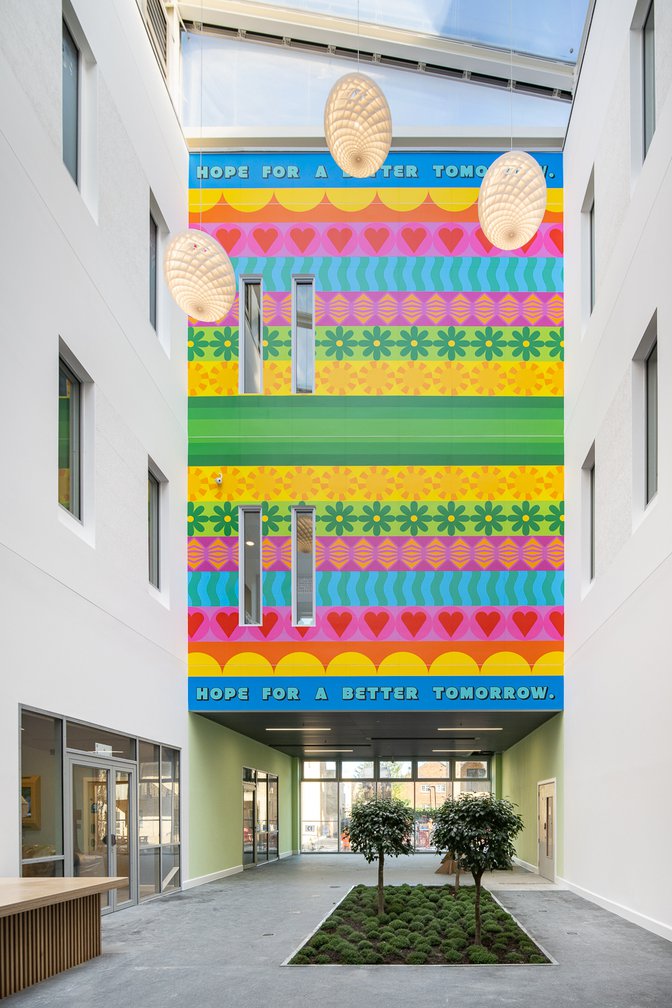
Mural by Yinka Ilori at Springfield Hospital. Photographer Damian Griffiths, courtesy of Hospital Rooms
Other measures range from: the fact that service users might have shorter stays in Hospital Rooms units; the reporting of better interactions between staff and patients (a staff member on one ward recently reported that the artwork, “makes me want to go to work now”); artists describing the projects as career highlights that bring new dimensions to their work; the success of our annual fundraising auction of world-class art; collaboration with bodies such as the World Health Organisation and New York University; awards and grants; the foundation of a sister organisation, The Art of Healing, in Lagos by artist Nengi Omuku.
The most important and validating measure is probably the feedback the team receives. Dr. Sophie Bagge, Lived Experience Lead on our three-year project at Hellesdon Hospital, Norwich, said recently that she was blown away by the work’s ability to create spaces that “people felt equal in, they felt heard”. Sophie recalls: “One woman said it was the first time in months she had experienced a ‘quiet mind’ and I don’t think anyone who hasn’t experienced voices or intrusive, rapid thoughts can truly understand what it is like to, even for a short period, experience rest from that.”
Perhaps the other clearest measure is how, in under a decade, Hospital Rooms has become a thriving organisation, with as many as 60 staff and freelancers around the country. The project has gone from being deemed impossible by many, to hugely in demand, supported by the NHS and Arts Council England as well as by crucial grants and private donations.
With nuanced, holistic evaluation, the power of this work becomes inarguable – I fundamentally believe it has the ability to destigmatise ill mental health, which is needed now more urgently than ever. The art sector similarly needs new models to safeguard the wellbeing of those who participate in it, and ensure its relevance in a rapidly moving world. Hospital Rooms offers us a new model for cross-sector collaboration with real world impact.
Brought together by Patrick McCrae, Chair
The most important and validating measure is probably the feedback the team receives. Dr. Sophie Bagge, Lived Experience Lead on our three-year project at Hellesdon Hospital, Norwich, said recently that she was blown away by the work’s ability to create spaces that “people felt equal in, they felt heard”. Sophie recalls: “One woman said it was the first time in months she had experienced a ‘quiet mind’ and I don’t think anyone who hasn’t experienced voices or intrusive, rapid thoughts can truly understand what it is like to, even for a short period, experience rest from that.”
Perhaps the other clearest measure is how, in under a decade, Hospital Rooms has become a thriving organisation, with as many as 60 staff and freelancers around the country. The project has gone from being deemed impossible by many, to hugely in demand, supported by the NHS and Arts Council England as well as by crucial grants and private donations.
With nuanced, holistic evaluation, the power of this work becomes inarguable – I fundamentally believe it has the ability to destigmatise ill mental health, which is needed now more urgently than ever. The art sector similarly needs new models to safeguard the wellbeing of those who participate in it, and ensure its relevance in a rapidly moving world. Hospital Rooms offers us a new model for cross-sector collaboration with real world impact.
Brought together by Patrick McCrae, Chair