article In conversation with
Caroline Jane Harris
In conversation with
Caroline Jane Harris
In conversation with Caroline Jane Harris
about labour, paper, and the effects of technology
on our experience of time and space.
about labour, paper, and the effects of technology
on our experience of time and space.
In conversation with Caroline Jane Harris
about labour, paper, and the effects of technology
on our experience of time and space.
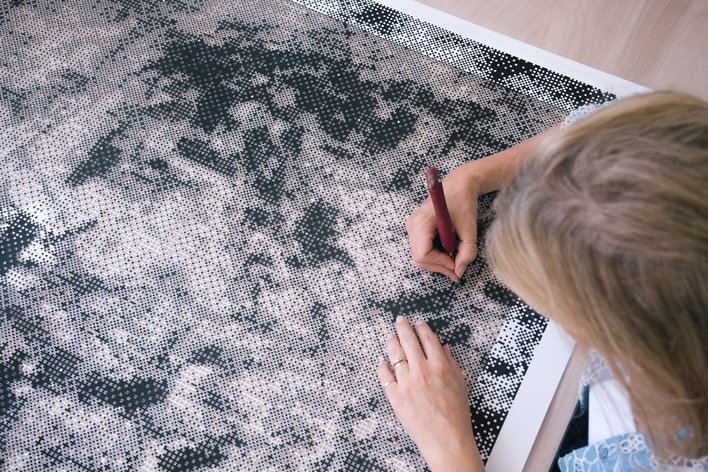
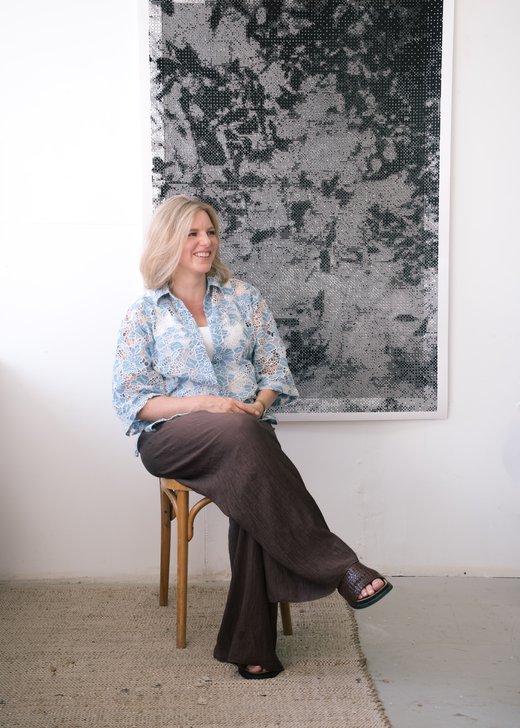
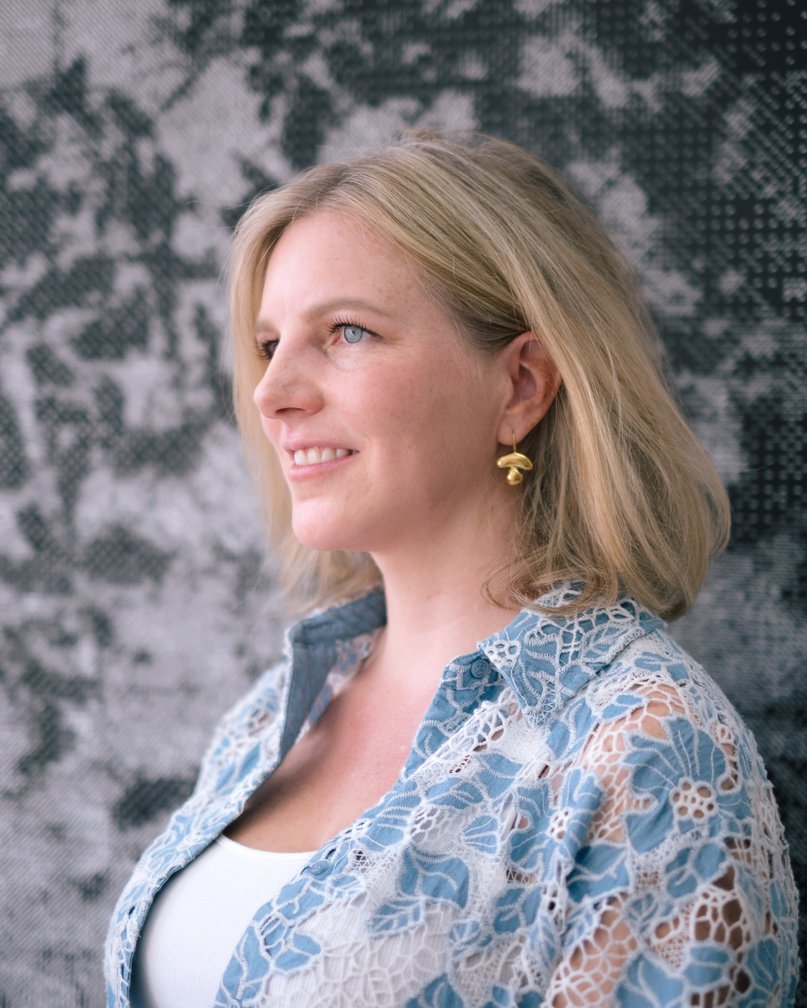
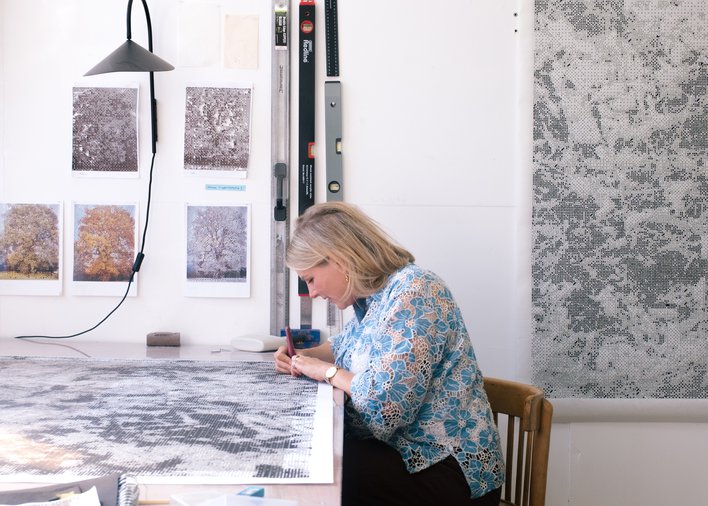
Caroline Jane Harris is a London-based artist whose practice transforms digital photographs into meticulously hand-cut paper works and etchings. Exploring slowness, touch and the natural world through the removal of individual pixels, we spoke with Caroline about her twenty-year practice, the role of paper in her work, and her exciting, upcoming work.
Your work is created through a slow, meticulous process of hand-cutting individual pixels from an image. How has this labour-intensive approach shaped the way your practice has evolved over time?
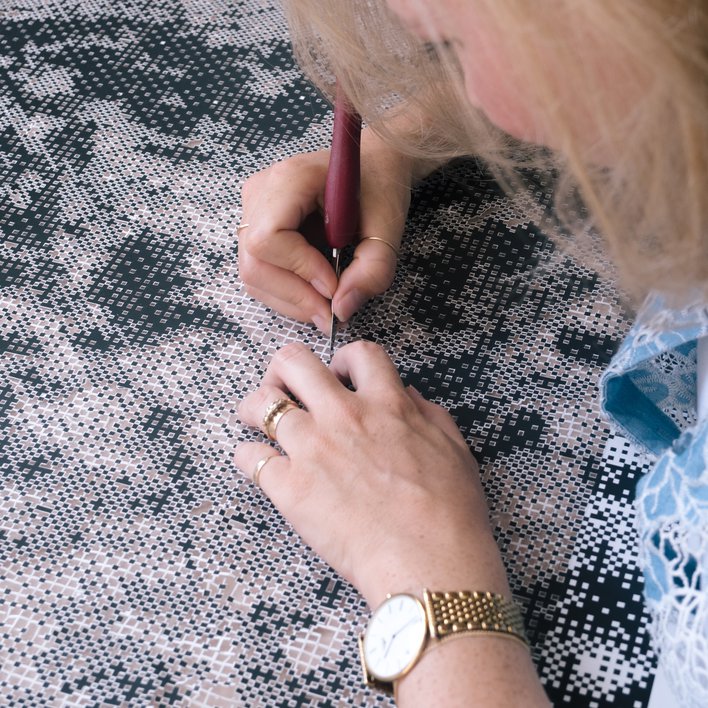
Cutting has been central to my work for 20 years now. There is an embodied knowledge in the execution of each piece. As with many forms of printmaking, the act of removing is final, there’s no going over a gesture or putting fragments back in the physical matrix, all decision-making is accountable. This responsibility aligns with my desire to be conscientious and considered in the world. The slowness of, and obligation to be present with the process of making my work means that my output is deliberate, going against the speed of “productivity”.
You've spoken about this slowness as a form of resistance to our increasingly fast-paced, image saturated culture. What do you hope viewers take away from experiencing both the finished works and the repetitive, time-intensive process behind them?
I don’t think it’s controversial to say that the internet has changed our capacity for concentration and contemplation. Just as the shift from paper to screen in the act of reading has affected the degree of immersion in writing, so too has our engrossment in viewing shortened. My process is long and labour-intensive, but this is not motivated by seeking recognition of ‘effort’. Rather, time represents our values. I aim to turn the formality of art into the tenderness of notice. To provide a space to go deeper instead of superficially skim the surface as we are becoming more unconsciously accustomed to doing. By incorporating the duration of perception into aesthetic structure, I hope to create a space for presence through attention and variable repetition.
Cutting has been central to my work for 20 years now. There is an embodied knowledge in the execution of each piece. As with many forms of printmaking, the act of removing is final, there’s no going over a gesture or putting fragments back in the physical matrix, all decision-making is accountable. This responsibility aligns with my desire to be conscientious and considered in the world. The slowness of, and obligation to be present with the process of making my work means that my output is deliberate, going against the speed of “productivity”.
You've spoken about this slowness as a form of resistance to our increasingly fast-paced, image saturated culture. What do you hope viewers take away from experiencing both the finished works and the repetitive, time-intensive process behind them?
I don’t think it’s controversial to say that the internet has changed our capacity for concentration and contemplation. Just as the shift from paper to screen in the act of reading has affected the degree of immersion in writing, so too has our engrossment in viewing shortened. My process is long and labour-intensive, but this is not motivated by seeking recognition of ‘effort’. Rather, time represents our values. I aim to turn the formality of art into the tenderness of notice. To provide a space to go deeper instead of superficially skim the surface as we are becoming more unconsciously accustomed to doing. By incorporating the duration of perception into aesthetic structure, I hope to create a space for presence through attention and variable repetition.
‘My process is long and labour-intensive, but this is not motivated by seeking recognition of ‘effort’. Rather, time represents our values. I aim to turn the formality of art into the tenderness of notice.’
- Caroline Jane Harris
Paper sits at the heart of your practice, both as a material and a concept. What draws you to paper, and how do its physical qualities and cultural history influence the way you work?
Paper is both humble and fundamental; we are born with a piece of paper; we die with a piece of paper. It’s an essential element of printmaking and each choice is full of subtle haptic inferences. Papermaking began in China, then spread to Korea and Japan. My practice is inspired by the philosophical, creative and devotional practices of Eastern Cultures, working intentionally with paper connects me to these traditions.
In each body of work, I aim to marry the materials and/or process with the concept. For my latest photo-etching series ‘Komorebi’ (a Japanese noun for the phenomena of dappled sunlight filtering through trees), the title is the subject of the printed image. I used fibrous hemp paper that not only mimics the tree branches in the original photograph, but the holes in the paper made by droplets of water speak to the dappling effect of tree silhouettes. The negative space in the paper creates subtle shadows that refer to the original subject matter and the interconnectedness of natural phenomena.
In our studio visit, you spoke about your paper-cutting practice as a form of printmaking. In what ways do these two processes overlap, and how has this way of thinking shaped your work?
I arrived at paper cutting through my undergraduate degree in Printmaking, it was a linear progression from woodblock carving to directly removing paper from digital prints with a scalpel. I knew I wanted to borrow directly from the world rather than invent or reproduce it with my own mark-making, so I moved to digital photography as a starting point. This also drew on my research into photographic visualisation as a surrogate for first-hand experiences of familiarity and awe. Studying the binary reduction of the woodcut block, I realised I could re-introduce the hand to the work sans gesture through cutting the negative space in the image, then experiment with processes of layering to introduce depth and fragment the gaze.
Paper is both humble and fundamental; we are born with a piece of paper; we die with a piece of paper. It’s an essential element of printmaking and each choice is full of subtle haptic inferences. Papermaking began in China, then spread to Korea and Japan. My practice is inspired by the philosophical, creative and devotional practices of Eastern Cultures, working intentionally with paper connects me to these traditions.
In each body of work, I aim to marry the materials and/or process with the concept. For my latest photo-etching series ‘Komorebi’ (a Japanese noun for the phenomena of dappled sunlight filtering through trees), the title is the subject of the printed image. I used fibrous hemp paper that not only mimics the tree branches in the original photograph, but the holes in the paper made by droplets of water speak to the dappling effect of tree silhouettes. The negative space in the paper creates subtle shadows that refer to the original subject matter and the interconnectedness of natural phenomena.
In our studio visit, you spoke about your paper-cutting practice as a form of printmaking. In what ways do these two processes overlap, and how has this way of thinking shaped your work?
I arrived at paper cutting through my undergraduate degree in Printmaking, it was a linear progression from woodblock carving to directly removing paper from digital prints with a scalpel. I knew I wanted to borrow directly from the world rather than invent or reproduce it with my own mark-making, so I moved to digital photography as a starting point. This also drew on my research into photographic visualisation as a surrogate for first-hand experiences of familiarity and awe. Studying the binary reduction of the woodcut block, I realised I could re-introduce the hand to the work sans gesture through cutting the negative space in the image, then experiment with processes of layering to introduce depth and fragment the gaze.
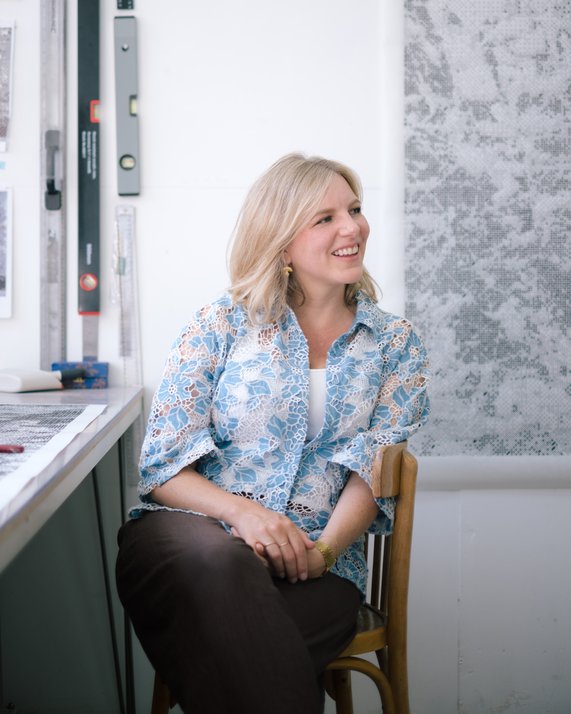
‘I knew I wanted to borrow directly from the world rather than invent or reproduce it with my own mark-making.’
- Caroline Jane Harris
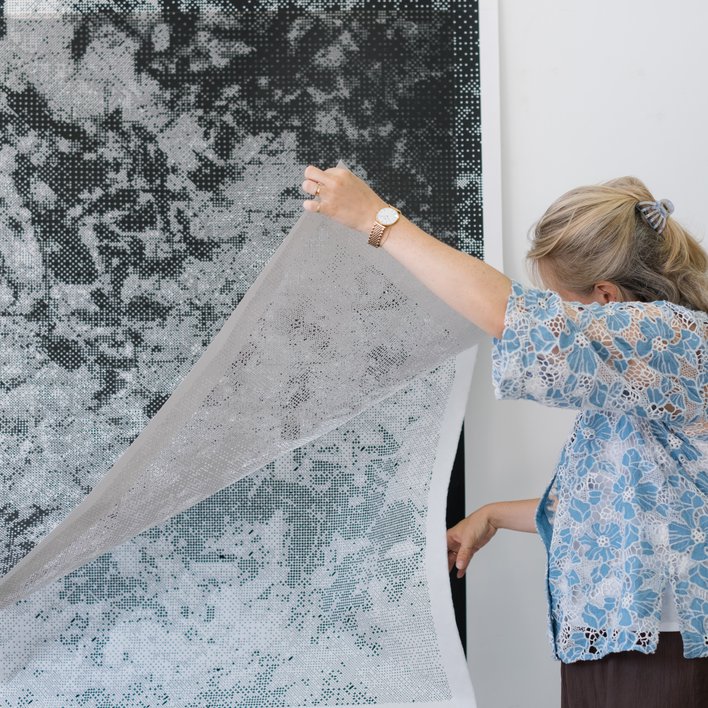
Your source imagery often draws on the natural world, yet your process transforms these images through the language of digital pixels. Where do you find the imagery you work with, and what interests you about bringing together nature and digital aesthetics in this way?
My subject matter is unearthed spontaneously. As the rest of my process is meticulously devised, I like to leave an opening for ideas to arise from awe and happenstance. I wait to notice images/ideas that are contemporaneous with considerations around environment, media and how we interface with the world. For example, in the pandemic I came across a website which I screenshot, containing videos submitted internationally of the view from people’s windows, resulting in my body of work ‘WindowSwap’. This approach mirrored a meta meditation on the global experience of time, self, and space displaced amongst layers of digital screen-based mediation.
Do you have any upcoming projects that you would like to share with us?
I am working on a large-scale copper etching where the plates will be the finished piece, working title ‘A Sky Full of Ghosts’. To begin, I lifted the thumbprints from my mobile phone screen using crime scene powder, then scanned the image and blew it up to the ratio of a portrait phone screen at 2 metres tall. The image is divided into 6 panels, pixelated, and being cut-out by hand. I will use wax as a resist manually pressed through the cut-out spaces onto copper, leaving traces of fingerprints once more. The plates will be etched in acid then inked.
The work creates an indexical relationship to touch and the artist’s hand and gestures whilst engaging with the digital world. The material copper, an essential part of mobile phones and the materialism of the geophysical media age, acts as a self-referential hyper-link. The residual swipes, these ghosts that get overwritten in time, are visually reminiscent of the cosmos, whilst speaking to the sky that we miss when we spend our time looking down.
My subject matter is unearthed spontaneously. As the rest of my process is meticulously devised, I like to leave an opening for ideas to arise from awe and happenstance. I wait to notice images/ideas that are contemporaneous with considerations around environment, media and how we interface with the world. For example, in the pandemic I came across a website which I screenshot, containing videos submitted internationally of the view from people’s windows, resulting in my body of work ‘WindowSwap’. This approach mirrored a meta meditation on the global experience of time, self, and space displaced amongst layers of digital screen-based mediation.
Do you have any upcoming projects that you would like to share with us?
I am working on a large-scale copper etching where the plates will be the finished piece, working title ‘A Sky Full of Ghosts’. To begin, I lifted the thumbprints from my mobile phone screen using crime scene powder, then scanned the image and blew it up to the ratio of a portrait phone screen at 2 metres tall. The image is divided into 6 panels, pixelated, and being cut-out by hand. I will use wax as a resist manually pressed through the cut-out spaces onto copper, leaving traces of fingerprints once more. The plates will be etched in acid then inked.
The work creates an indexical relationship to touch and the artist’s hand and gestures whilst engaging with the digital world. The material copper, an essential part of mobile phones and the materialism of the geophysical media age, acts as a self-referential hyper-link. The residual swipes, these ghosts that get overwritten in time, are visually reminiscent of the cosmos, whilst speaking to the sky that we miss when we spend our time looking down.
Want to be part of our network? Submit your work and join Artiq's growing community of artists.