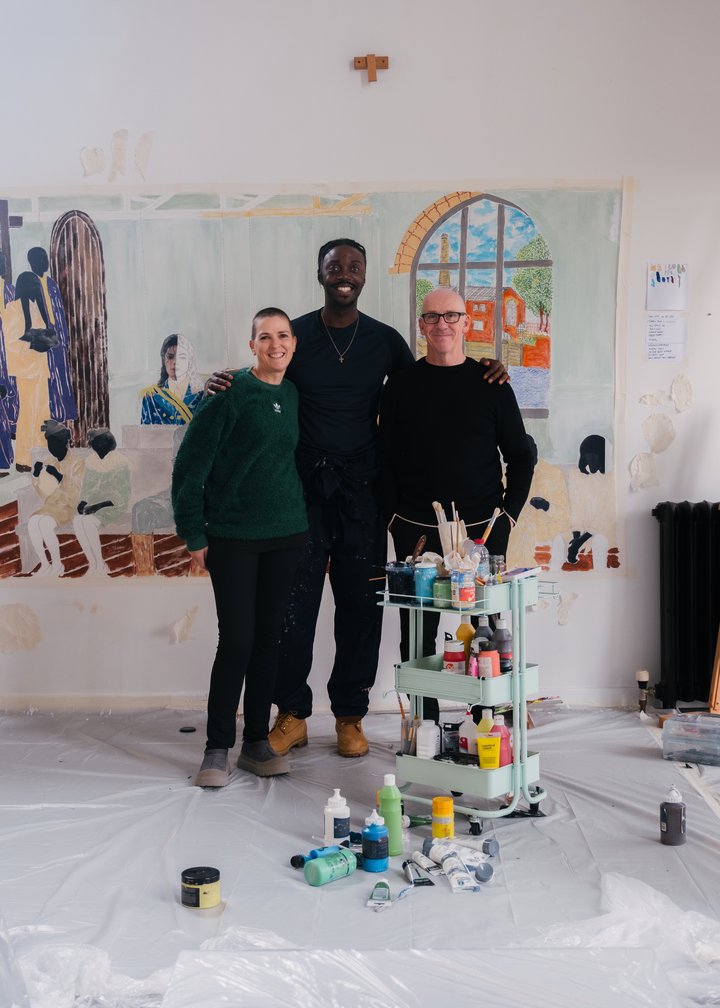
article In conversation with Emmanuel Unaji, winner of The Pump House Residency 2026
In conversation with Emmanuel Unaji, winner of The Pump House Residency 2026
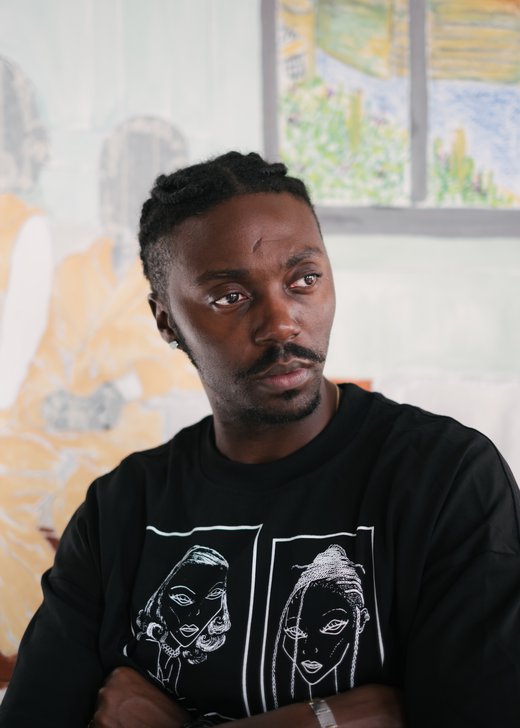
In conversation with Emmanuel Unaji
about studio discipline, sacred architecture
and the artist as custodian of storytelling.
about studio discipline, sacred architecture
and the artist as custodian of storytelling.
In conversation with Emmanuel Unaji
about studio discipline, sacred architecture
and the artist as custodian of storytelling.
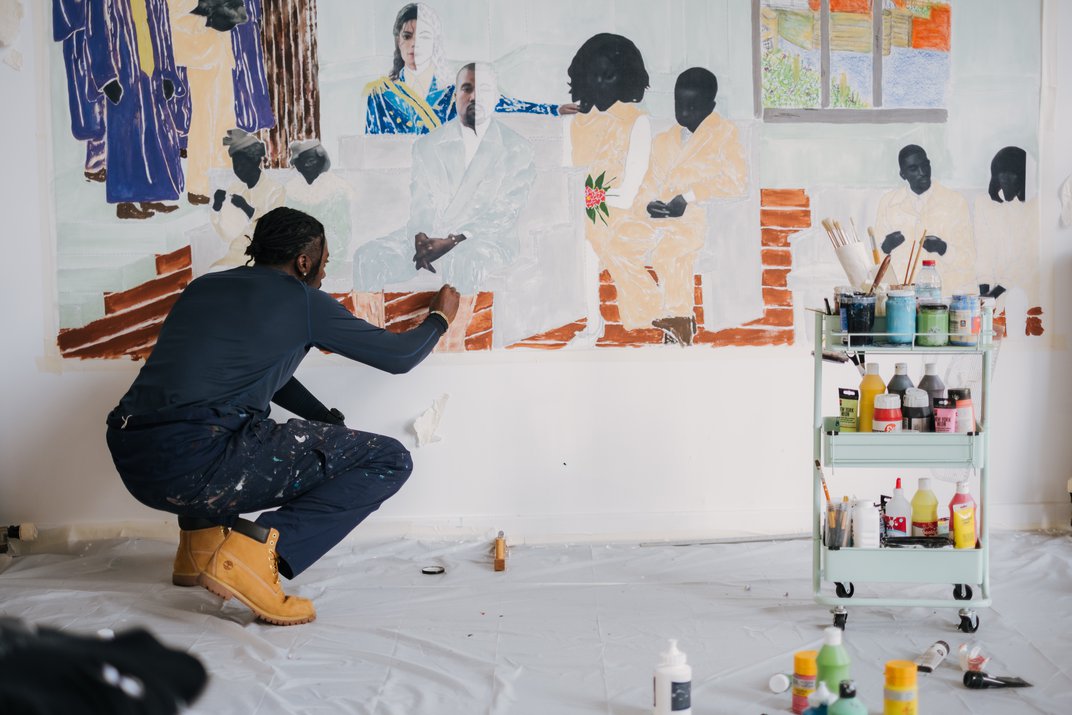
Working across wellbeing, performance and fine art, Emmanuel Unaji deconstructs cultural iconography through split portraiture and layered photo-collage. Following his time at the The Pump House Residency, we spoke with Emmanuel about his time in rural Nottinghamshire, uncovering how The Pump House's Grade II listed architecture shaped his large-scale canvas, and informed questions of faith and ambition that run throughout the work.
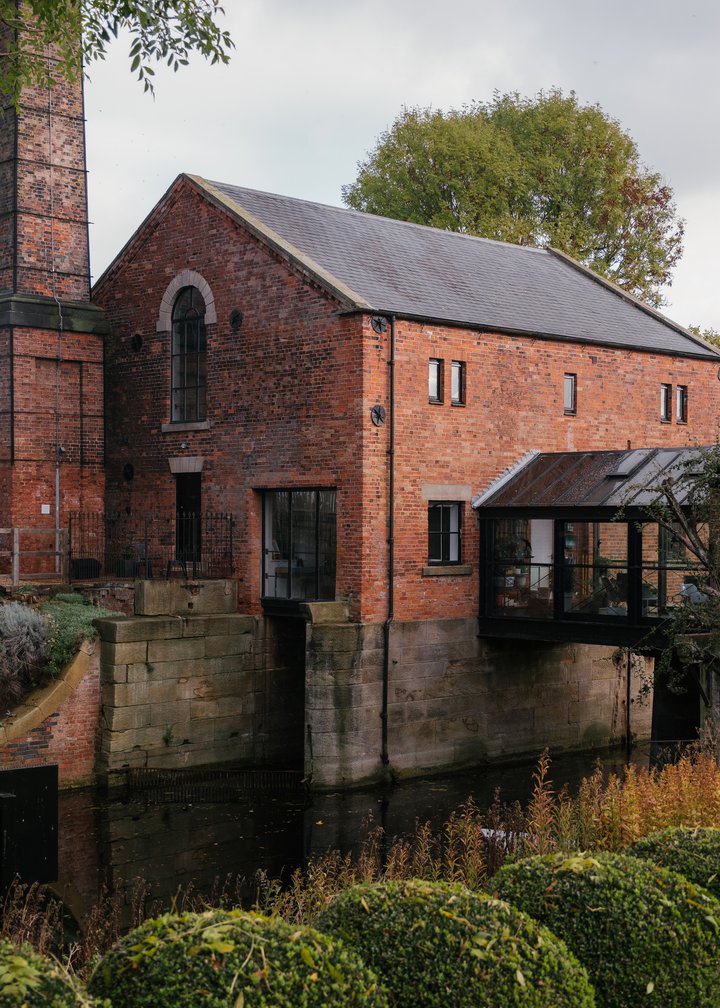
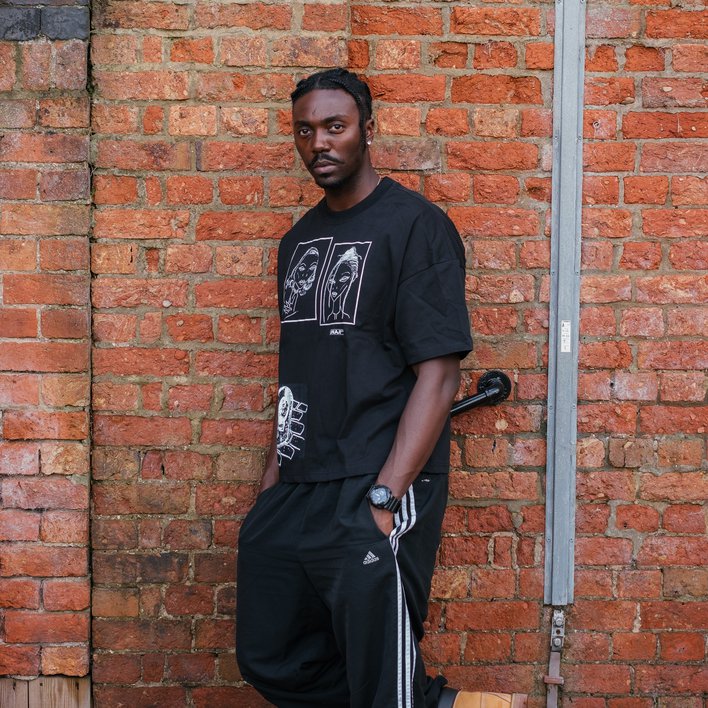
What did a typical day at the residency look like for you?
Upon arrival, I prepared a 300 cm x 155 cm canvas and organised the necessary materials within the initial hours to ensure creative work could commence early the following day. Following recommendations from former artist-in-residence Zoë Wilkinson, I established a structured daily schedule. Residing within the studio space enabled a seamless integration between the creative process and daily routines, including painting, research, physical exercise, and meals.
A standard day involved a morning wellness routine, followed by painting immediately after breakfast while listening to a curated selection of academic lectures on art, alongside soul, gospel, R&B, and hip-hop music. The objective was to systematically stimulate the mind through curated auditory inputs, directly informing the artistic output produced on canvas. Incorporating structured creative methodologies marks a pivotal evolution in my studio practice, yielding significantly higher productivity relative to prior, sporadic workflows. This process involves methodically documenting inspiration, executing digital sketches on an iPad, synthesising conceptual ideas, and converting reflective notes into actionable creative steps.
You proposed working from a range of references such as The Pump House's structural design and David Hockney's California Modernism series, with elements of your existing practice including collaged twentieth-century cultural icons. Could you share more about bringing these references together?
Adopting an editorial framework to set narrative contexts for cultural icons was central to conceptual development. Setting the scene within a church provided a foundation for an existential exploration into personal well-being, contrasting material ambitions with the tranquil landscape of Nottinghamshire. While David Hockney's California Modernism series guided my perspective on the physical structure of The Pump House, observing the space in situ highlighted its exposed ceiling timbers and window brickwork as essential features to incorporate. Additionally, Hockney's iPad series influenced the fluid mark-making technique that ultimately guided my oil pastel rendering of the window scene. Discussions with the owners, Nic and Claire, led to a strong recommendation to visit the Medieval Parish Church of All Saints, featuring a notable stained-glass window designed by John Piper in 1966. This juxtaposition of rural and urban environments offered a meaningful perspective on natural beauty.
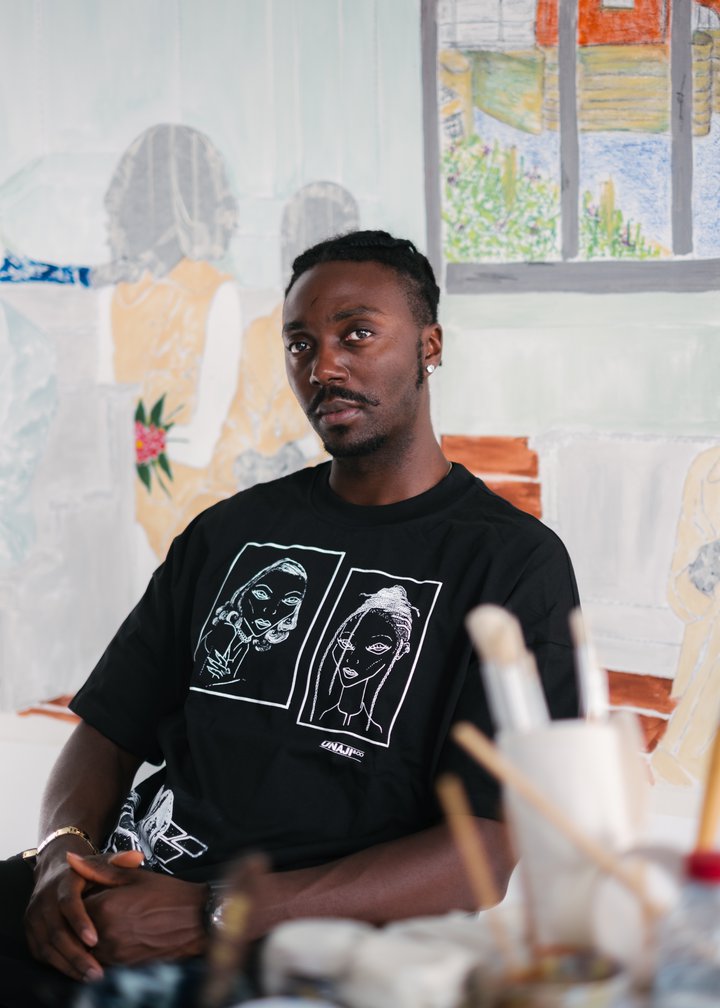
‘While David Hockney's California Modernism series guided my perspective on the physical structure of The Pump House, observing the space in situ highlighted its exposed ceiling timbers and window brickwork as essential features to incorporate.’
- Emmanuel Unaji
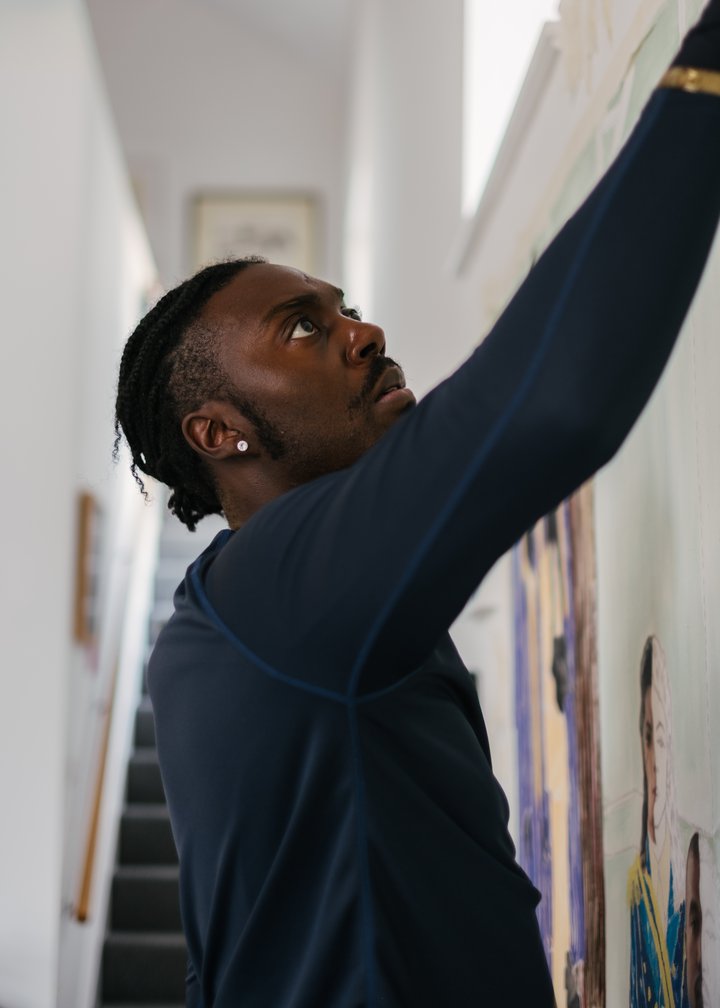
How has your background and interest in fashion shaped the composition and narratives of these works through your practice?
My background in fashion shapes stylised depictions of the human form, drawing from 20th-century print publications, illustration, and commercial advertising. This residency supported my visual inquiry to bridge 2024 artwork, 'I Shop Therefore I Am', with my 2019 archival interview with British GQ. When asked 'Who is the one person, dead or alive, that you would like to have dinner with and why?' I responded saying "Kanye West in 2013. That was when arguably one of the most influential audio-visual artists of our generation hit a glass ceiling, like Michael Jackson vs MTV or David vs Goliath. Culture shifted then.
My work explores that ceiling, asking who dictates artistic output—the people or the powers that be?" Fashion illustration has evolved into a satirical, postmodern view of luxury fashion, using a visual language rooted in socioeconomic and humanitarian themes. Through stylised oxymorons, the work offers reflective moments in a digital media age, uniting editorial paintings under a shared narrative that prompts viewers to re-examine culture.
Your work includes a range of mediums including photo-collage, drawing and painting. How do you approach combining these different materials, and what possibilities does this create that might not be achieved through a single medium alone?
A foundational element of my undergraduate thesis at Kingston University focused on the Pictures Generation—a collective of American artists active between 1974 and 1984 who utilized appropriation and montage to critique and expose the constructed nature of contemporary imagery. By employing non-traditional formats, I integrate hand-drawn elements with photo-collage via high-resolution scanning to emulate commercial print production.
Utilising a multi-medium approach provides a framework to re-examine compositions through oil pastel and paint, thereby deepening the critical analysis of iconography, tropes, and stereotypes prevalent in popular culture. This methodology constructs a refined narrative that synthesises diverse visual material within a rigorous theoretical framework. Furthermore, uniting traditional analogue practices with digital techniques underscores the structural significance of organic imperfection in contemporary visual art, where layered mediums serve to symbolise conceptual nuance and multifaceted layers of truth that we all possess as human beings.
‘Positioning figures associated with fame and fortune within a sacred architecture poses the fundamental inquiry: 'For what shall it profit a man, if he shall gain the whole world, and lose his own soul?’
- Emmanuel Unaji
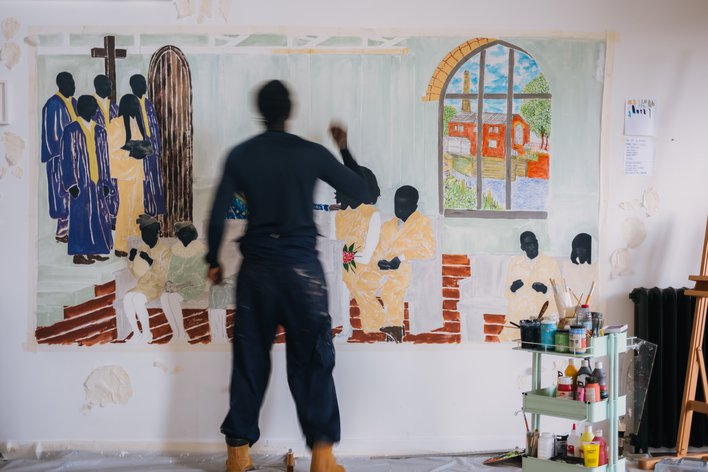
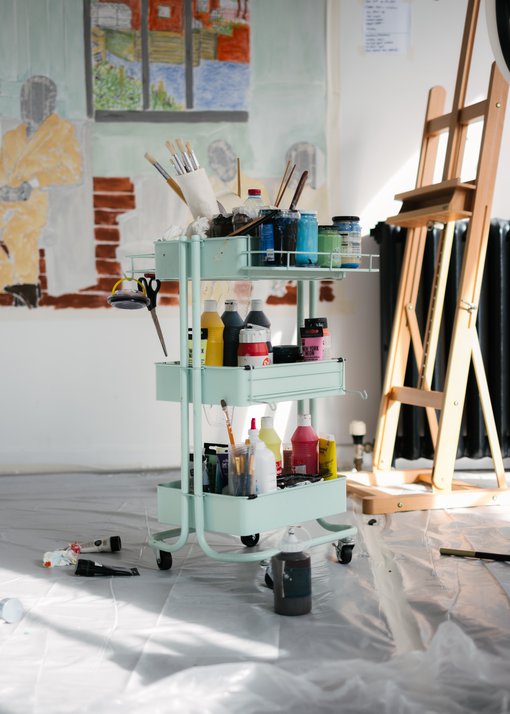
Can you describe how your time in the space inspired the work you made while you were there? Beyond the direct, figurative presence of The Pump House in your piece, are there quieter references to your time here that the viewer might not notice straight away?
After eleven years as a practicing artist, I recognised a subconscious trajectory—a persistent drive toward specific benchmarks.
After achieving a long-term goal in early 2026, I felt compelled to reposition commercial demands and center fine art. Subtler themes from the residency explore theological tensions between physical desire and spiritual devotion, contrasting Christian principles with modern secular idolatry. This involved navigating personal faith alongside material ambitions.
The rural environment prompted a re-examination of inner peace, while the depicted cultural icons represent conventional metrics of success within the entertainment sector. Positioning figures associated with fame and fortune within a sacred architecture poses the fundamental inquiry: "For what shall it profit a man, if he shall gain the whole world, and lose his own soul?" (Mark 8:36). Every residency offers a distinct, transformative perspective. Through the Pump House residency, the answer to my Kanye West question is the artist. The artist is the custodian of storytelling.
Looking ahead, how do you see your practice further evolving? Do you have any upcoming projects you would like to share with us?
Having engaged early in my career with the intricacies of an increasingly globalised art ecosystem, the current evolution of my practice focuses on refining traditional studio methodologies. This involves integrating conceptual strands from the 'I Shop Therefore I Am' series into a unified body of work that critically examines contemporary public discourse surrounding popular culture. Dedicated, uninterrupted focus has allowed for the intellectual development of a distinct visual vocabulary and textured aesthetic.
In terms of forthcoming initiatives, I am developing solo exhibitions scheduled for presentation across the United States, Nigeria, and the United Kingdom. Working with Artiq remains a highly valued experience; its commitment to supporting artists reinforces an ethos centered on articulating pivotal aspects of the human condition and reasserting fine art as a vital cultural instrument within contemporary society.