article In conversation with
Gina Cross
In conversation with
Gina Cross
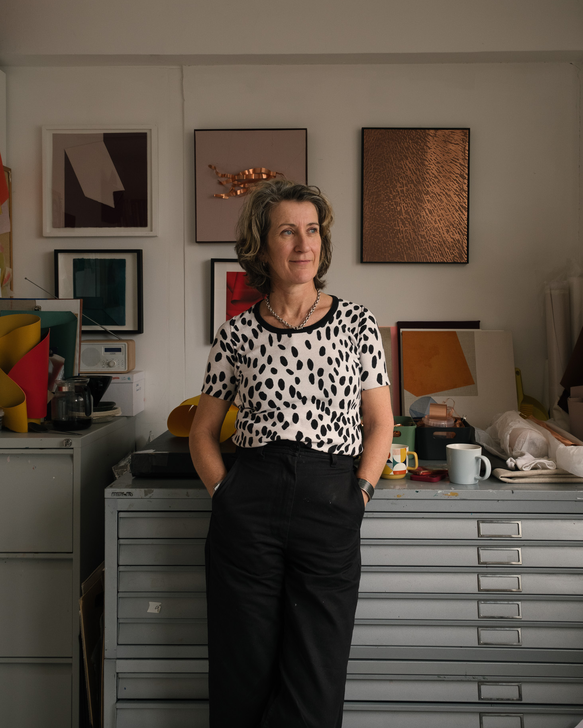
In conversation with Gina Cross about
the poetic connection between material,
motion, and the human experience.
the poetic connection between material,
motion, and the human experience.
In conversation with Gina Cross about
the poetic connection between material,
motion, and the human experience.
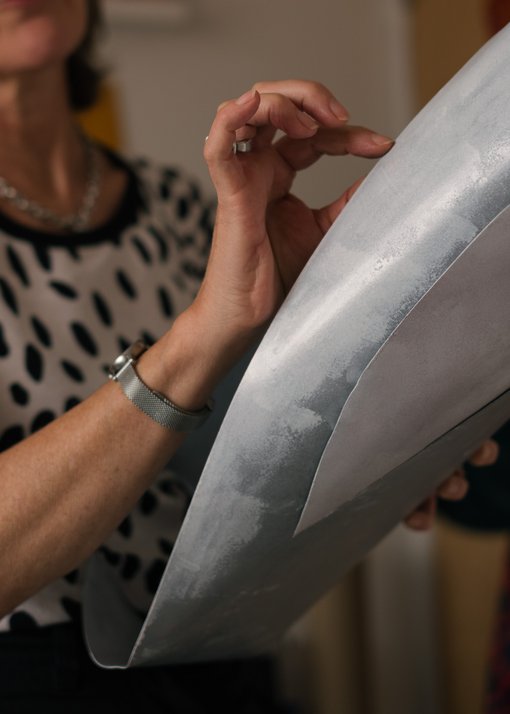
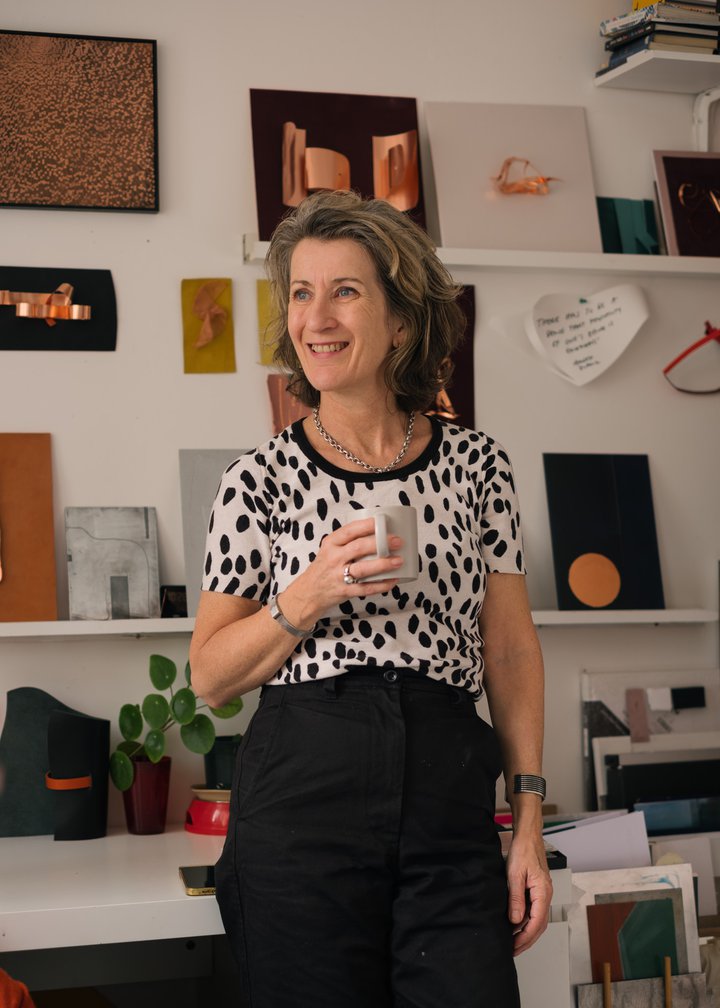
Gina Cross is a London-based multidisciplinary artist whose work investigates the dynamic interplay of shape, colour, space, and light. Drawing from a background in printed textiles, she now works intuitively and experimentally with metal plate, found or reclaimed paper, and still-life photography to explore materiality and perception.
Her practice often references the structural elegance of haute couture, the spatial complexities of architecture, and the tactile possibilities of metal, paper, and fabric. Each piece reflects the body’s physical and emotional engagement with its surroundings, whether through the sharp precision of etched metal or the delicate folds of paper.
Her practice often references the structural elegance of haute couture, the spatial complexities of architecture, and the tactile possibilities of metal, paper, and fabric. Each piece reflects the body’s physical and emotional engagement with its surroundings, whether through the sharp precision of etched metal or the delicate folds of paper.
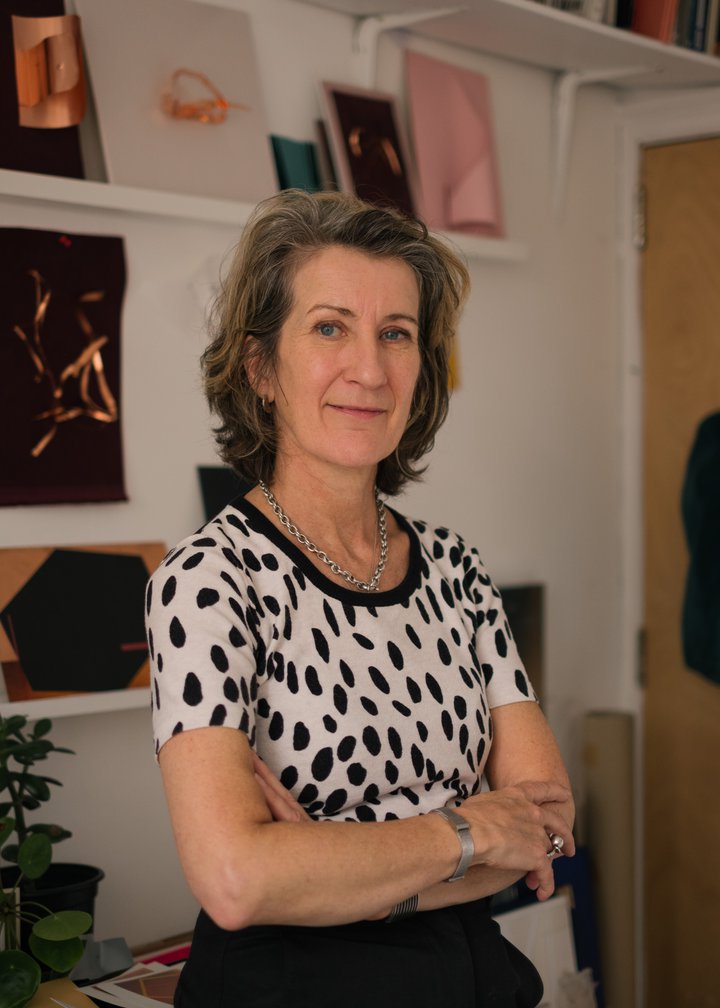
Artiq Your practice has expanded across paper and canvas to copper and metal. How do you approach the interplay of mediums across your practice? How do you see the mediums inform each other within one piece?
Gina Curiosity is always my starting point. I allow the materials to guide my interest and create a spatially interesting composition. Initially, I photographed copper to use as a ‘canvas’ for digital artworks to emphasise the feeling of the heat and light of the Mediterranean. I later photo etched and aquatinted copper, applying paint and heat to the surfaces to add colour. However my inclination is to fold or roll whatever material I am working on. I like to combine the copper materials which includes mesh, leaf, sheet and plate with paper constructions or works on fabrics including canvas, linen and leather, whether that be to create a one-off artwork or to use as a still life for photography. There is something about the reflective, hard surface that works so harmoniously with the softer fabrics and paper that keeps excited me to discover more.
Artiq Throughout your varied practice, you emphasise the importance and role of light within your work. What techniques do you use in approaching light and how has this developed over time?
Gina Light has always been fundamental to my practice. In my digital works I play with textures I’ve photographed and combine them with copper leaf to bring light into the compositions. My ‘Lightfalls’ series was inspired by sunlight reacting off a crystal decanter in my mum’s flat - I abstracted that idea and photo etched into copper. I had an intense experience with light the day my mum died, where the whole sky, trees, fields and hedges were lit bright orange by a late winter sunset. The colour orange appears regularly - most recently when I discovered the ‘synergistic’ qualities of copper when it reflects itself, creating an intense orange like I saw that day. I also photograph light in my studio, playing with light bouncing on to various surface and also creating beautiful shadows on some of my paper still life sculptures. I often say that I’m ‘painting and collaging with light’
Gina Curiosity is always my starting point. I allow the materials to guide my interest and create a spatially interesting composition. Initially, I photographed copper to use as a ‘canvas’ for digital artworks to emphasise the feeling of the heat and light of the Mediterranean. I later photo etched and aquatinted copper, applying paint and heat to the surfaces to add colour. However my inclination is to fold or roll whatever material I am working on. I like to combine the copper materials which includes mesh, leaf, sheet and plate with paper constructions or works on fabrics including canvas, linen and leather, whether that be to create a one-off artwork or to use as a still life for photography. There is something about the reflective, hard surface that works so harmoniously with the softer fabrics and paper that keeps excited me to discover more.
Artiq Throughout your varied practice, you emphasise the importance and role of light within your work. What techniques do you use in approaching light and how has this developed over time?
Gina Light has always been fundamental to my practice. In my digital works I play with textures I’ve photographed and combine them with copper leaf to bring light into the compositions. My ‘Lightfalls’ series was inspired by sunlight reacting off a crystal decanter in my mum’s flat - I abstracted that idea and photo etched into copper. I had an intense experience with light the day my mum died, where the whole sky, trees, fields and hedges were lit bright orange by a late winter sunset. The colour orange appears regularly - most recently when I discovered the ‘synergistic’ qualities of copper when it reflects itself, creating an intense orange like I saw that day. I also photograph light in my studio, playing with light bouncing on to various surface and also creating beautiful shadows on some of my paper still life sculptures. I often say that I’m ‘painting and collaging with light’
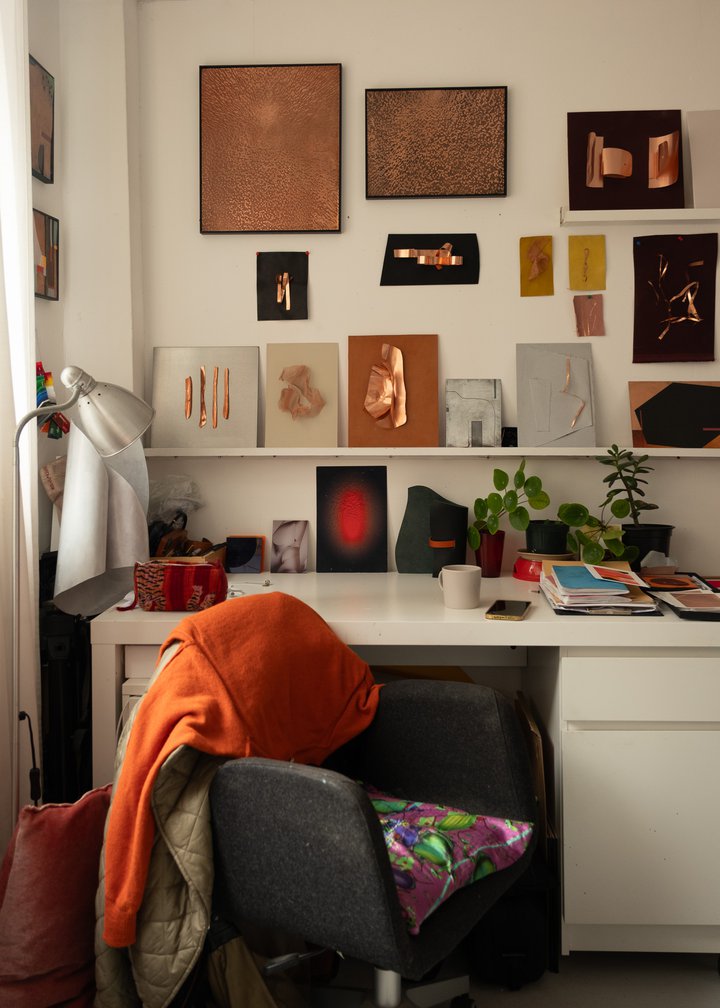
Artiq Where do you gather inspiration for your compositions? How do you decide on colour, medium, etc.?
Gina Most of my work begins intuitively and I do not plan my compositions. I often begin with large sheets of paper or material pinned to the wall and draw unplanned shapes, often quite energetically, with a knife or blade. When working with metal I have recently been cutting copper and steel sheet with a similar intuitive approach and once I have shapes to ‘play’ with then that’s exactly what I do. When working with combined materials I will feel how the colours work together. My colour palette is informed from my earlier life of living in Spain, and I recently realised that all of my colours are from that experience. When working with folded or rolled 3D pieces I like to use the tonal opposites of the same colour, like when you look at leaves in the sun you can see the dark and the light of the same colour.
Artiq Your practice involves engaging with concepts of interconnection and movement. How do you explore these thematics through your various techniques of developing each piece? How does experimentation fit into your exploration?
Gina In recent works I have focused on human physicality and natural forms of plants as I want the shapes to be more ‘organic’ from my earlier geometric works. When physically drawing with a blade I aim to transmit movement and feeling in the forms created. While working on wall based paper compositions, the shapes remind me of the large leaves of tropical plants I observed in Spain - all connected to the same stem but occupying their own space - interconnected as they sway. It made me reflect on my own relationships - both to my body and also feeling closeness to those that are no longer with me and to those that are here. This led me to drawings and video improvised dance at the Rambert, observing the dancers working in close connection. This push and pull of energy really inspired me to include that feeling in my work.
Gina Most of my work begins intuitively and I do not plan my compositions. I often begin with large sheets of paper or material pinned to the wall and draw unplanned shapes, often quite energetically, with a knife or blade. When working with metal I have recently been cutting copper and steel sheet with a similar intuitive approach and once I have shapes to ‘play’ with then that’s exactly what I do. When working with combined materials I will feel how the colours work together. My colour palette is informed from my earlier life of living in Spain, and I recently realised that all of my colours are from that experience. When working with folded or rolled 3D pieces I like to use the tonal opposites of the same colour, like when you look at leaves in the sun you can see the dark and the light of the same colour.
Artiq Your practice involves engaging with concepts of interconnection and movement. How do you explore these thematics through your various techniques of developing each piece? How does experimentation fit into your exploration?
Gina In recent works I have focused on human physicality and natural forms of plants as I want the shapes to be more ‘organic’ from my earlier geometric works. When physically drawing with a blade I aim to transmit movement and feeling in the forms created. While working on wall based paper compositions, the shapes remind me of the large leaves of tropical plants I observed in Spain - all connected to the same stem but occupying their own space - interconnected as they sway. It made me reflect on my own relationships - both to my body and also feeling closeness to those that are no longer with me and to those that are here. This led me to drawings and video improvised dance at the Rambert, observing the dancers working in close connection. This push and pull of energy really inspired me to include that feeling in my work.
Artiq You’ve had an extensive career in the arts as an active artist, mentor and gallerist. How has your career development impacted your own practice and how do you approach creative challenges?
Gina I left art school before social media made it possible to be visible, so had a 20 year hiatus. I was lucky to work commissioning illustrations for the Guardian and became involved with their exhibition design and programming too. I began mentoring at art schools and continue to do so with students and practitioners. A part time MA and a side hustle lead to a 15 year business representing artists, curating and showing at art fairs. It took a friend becoming terminally ill to make me realise there’s no time to lose and I returned to my own work in 2019. I have experience with how to present work, but it’s still down to me to make interesting work that people want to own, and that’s not always within your control! Mostly I love making work again and feel blessed to be able to do so.
Artiq Do you have any upcoming projects that you would like to share with us?
Gina I’m currently preparing for an open studios at Coldharbour Studios but my main focus is on being in the studio for the next few months to make a dedicated body of work for Artiq as well as for other projects in 2026. I very much want to make a series of wall reliefs and wall based installation pieces and I am researching residencies - I would love to do something in Italy as I’ve got the calling to go to Milan for some reason, Let’s see what transpires!
Gina I left art school before social media made it possible to be visible, so had a 20 year hiatus. I was lucky to work commissioning illustrations for the Guardian and became involved with their exhibition design and programming too. I began mentoring at art schools and continue to do so with students and practitioners. A part time MA and a side hustle lead to a 15 year business representing artists, curating and showing at art fairs. It took a friend becoming terminally ill to make me realise there’s no time to lose and I returned to my own work in 2019. I have experience with how to present work, but it’s still down to me to make interesting work that people want to own, and that’s not always within your control! Mostly I love making work again and feel blessed to be able to do so.
Artiq Do you have any upcoming projects that you would like to share with us?
Gina I’m currently preparing for an open studios at Coldharbour Studios but my main focus is on being in the studio for the next few months to make a dedicated body of work for Artiq as well as for other projects in 2026. I very much want to make a series of wall reliefs and wall based installation pieces and I am researching residencies - I would love to do something in Italy as I’ve got the calling to go to Milan for some reason, Let’s see what transpires!