article In conversation with Ines Fernandez de Cordova
In conversation with Ines Fernandez de Cordova
In conversation with Ines Fernandez de Cordova
about cyclical making and the precariousness of sculpture
about cyclical making and the precariousness of sculpture
In conversation with Ines Fernandez de Cordova
about cyclical making and the precariousness of sculpture
Artiq Your practice has evolved to incorporate a wide range of mediums and processes. Can you speak more to this development? What are you currently experimenting with?
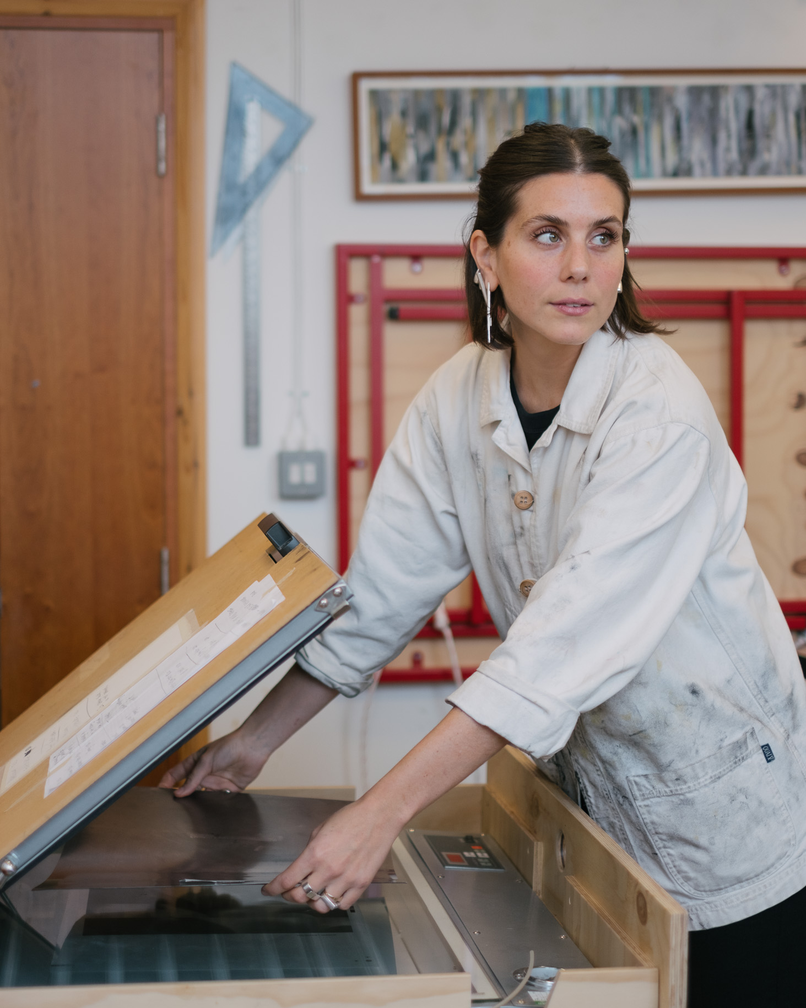
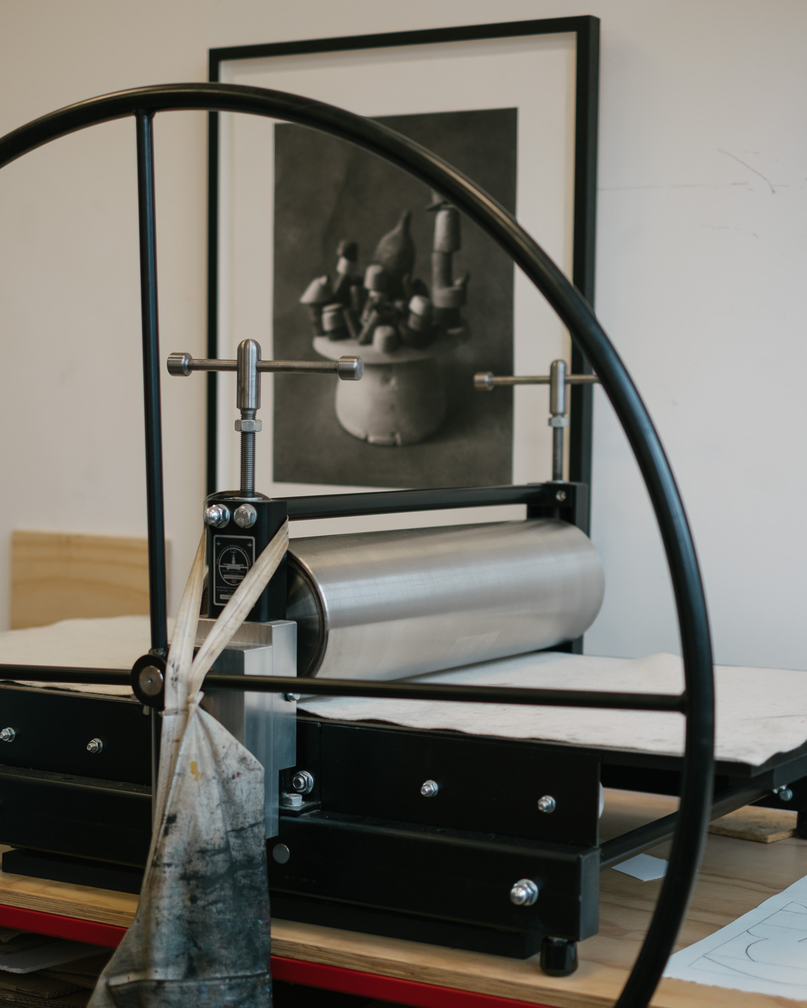
Ines When I discovered printmaking, I was studying illustration and as such my work was very much based in drawing and painting, which I think is quite evident from my earlier prints. Eventually, my work started changing, I started making sculptures out of plaster and concrete and used them as tools to create still-lives, constructing subtle narratives through the use of sequence, mark making, layering and mirroring. In the pursuit of marrying sculpture and printmaking, I began making photopolymer prints which I explored for years. I love the richness and tone you can get with it and how it gave a certain essence of classical still life to an other-worldly and only vaguely recognisable scene. I also use screen-printing as a medium which provides great flexibility with materials. In the hunt for more depth and texture, I started printing on wood for some of my pieces, which I think provided an underlying warmth which I felt I was struggling to find printing on paper. More recently I am returning to a more gestural approach although still within print, re-familiarising myself with more classical processes of copper plate etching and drypoint which has been really exciting after so many years of photography.
Ines When I discovered printmaking, I was studying illustration and as such my work was very much based in drawing and painting, which I think is quite evident from my earlier prints. Eventually, my work started changing, I started making sculptures out of plaster and concrete and used them as tools to create still-lives, constructing subtle narratives through the use of sequence, mark making, layering and mirroring. In the pursuit of marrying sculpture and printmaking, I began making photopolymer prints which I explored for years. I love the richness and tone you can get with it and how it gave a certain essence of classical still life to an other-worldly and only vaguely recognisable scene. I also use screen-printing as a medium which provides great flexibility with materials. In the hunt for more depth and texture, I started printing on wood for some of my pieces, which I think provided an underlying warmth which I felt I was struggling to find printing on paper. More recently I am returning to a more gestural approach although still within print, re-familiarising myself with more classical processes of copper plate etching and drypoint which has been really exciting after so many years of photography.
Artiq Where does your inspiration come from?
Ines My starting point is usually the sculptures I make. I suppose my work is cyclical in the sense that it continuously loops from 3D into 2D. Making these objects through the years, I have managed to grow a collection of them which I find helpful as tools for creating. They are the sitters in my more photographic endeavours, but are also the foundation of my drawings and mono prints, allowing me to extract silhouettes and landscapes to expand on. The sculptures are not necessarily literal representations of anything in particular but instead hopefully evoke a feeling and perhaps nudge a memory for the person looking at them.
Artiq Many of your pieces feature a distinct look, especially in texture. Where did this style originate from?
Ines I think my aesthetic developed from the unique nature of printmaking processes in general. The texture and tones achievable in the various methods is precisely what attracted me to printmaking. There is so much to explore within print which you just can’t replicate without it, whether it be half tones in screen-printing, aquatint and resists etching, the unbelievable graphicness of tones in photopolymer, each process provides a nuanced mark that allows you to convey an idea. I think the style originated from being playful with my approach to the different techniques and thinking of how to use them to enhance the character of each piece. My wooden pieces wouldn’t have the same feel as they do now if it wasn’t for the wood grain showing through the very thin screen-printed layers over it. Photopolymer plates allow for a very rich range of tonality which enhanced my use of light and dark throughout the photographic elements of my work, giving those pieces a saturated quality to the surface and thus enhancing the materials in the sculptures.
Ines My starting point is usually the sculptures I make. I suppose my work is cyclical in the sense that it continuously loops from 3D into 2D. Making these objects through the years, I have managed to grow a collection of them which I find helpful as tools for creating. They are the sitters in my more photographic endeavours, but are also the foundation of my drawings and mono prints, allowing me to extract silhouettes and landscapes to expand on. The sculptures are not necessarily literal representations of anything in particular but instead hopefully evoke a feeling and perhaps nudge a memory for the person looking at them.
Artiq Many of your pieces feature a distinct look, especially in texture. Where did this style originate from?
Ines I think my aesthetic developed from the unique nature of printmaking processes in general. The texture and tones achievable in the various methods is precisely what attracted me to printmaking. There is so much to explore within print which you just can’t replicate without it, whether it be half tones in screen-printing, aquatint and resists etching, the unbelievable graphicness of tones in photopolymer, each process provides a nuanced mark that allows you to convey an idea. I think the style originated from being playful with my approach to the different techniques and thinking of how to use them to enhance the character of each piece. My wooden pieces wouldn’t have the same feel as they do now if it wasn’t for the wood grain showing through the very thin screen-printed layers over it. Photopolymer plates allow for a very rich range of tonality which enhanced my use of light and dark throughout the photographic elements of my work, giving those pieces a saturated quality to the surface and thus enhancing the materials in the sculptures.
Artiq We were excited to feature three of your pieces in our anniversary exhibition Fifteen, which explored themes of steadfastness. Can you speak to how this ties into your wider practice?
Ines The precarious nature of the sculptures is something I play with when it comes to composition. I like to highlight the unsteady characteristics of the objects in their various arrangements and freeze them in prints, staging snapshots that suggest a longer narrative. Perhaps not an obvious concept when you first look at my work, but sequence has always been a theme that I have explored, often using collage and repetition to suggest movement, while using print to hold the composition forever fixed in place, like a window into some uncanny scene. By mirroring and creating parallels in my compositions I also try to emphasise the sense that there is a before and an after, a suggestion of some longer story.
Artiq Do you have any upcoming projects you would like to share with us?
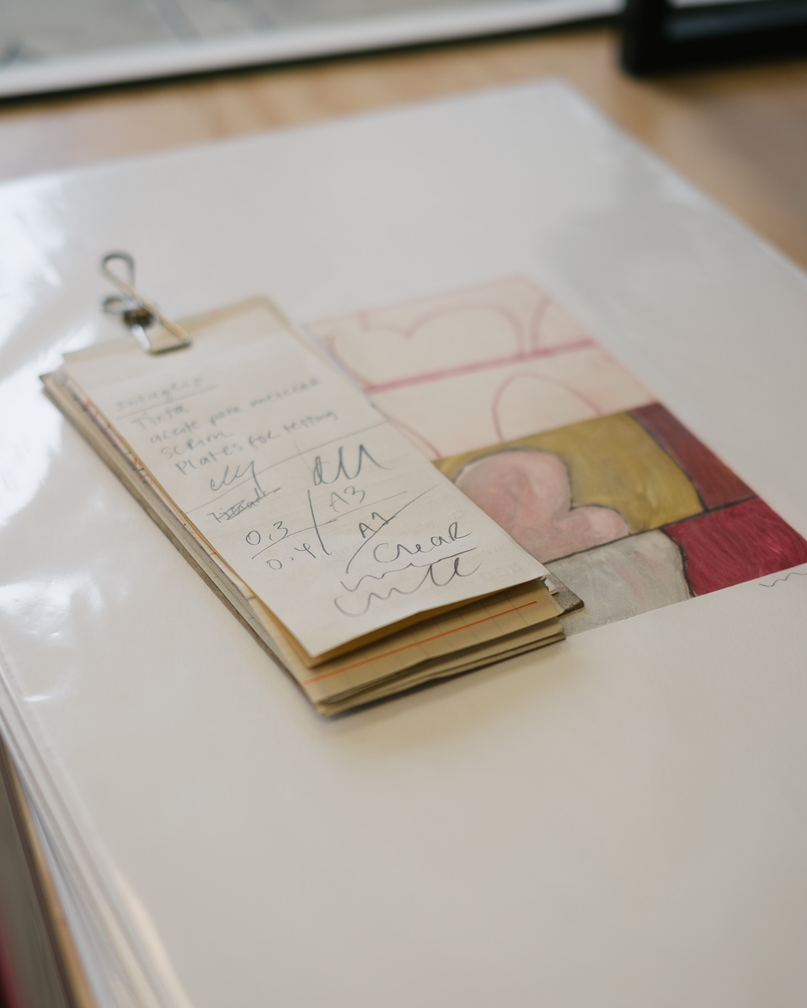
Ines Regarding what I said earlier about getting back into drawing and painting, I’ve been experimenting with less toxic ways of traditional copper plate etching and aquatint in my studio. It’s been really exciting as it has allowed me to pursue ideas with more freedom different to what would be afforded through processes like photopolymer and screen-printing, which have a more mechanical approach in their production. Copper plate etchings and dry point feels like a more immediate and gestural way of working which I am finding really liberating. I’ve also been working with a Dutch record label Called Pintai who have asked me to do their record sleeves. It’s been interesting being set some parameters to work in and develop a style that we all want to carry forward for their future releases. Developing something that can be recognisable on a shelf as the labels identity, but also allow for evolution as the releases progress is going to be a great journey.
Ines The precarious nature of the sculptures is something I play with when it comes to composition. I like to highlight the unsteady characteristics of the objects in their various arrangements and freeze them in prints, staging snapshots that suggest a longer narrative. Perhaps not an obvious concept when you first look at my work, but sequence has always been a theme that I have explored, often using collage and repetition to suggest movement, while using print to hold the composition forever fixed in place, like a window into some uncanny scene. By mirroring and creating parallels in my compositions I also try to emphasise the sense that there is a before and an after, a suggestion of some longer story.
Artiq Do you have any upcoming projects you would like to share with us?
Ines Regarding what I said earlier about getting back into drawing and painting, I’ve been experimenting with less toxic ways of traditional copper plate etching and aquatint in my studio. It’s been really exciting as it has allowed me to pursue ideas with more freedom different to what would be afforded through processes like photopolymer and screen-printing, which have a more mechanical approach in their production. Copper plate etchings and dry point feels like a more immediate and gestural way of working which I am finding really liberating. I’ve also been working with a Dutch record label Called Pintai who have asked me to do their record sleeves. It’s been interesting being set some parameters to work in and develop a style that we all want to carry forward for their future releases. Developing something that can be recognisable on a shelf as the labels identity, but also allow for evolution as the releases progress is going to be a great journey.