article In conversation with
Jacelyn Zhen
In conversation with
Jacelyn Zhen
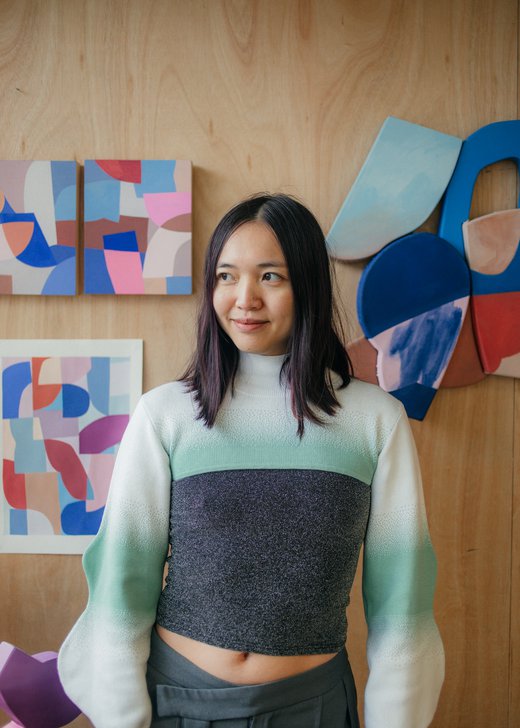
Singaporean artist Jacelyn Zhen reveals
how colour, movement, and playful forms
shape her evolving practice
how colour, movement, and playful forms
shape her evolving practice
Singaporean artist Jacelyn Zhen reveals
how colour, movement, and playful forms
shape her evolving practice
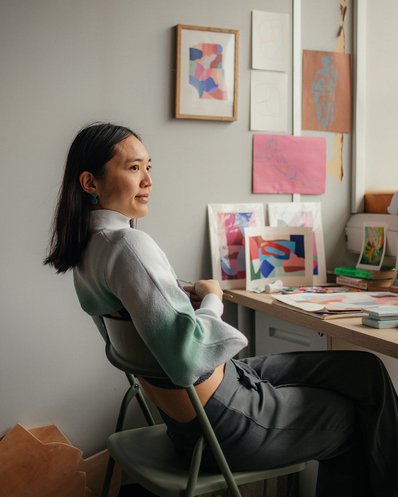
Working under the moniker Bbblob, Jacelyn Zhen is a Singaporean artist exploring transience through abstract, layered forms inspired by nature and the body. Blending colour, pattern and sculptural collage, she creates dreamlike compositions that evoke movement, memory and quiet transformation. Recently featured in our art rental collection for CFC Underwriting, we visited Jacelyn’s studio to learn more about her process and her move into three-dimensional work.
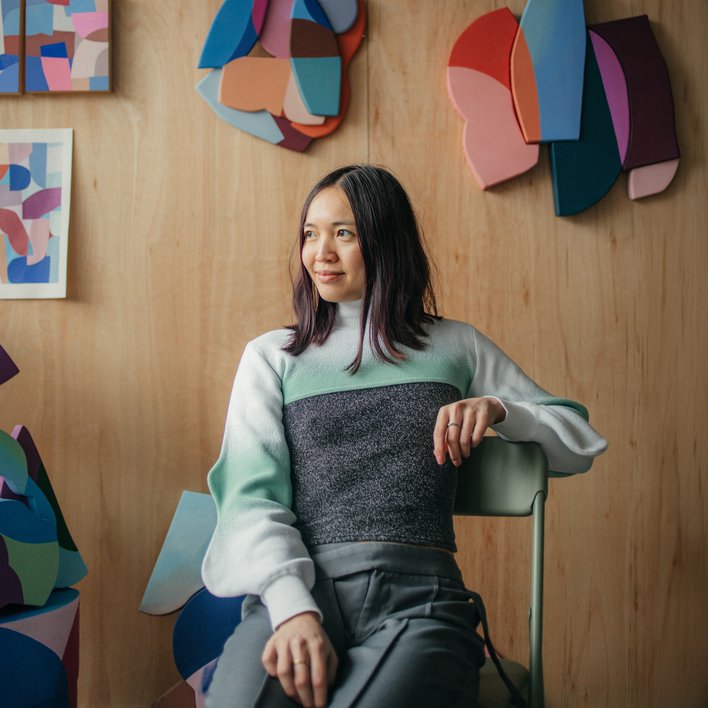
As an artist, how did you develop your moniker Bbblob? How did this name first emerge, and in what ways does it reflect and relate to your artistic practice today?
Bbblob means something organic and transient. It is also an onomatopoeia, the sound of a water droplet. It is playful, which reflects my personality and represents the style of my work. The three elements of colour, sound and form shape my experiences and influences. I feel connected to water, I love swimming, being in the ocean, a feeling of freedom, it inspired me to create through this fluid world of Bbblob. The idea of something touching water also has a symbolic meaning of birth, something emerging, which is related to my language of forms.
Your practice works around ideas of perception through structured layers and balance within your pieces. Can you describe the evolution of your practice from 2D collage to more sculptural wall hanging and free standing pieces?
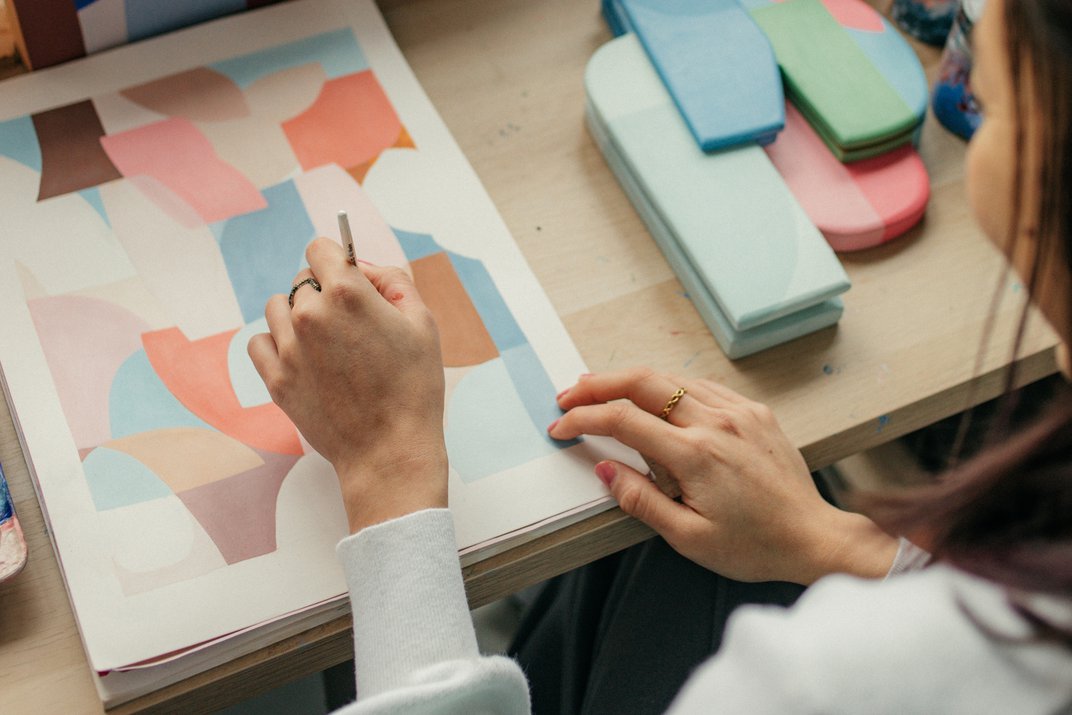
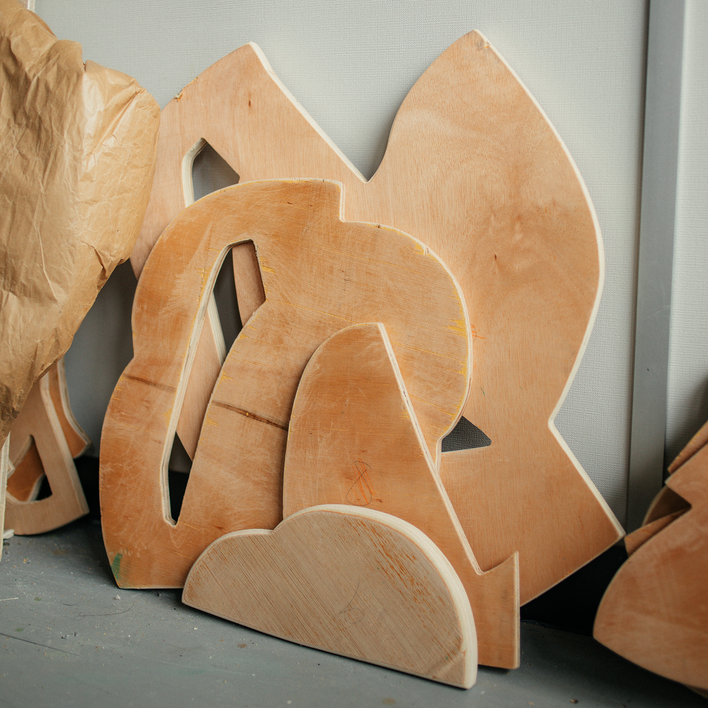
While I was creating a collage or a painting a day, it became a fun process to play with colour and composition. In arranging the paper cutouts, I started being interested in the shadows between the layers.I discovered my medium with wood through exploring depth. While experimenting with wood, I would go to a community workshop to source for offcuts. I was familiar with making things due to my design background and it felt natural to work with wood, cutting and shaping the pieces by hand. It was exciting to see my paper collages develop into wall pieces. I sketch out the layers to think through how I would construct them in woodcuts. Working with surface and material became part of my practice. The relief layers add another depth of perception, giving colour space. As my pieces grew, I also created standing pieces to explore the spatial sense of my forms.
Bbblob means something organic and transient. It is also an onomatopoeia, the sound of a water droplet. It is playful, which reflects my personality and represents the style of my work. The three elements of colour, sound and form shape my experiences and influences. I feel connected to water, I love swimming, being in the ocean, a feeling of freedom, it inspired me to create through this fluid world of Bbblob. The idea of something touching water also has a symbolic meaning of birth, something emerging, which is related to my language of forms.
Your practice works around ideas of perception through structured layers and balance within your pieces. Can you describe the evolution of your practice from 2D collage to more sculptural wall hanging and free standing pieces?
While I was creating a collage or a painting a day, it became a fun process to play with colour and composition. In arranging the paper cutouts, I started being interested in the shadows between the layers.I discovered my medium with wood through exploring depth. While experimenting with wood, I would go to a community workshop to source for offcuts. I was familiar with making things due to my design background and it felt natural to work with wood, cutting and shaping the pieces by hand. It was exciting to see my paper collages develop into wall pieces. I sketch out the layers to think through how I would construct them in woodcuts. Working with surface and material became part of my practice. The relief layers add another depth of perception, giving colour space. As my pieces grew, I also created standing pieces to explore the spatial sense of my forms.
‘While experimenting with wood, I would go to a community workshop to source for offcuts. I was familiar with making things due to my design background and it felt natural to work with wood, cutting and shaping the pieces by hand.’
- Jacelyn Zhen
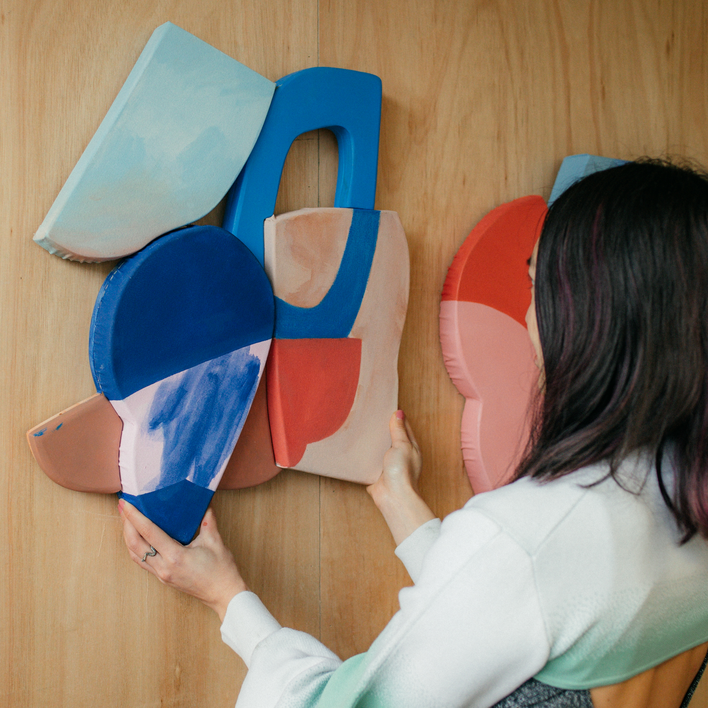
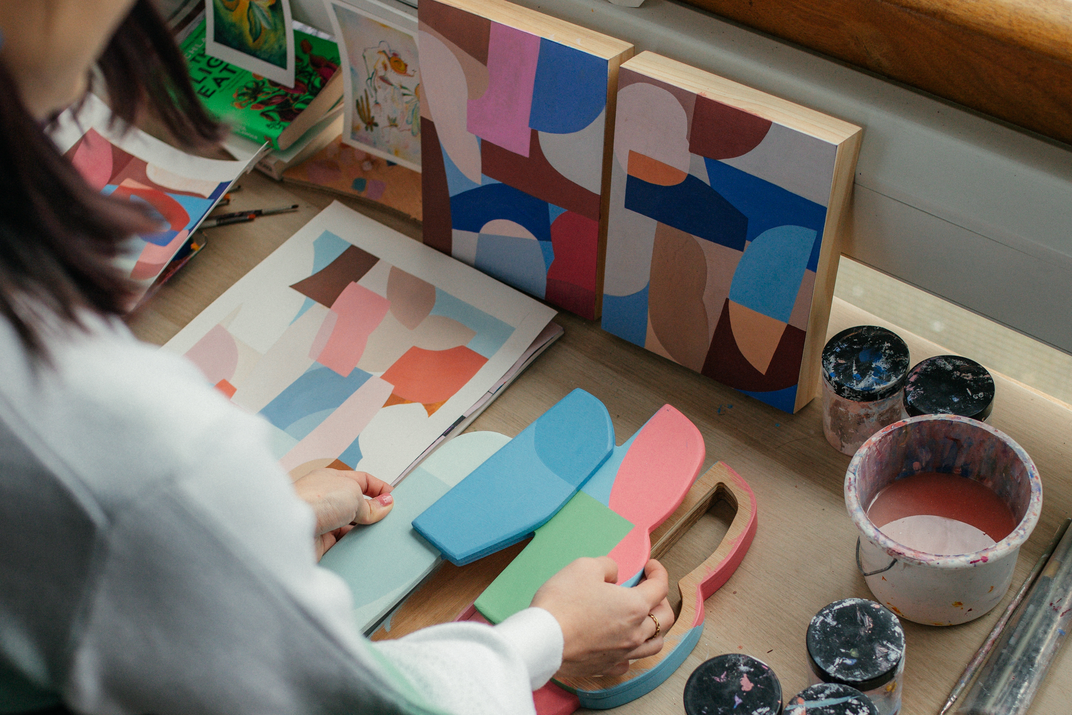
During our studio visit, you were able to show some of the new work you were making including a free standing modular sculpture, a work in progress functional light, and a small scale mock-up of a modular table. How does working with modular systems expand or challenge your practice, particularly as it moves toward functional objects?
My interest in sculpture and objects grew from my work with interiors and spaces. I collaborated on rugs, wallpaper, clothing and murals. I started thinking more spatially, how I could create an environment through my work. The idea of modular systems is connected to my inspiration with nature. My work reinterprets nature systems, the stacking of plants, layers of landscapes and the idea that nature is a reflection of us. It plays with the work, where they can be presented as a series and have different ways of arranging them. As my paintings are also objects, having a functional element adds another playful side to the work. I think of my pieces primarily as paintings that could also be sculpture, a mural or an object. I like the abstract symbolic spirit it carries.
Built of cool shades of pinks, purples, blues and greens, your colour palette is quite distinctive. What influences or references have shaped this palette, and how does colour function within the spatial and structural aspects of your pieces especially as you begin interacting with more texture in your works such as gradients?
Colour has always been a central part of my expression. It is something that comes intuitively when I choose certain hues. Similar to how certain sounds resonate with me, colour is an extension of my emotions. I tend to gravitate towards bright and soft colours. My colours create a dreamy and playful feeling. It is a reflection of my inner state. There is a combination of calm and bursts of energy in my colour palette. By exploring colour and depth, layers of colour interact with one another to play with balance and rhythm. It is similar to transitions in nature, flowing from light to dark, bright and pastel. Depth in colour also means exploring gradients, which further engages with perception.
My interest in sculpture and objects grew from my work with interiors and spaces. I collaborated on rugs, wallpaper, clothing and murals. I started thinking more spatially, how I could create an environment through my work. The idea of modular systems is connected to my inspiration with nature. My work reinterprets nature systems, the stacking of plants, layers of landscapes and the idea that nature is a reflection of us. It plays with the work, where they can be presented as a series and have different ways of arranging them. As my paintings are also objects, having a functional element adds another playful side to the work. I think of my pieces primarily as paintings that could also be sculpture, a mural or an object. I like the abstract symbolic spirit it carries.
Built of cool shades of pinks, purples, blues and greens, your colour palette is quite distinctive. What influences or references have shaped this palette, and how does colour function within the spatial and structural aspects of your pieces especially as you begin interacting with more texture in your works such as gradients?
Colour has always been a central part of my expression. It is something that comes intuitively when I choose certain hues. Similar to how certain sounds resonate with me, colour is an extension of my emotions. I tend to gravitate towards bright and soft colours. My colours create a dreamy and playful feeling. It is a reflection of my inner state. There is a combination of calm and bursts of energy in my colour palette. By exploring colour and depth, layers of colour interact with one another to play with balance and rhythm. It is similar to transitions in nature, flowing from light to dark, bright and pastel. Depth in colour also means exploring gradients, which further engages with perception.
‘My work reinterprets nature systems, the stacking of plants, layers of landscapes and the idea that nature is a reflection of us’
- Jacelyn Zhen
Many of your works suggest a sense of motion, rhythm, or shifting balance, even though they are static objects. How do you approach creating that feeling of movement within fixed materials like wood and canvas?
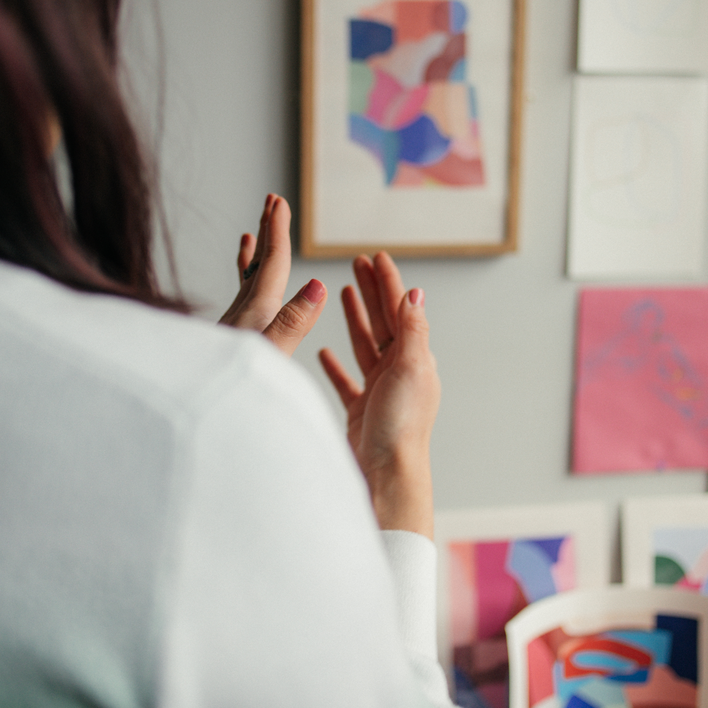
My first encounter with movement is dance particularly contemporary dance, which inspires my sense of rhythm. When I translate movement into painting, I think of nature moving, every shift is a layer or change in form. The way I arrange forms, stacking and connecting them into a pattern and rhythm, suggests movement. Sometimes I imagine my forms in a dance, floating and shifting in space. Nature is also slowly moving, changing, and I try to reimagine this feeling in my work. When I work with wood and canvas, I think of my forms as paper cuts and I collage them as a painting or woodcut relief. It is a process where one form leads to another to create a composition.
Do you have any upcoming projects that you would like to share with us?
I am currently working on a solo presentation with ARC Salon curated by Anna Woodward. It will be presented at a holiday home in the Cotswolds in April.
My first encounter with movement is dance particularly contemporary dance, which inspires my sense of rhythm. When I translate movement into painting, I think of nature moving, every shift is a layer or change in form. The way I arrange forms, stacking and connecting them into a pattern and rhythm, suggests movement. Sometimes I imagine my forms in a dance, floating and shifting in space. Nature is also slowly moving, changing, and I try to reimagine this feeling in my work. When I work with wood and canvas, I think of my forms as paper cuts and I collage them as a painting or woodcut relief. It is a process where one form leads to another to create a composition.
Do you have any upcoming projects that you would like to share with us?
I am currently working on a solo presentation with ARC Salon curated by Anna Woodward. It will be presented at a holiday home in the Cotswolds in April.
Want to be part of our network? Submit your work and join Artiq's growing community of artists.