article Making Space
Making Space
A shopping district, a public park, or an entirely new
neighbourhood, Heatherwick studio prioritises people in every
design, regardless of scale or location.
neighbourhood, Heatherwick studio prioritises people in every
design, regardless of scale or location.
A shopping district, a public park, or an entirely new
neighbourhood, Heatherwick studio prioritises people in every
design, regardless of scale or location.
Spatial design is being approached with greater consideration of the human experience within communal urban spaces. A renowned UK-based architecture and design studio, Heatherwick Studio, is paving the way for people-centric and experience-led design approaches. Much like curating art, the goal in both cases is to design with empathy—prioritising the emotional and psychological needs of the individuals who interact with the space, whether living around it or merely passing through.
Founded in 1994 by Thomas Heatherwick, Heatherwick studio operates across a wide array of disciplines, from public transportation systems to cultural landmarks, always driven by a deep commitment to enhancing the human experience. At its core, the studio’s philosophy is based on the belief that architecture and design should not only serve a functional purpose, but also cultivate a sense of joy, community, and social responsibility.
Tim Brown, in Change by Design, advocates for a holistic approach to design that considers the social, emotional, and cultural contexts of a space, an ethos that is also reflected in Heatherwick’s commitment to positive social impact through his team’s work.
In the studio’s large-scale public projects, the human experience is evident, particularly in communal spaces designed to foster connection. From urban pedestrian plazas and public parks to entire neighbourhoods, their designs prioritise human interaction and inclusivity.
This article highlights three international public projects by Heatherwick studio: Coal Drops Yard in London, UK; Little Island in New York City, US; and Xi’an CCBD in Xi’an, China. Each of these projects encapsulates how the studio continues to push the boundaries of design with a focus on human experience, and how this approach promotes both individual enjoyment and collective social progress.
These projects are also featured in Thomas Heatherwick’s book Making, recently revised and reissued with sixteen new projects and insights into the studio’s creative and collaborative processes.
In a sense, the collaboration continues with the people who ultimately inhabit the spaces. In a conversation with Dezeen founder and editor-in-chief Marcus Fairs, Thomas Heatherwick explained that his projects are open to users’ interpretations. “We’re trying not to tell people what they’re supposed to do. We’re just making platforms.” He continued: “We prioritise projects that are publicly accessible and are interested in the human-centred dimension.”
Coal Drops Yard in London demonstrates the studio’s commitment to user experience by promoting fluid movement and interaction. Its design incorporates a network of pathways and open areas that allow visitors to wander, explore, and engage dynamically with the architecture.
Little Island in New York City further reflects this people-centred approach, creating an environment that fosters both passive enjoyment and active engagement through public events and performances, cultivating a strong sense of community through its inclusive and diverse programming.
The Xi’an CCBD project in the city of Xi’an highlights their emphasis on adaptability and community engagement. Designed to accommodate a range of activities, from business and retail to cultural events and public leisure, the space can evolve over time with changing needs, making Xi’an CCBD not just a destination, but a versatile environment that can meet future demands and ensure long-term urban resilience.
Founded in 1994 by Thomas Heatherwick, Heatherwick studio operates across a wide array of disciplines, from public transportation systems to cultural landmarks, always driven by a deep commitment to enhancing the human experience. At its core, the studio’s philosophy is based on the belief that architecture and design should not only serve a functional purpose, but also cultivate a sense of joy, community, and social responsibility.
Tim Brown, in Change by Design, advocates for a holistic approach to design that considers the social, emotional, and cultural contexts of a space, an ethos that is also reflected in Heatherwick’s commitment to positive social impact through his team’s work.
In the studio’s large-scale public projects, the human experience is evident, particularly in communal spaces designed to foster connection. From urban pedestrian plazas and public parks to entire neighbourhoods, their designs prioritise human interaction and inclusivity.
This article highlights three international public projects by Heatherwick studio: Coal Drops Yard in London, UK; Little Island in New York City, US; and Xi’an CCBD in Xi’an, China. Each of these projects encapsulates how the studio continues to push the boundaries of design with a focus on human experience, and how this approach promotes both individual enjoyment and collective social progress.
These projects are also featured in Thomas Heatherwick’s book Making, recently revised and reissued with sixteen new projects and insights into the studio’s creative and collaborative processes.
In a sense, the collaboration continues with the people who ultimately inhabit the spaces. In a conversation with Dezeen founder and editor-in-chief Marcus Fairs, Thomas Heatherwick explained that his projects are open to users’ interpretations. “We’re trying not to tell people what they’re supposed to do. We’re just making platforms.” He continued: “We prioritise projects that are publicly accessible and are interested in the human-centred dimension.”
Coal Drops Yard in London demonstrates the studio’s commitment to user experience by promoting fluid movement and interaction. Its design incorporates a network of pathways and open areas that allow visitors to wander, explore, and engage dynamically with the architecture.
Little Island in New York City further reflects this people-centred approach, creating an environment that fosters both passive enjoyment and active engagement through public events and performances, cultivating a strong sense of community through its inclusive and diverse programming.
The Xi’an CCBD project in the city of Xi’an highlights their emphasis on adaptability and community engagement. Designed to accommodate a range of activities, from business and retail to cultural events and public leisure, the space can evolve over time with changing needs, making Xi’an CCBD not just a destination, but a versatile environment that can meet future demands and ensure long-term urban resilience.
Project Name Coal Drops Yard
Year Completed 2018
Location London, UK
Area 100,000 sq ft
Tucked away in the heart of King’s Cross, an area once defined by industrial grime, stand two elongated Victorian warehouses that have quietly witnessed London’s transformation for over 150 years. Known today as Coal Drops, they were originally built in the 1850s and ’60s to store and distribute coal brought by rail from northern England. Their decline mirrored the city’s shift to new energy sources, and by the late 20th century, they had become relics of a bygone era.
In the past two decades, however, urban regeneration has breathed new life into the area, including these once-abandoned buildings. To lead their transformation into a contemporary retail district, the King’s Cross Development Partnership commissioned Heatherwick studio to reimagine the site.
“Our challenge was to radically remodel this Victorian infrastructure to meet the needs of a modern urban development without losing what made it special,” says Lisa Finley, Group Leader at the studio. “To achieve this, we focused on understanding its original function and how it evolved over time. This allowed us to determine the best way to preserve and reuse the existing fabric while seamlessly integrating new elements.”
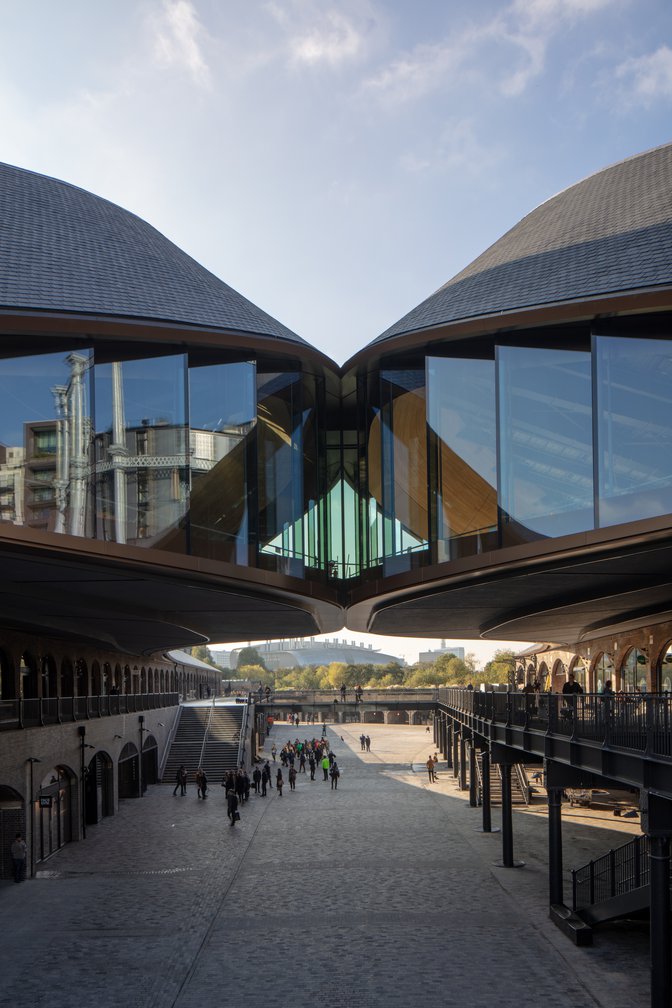
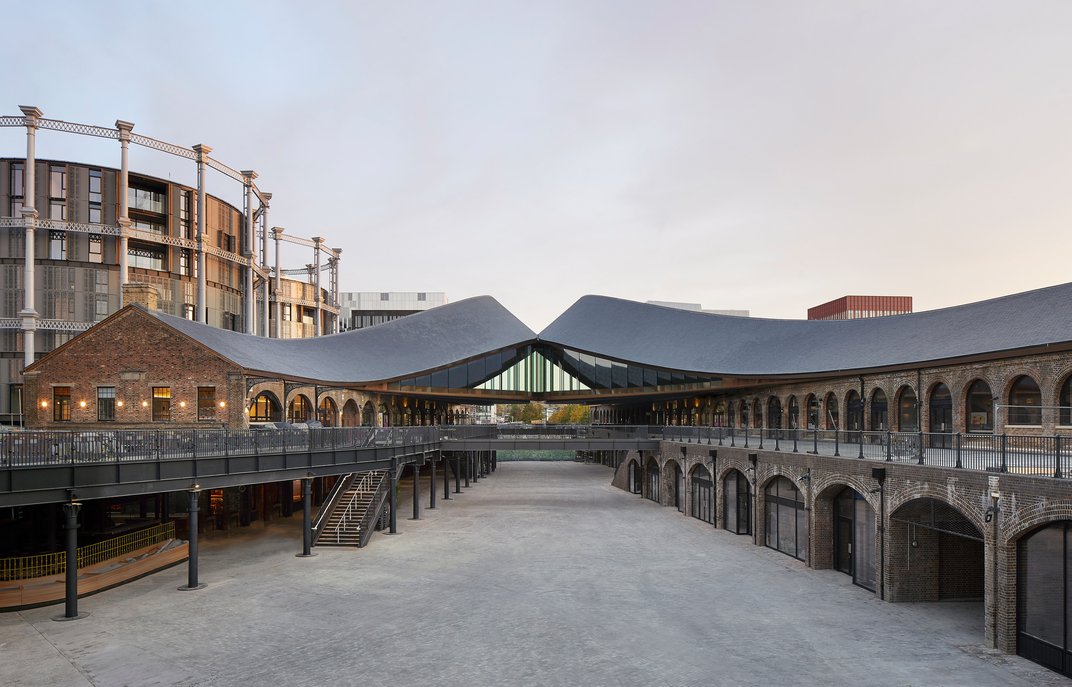
The grandeur of the two-story coal drops had faded over time, later housing light industry, warehousing, and nightclubs before falling partially into abandonment in the 1990s. Today, that grandeur has been restored. A striking new 35-meter-wide extension flows seamlessly from the original gables, creating the illusion that the two buildings touch in midair—a bold architectural gesture that bridges past and present, as well as the two rows of units.
Yet restoring the buildings was only part of the challenge. The long, linear site needed to be transformed into a vibrant public space where people could gather and move freely. The result achieves just that. Designed as a network of interconnected streets rather than a conventional shopping mall, the retail quarter offers a dynamic, multi-level experience. The 55 retail units vary in size, catering to a diverse mix of retailers, from emerging pop-ups to flagship stores for established brands.
Multiple entry points at both ends of the viaducts, along with thoughtfully designed bridges and staircases linking into the central yard, create an open, fluid space that encourages natural movement through the site. It’s an incredible achievement to transform two long, linear rows of warehouses into something that feels soft, almost circular.
Coal Drops Yard is a testament to the power of adaptive reuse, preserving its industrial heritage while making it fit for contemporary purposes. Rather than forsake the past in pursuit of the future, the project embraces it. By repurposing instead of demolishing, it retains a sense of place and authenticity—qualities too often lost in regeneration projects.
Perhaps it’s the studio’s commitment to “leading from human experience” that has ensured this balance. As cities reimagine post-industrial spaces for 21st-century needs, Coal Drops Yard demonstrates that a heritage-led approach to urban renewal can be both commercially viable and socially meaningful, honouring the past while remaining relevant for the future.
Year Completed 2018
Location London, UK
Area 100,000 sq ft
Tucked away in the heart of King’s Cross, an area once defined by industrial grime, stand two elongated Victorian warehouses that have quietly witnessed London’s transformation for over 150 years. Known today as Coal Drops, they were originally built in the 1850s and ’60s to store and distribute coal brought by rail from northern England. Their decline mirrored the city’s shift to new energy sources, and by the late 20th century, they had become relics of a bygone era.
In the past two decades, however, urban regeneration has breathed new life into the area, including these once-abandoned buildings. To lead their transformation into a contemporary retail district, the King’s Cross Development Partnership commissioned Heatherwick studio to reimagine the site.
“Our challenge was to radically remodel this Victorian infrastructure to meet the needs of a modern urban development without losing what made it special,” says Lisa Finley, Group Leader at the studio. “To achieve this, we focused on understanding its original function and how it evolved over time. This allowed us to determine the best way to preserve and reuse the existing fabric while seamlessly integrating new elements.”
The grandeur of the two-story coal drops had faded over time, later housing light industry, warehousing, and nightclubs before falling partially into abandonment in the 1990s. Today, that grandeur has been restored. A striking new 35-meter-wide extension flows seamlessly from the original gables, creating the illusion that the two buildings touch in midair—a bold architectural gesture that bridges past and present, as well as the two rows of units.
Yet restoring the buildings was only part of the challenge. The long, linear site needed to be transformed into a vibrant public space where people could gather and move freely. The result achieves just that. Designed as a network of interconnected streets rather than a conventional shopping mall, the retail quarter offers a dynamic, multi-level experience. The 55 retail units vary in size, catering to a diverse mix of retailers, from emerging pop-ups to flagship stores for established brands.
Multiple entry points at both ends of the viaducts, along with thoughtfully designed bridges and staircases linking into the central yard, create an open, fluid space that encourages natural movement through the site. It’s an incredible achievement to transform two long, linear rows of warehouses into something that feels soft, almost circular.
Coal Drops Yard is a testament to the power of adaptive reuse, preserving its industrial heritage while making it fit for contemporary purposes. Rather than forsake the past in pursuit of the future, the project embraces it. By repurposing instead of demolishing, it retains a sense of place and authenticity—qualities too often lost in regeneration projects.
Perhaps it’s the studio’s commitment to “leading from human experience” that has ensured this balance. As cities reimagine post-industrial spaces for 21st-century needs, Coal Drops Yard demonstrates that a heritage-led approach to urban renewal can be both commercially viable and socially meaningful, honouring the past while remaining relevant for the future.
Project Name Little Island
Year Completed 2021
Location New York City, US
Area 11,000 sq ft
Is there any place in the world more closely associated with creativity, the performing arts, and vibrant urban life than New York City? It’s equally known for its density and the constant demand for public space. So, when planning a new public park, where do you begin?
New York City has a strong tradition of reinventing public spaces, turning overlooked or underused areas into greener destinations. In 1857, Central Park became one of the first major landscaped public parks in the US. More recently, in 2009, a disused elevated freight line was reimagined as The High Line, a lush, linear park stretching from Hudson Yards in the north to the Meatpacking District in the south. Not far from there, a new public park opened in 2021, suspended over the Hudson River, nodding to Manhattan’s maritime past and its obsession with piers.
When philanthropist Barry Diller and the Hudson River Park Trust invited Heatherwick studio to design a new addition to the waterfront off Manhattan’s Lower West Side, the team saw a larger opportunity: to rethink what a pier could be.
“The project began when we were asked to conceive of a sculptural structure to go on a design for a newly enlarged piece of the Hudson River Park promenade. The project was interesting, but we saw the opportunity to create a more engaging experience for New Yorkers and to build on the city’s heritage of inventing exciting new public spaces,” explained Thomas Heatherwick.
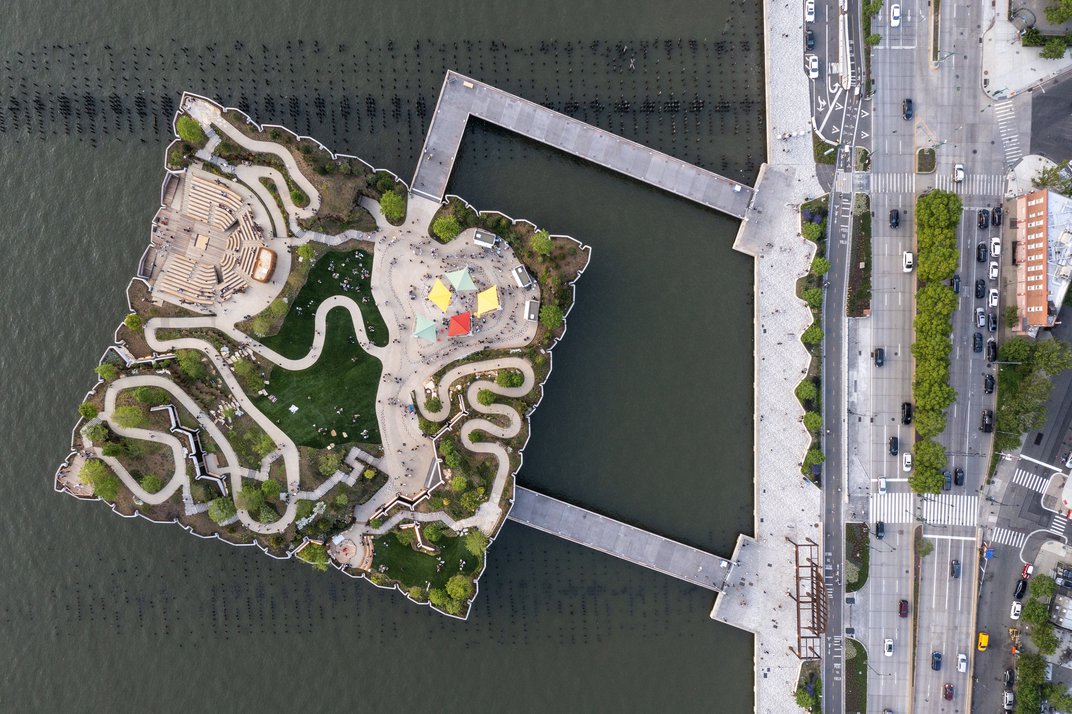
The pier was reimagined as a seamless, sculpted landscape rather than a structure propped on stilts. Its supporting piles rise into planters, shaping the park’s rolling topography, lifting at the edges for sunlight, dipping to form hills, viewpoints, and a natural amphitheatre.
Every corner of the island offers a distinct microclimate, creating a tapestry of greenery that shifts with the seasons.
Placing people’s experience front and centre of the design, the team wanted to eliminate any disruptive structures that might break the illusion of being immersed in nature. But a theatre also requires a back-of-house, and the studio cleverly employed organic design solutions to conceal the practical realities of how the open-air theatre operates on Little Island.
The tallest piles distribute the load to the shorter ones, creating a void beneath the deck. This undercroft reveals the structure’s foundations while forming a viewing platform over the water, offering a unique perspective of both the park and river. Essential facilities are tucked away on a discreet lower deck, keeping the landscape uninterrupted. Every detail was carefully considered, from how the greenery unfolds upon arrival to the view from every theatre seat.
Blending performance and parkland, Little Island offers New Yorkers a rare retreat—a place to pause, watch a show or unwind under a tree and watch the sunset. It’s bold, fluid, and effortlessly theatrical, the perfect stage. Its slopes and pockets of greenery create a sense of intimacy, feeling organic rather than engineered. You’re still very much in the city, but it feels just far enough away.
Year Completed 2021
Location New York City, US
Area 11,000 sq ft
Is there any place in the world more closely associated with creativity, the performing arts, and vibrant urban life than New York City? It’s equally known for its density and the constant demand for public space. So, when planning a new public park, where do you begin?
New York City has a strong tradition of reinventing public spaces, turning overlooked or underused areas into greener destinations. In 1857, Central Park became one of the first major landscaped public parks in the US. More recently, in 2009, a disused elevated freight line was reimagined as The High Line, a lush, linear park stretching from Hudson Yards in the north to the Meatpacking District in the south. Not far from there, a new public park opened in 2021, suspended over the Hudson River, nodding to Manhattan’s maritime past and its obsession with piers.
When philanthropist Barry Diller and the Hudson River Park Trust invited Heatherwick studio to design a new addition to the waterfront off Manhattan’s Lower West Side, the team saw a larger opportunity: to rethink what a pier could be.
“The project began when we were asked to conceive of a sculptural structure to go on a design for a newly enlarged piece of the Hudson River Park promenade. The project was interesting, but we saw the opportunity to create a more engaging experience for New Yorkers and to build on the city’s heritage of inventing exciting new public spaces,” explained Thomas Heatherwick.
The pier was reimagined as a seamless, sculpted landscape rather than a structure propped on stilts. Its supporting piles rise into planters, shaping the park’s rolling topography, lifting at the edges for sunlight, dipping to form hills, viewpoints, and a natural amphitheatre.
Every corner of the island offers a distinct microclimate, creating a tapestry of greenery that shifts with the seasons.
Placing people’s experience front and centre of the design, the team wanted to eliminate any disruptive structures that might break the illusion of being immersed in nature. But a theatre also requires a back-of-house, and the studio cleverly employed organic design solutions to conceal the practical realities of how the open-air theatre operates on Little Island.
The tallest piles distribute the load to the shorter ones, creating a void beneath the deck. This undercroft reveals the structure’s foundations while forming a viewing platform over the water, offering a unique perspective of both the park and river. Essential facilities are tucked away on a discreet lower deck, keeping the landscape uninterrupted. Every detail was carefully considered, from how the greenery unfolds upon arrival to the view from every theatre seat.
Blending performance and parkland, Little Island offers New Yorkers a rare retreat—a place to pause, watch a show or unwind under a tree and watch the sunset. It’s bold, fluid, and effortlessly theatrical, the perfect stage. Its slopes and pockets of greenery create a sense of intimacy, feeling organic rather than engineered. You’re still very much in the city, but it feels just far enough away.
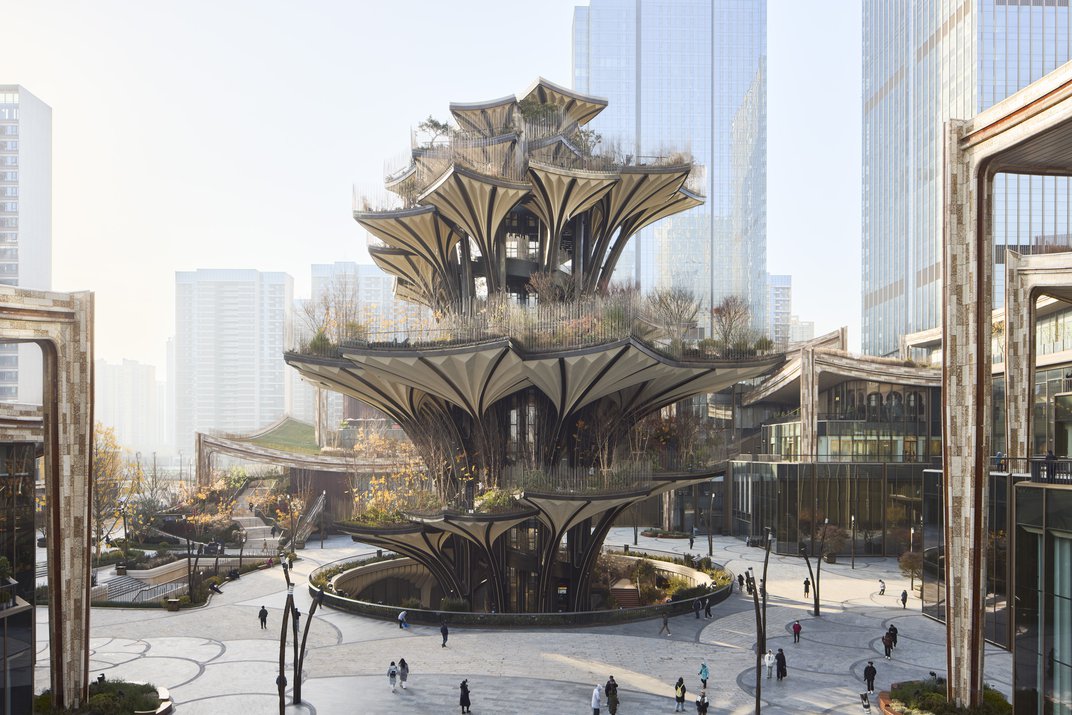
Project Name Xi'An CCBD
Year Completed 2024
Location Xi'an China
Area 155,000 sq m
The ancient city of Xi’an in central China has a rich legacy of terracotta and pottery spanning thousands of years. Once the eastern gateway of the Silk Road, it exported glazed pottery to the far corners of the world and is best known as the home of the famed Terracotta Army.
Like many cities in China, Xi’an is undergoing rapid transformation and urbanisation. At the end of last year, a new district designed by Heatherwick studio opened to the public. As a studio, their philosophy is inherently forward-looking. But how do you merge this vision with the deep history and heritage of such an ancient city?
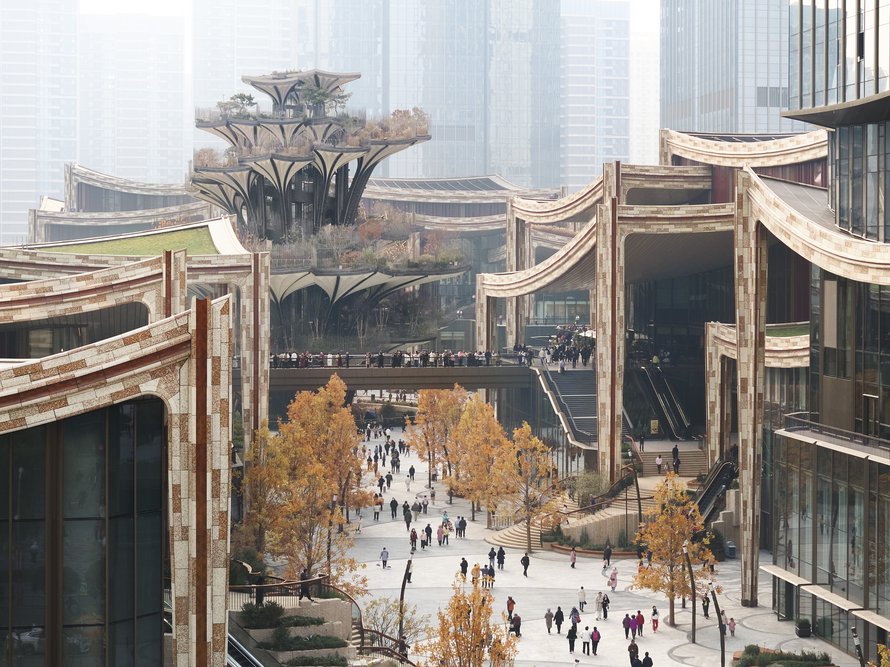
The Xi’an Centre Culture Business District (CCBD) lies south of the historic city centre. Spanning 155,000 sq m, the new neighbourhood weaves together shops, restaurants, offices, and apartments amid manicured gardens and terraces. Rather than the generic glass and steel monoliths we’ve grown accustomed to, this development honours the city’s legacy of craftsmanship and its historic connection to ceramics. More than 100,000 uniquely glazed tiles—developed in close collaboration with local makers—clad the façades, columns, and curving beams. Despite its newness, the goal was to create visual complexity: imperfect, textured, and deeply resonant with Xi’an.
Mat Cash, Partner and Group Leader at Heatherwick studio, reflects on the challenges of designing on such a scale: “Super large-scale developments are being built all over the world to satisfy rapidly urbanising populations. By their very nature, they are often overbearing, singular, and devoid of character – they do nothing for the people they are meant to serve.”
As a response, the studio took a different approach. “We wanted to infuse our project with the spirit, variety, and texture that happens naturally in cities over time,” he explains. “The district pays homage to the city’s tradition of making and its historic connection to ceramics.”
The design is intricate, with imagination and creativity evident in every detail. Conceived for visual complexity, the district reveals itself in layers. From a distance, its skyline recalls the tiered roofs of Xi’an’s ancient temples. Up close, ceramic planters, soft-edged stone, and lush greenery add depth and texture. At its centre stands the Xi’an Tree, a 57-metre-high vertical park—both a landmark and a gathering place—rooting the district in nature and community.
Leela Keshav, invited to write an essay on the project, posed an important question:“In an era of mass industrialisation and cheap construction, might there still be value in an approach rooted in craft, care, and long-term thinking?” We live in a time defined by instant gratification and short-term thinking, and thus, the need for lasting design has never been greater. The places we return to, year after year, are those that make us feel good, keep us engaged, and stand the test of time. Xi’an CCBD is a prime example. At its core, it is a statement of aesthetic expression—a reflection of the studio’s vision to create buildings that spark joy and contribute to a modern heritage that enriches the city.
Lovisa Ranta, Marketing Manager and Tommaso de Benedictis, Curator
Year Completed 2024
Location Xi'an China
Area 155,000 sq m
The ancient city of Xi’an in central China has a rich legacy of terracotta and pottery spanning thousands of years. Once the eastern gateway of the Silk Road, it exported glazed pottery to the far corners of the world and is best known as the home of the famed Terracotta Army.
Like many cities in China, Xi’an is undergoing rapid transformation and urbanisation. At the end of last year, a new district designed by Heatherwick studio opened to the public. As a studio, their philosophy is inherently forward-looking. But how do you merge this vision with the deep history and heritage of such an ancient city?
The Xi’an Centre Culture Business District (CCBD) lies south of the historic city centre. Spanning 155,000 sq m, the new neighbourhood weaves together shops, restaurants, offices, and apartments amid manicured gardens and terraces. Rather than the generic glass and steel monoliths we’ve grown accustomed to, this development honours the city’s legacy of craftsmanship and its historic connection to ceramics. More than 100,000 uniquely glazed tiles—developed in close collaboration with local makers—clad the façades, columns, and curving beams. Despite its newness, the goal was to create visual complexity: imperfect, textured, and deeply resonant with Xi’an.
Mat Cash, Partner and Group Leader at Heatherwick studio, reflects on the challenges of designing on such a scale: “Super large-scale developments are being built all over the world to satisfy rapidly urbanising populations. By their very nature, they are often overbearing, singular, and devoid of character – they do nothing for the people they are meant to serve.”
As a response, the studio took a different approach. “We wanted to infuse our project with the spirit, variety, and texture that happens naturally in cities over time,” he explains. “The district pays homage to the city’s tradition of making and its historic connection to ceramics.”
The design is intricate, with imagination and creativity evident in every detail. Conceived for visual complexity, the district reveals itself in layers. From a distance, its skyline recalls the tiered roofs of Xi’an’s ancient temples. Up close, ceramic planters, soft-edged stone, and lush greenery add depth and texture. At its centre stands the Xi’an Tree, a 57-metre-high vertical park—both a landmark and a gathering place—rooting the district in nature and community.
Leela Keshav, invited to write an essay on the project, posed an important question:“In an era of mass industrialisation and cheap construction, might there still be value in an approach rooted in craft, care, and long-term thinking?” We live in a time defined by instant gratification and short-term thinking, and thus, the need for lasting design has never been greater. The places we return to, year after year, are those that make us feel good, keep us engaged, and stand the test of time. Xi’an CCBD is a prime example. At its core, it is a statement of aesthetic expression—a reflection of the studio’s vision to create buildings that spark joy and contribute to a modern heritage that enriches the city.
Lovisa Ranta, Marketing Manager and Tommaso de Benedictis, Curator