article On Material
and Making
On Material
and Making
Molly Coffey in conversation with Juliet Ferguson-Rose
and Nowshin Prenon on process-led practice and the
blurred line between art and craft.
and Nowshin Prenon on process-led practice and the
blurred line between art and craft.
Molly Coffey in conversation with Juliet Ferguson-Rose
and Nowshin Prenon on process-led practice and the
blurred line between art and craft.
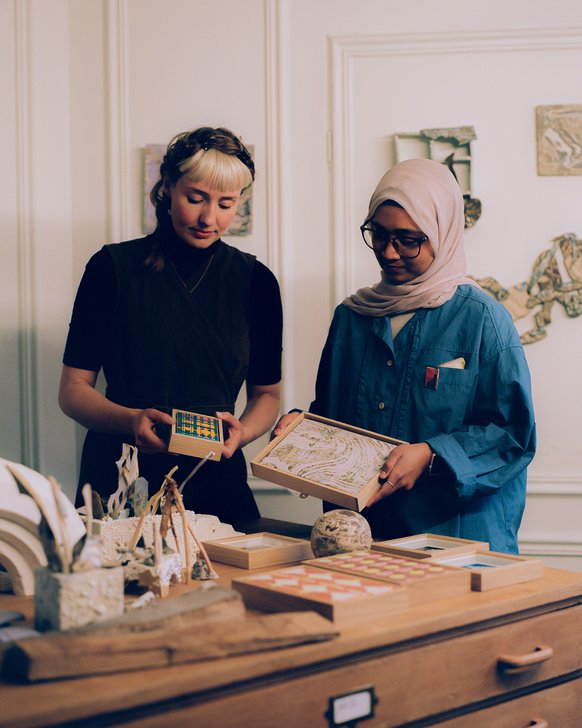
As if in reward for climbing several flights of stairs leading to Juliet Ferguson-Rose’s studio in the heart of bustling Holborn, I am met with the visual delight of her sculptural works. Bathed in the soft light of a March afternoon, these pieces, crafted from clay, feature marbled surfaces of ethereal lilac, burnt orange, and rich umber. Smaller pieces are displayed on surfaces scattered around the space, while larger works hang from the studio walls. They carry an organic, archaeological quality, both ancient and contemporary, as though unearthed from a distant past to be reinterpreted in the present.
Juliet explains that the marbling effect in her work comes from combining two clays sourced from different places. The result is a rich, organic texture, with variations in colour, density, and form that echo the natural world, reminiscent of geological formations or fossilisation processes. The clay, she tells me, becomes a time capsule, preserving the essence of the present moment.
As I take in her studio, an eclectic mix of artworks, artefacts, sketches, and photographs, I am reminded of the ancient human need to create, preserve, and remember.
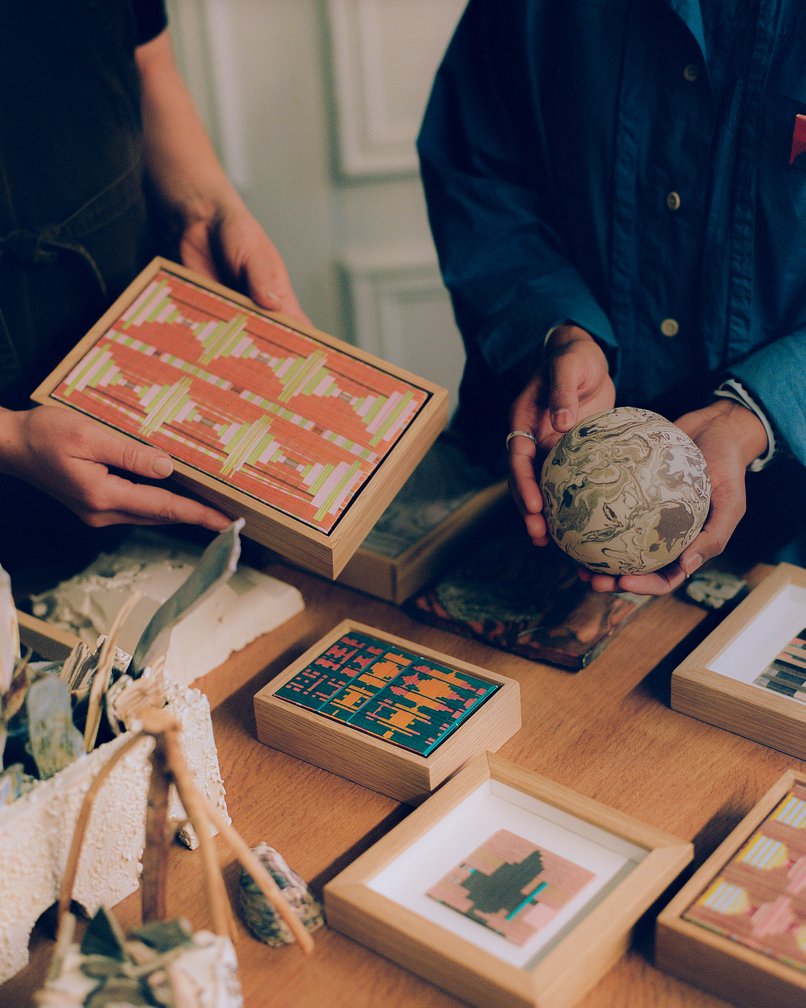
When textile artist Nowshin Prenon arrives with her handwoven silk pieces in tow, we are immediately captivated by their iridescent shimmer. She shares how she experiments with both acid and natural dyes to achieve her rich palette: the golden hue from avocado skin, the deep red of madder root, the warm yellow of onion peel. I learn that green emerges from a delicate mix of gardenia, indigo, and sometimes even red cabbage. Though her practice appears meticulous, there is an element of surprise, much like Juliet’s delight in the unpredictable alchemy of clay.
As we make room for several of Nowshin’s works on the central plan chest alongside Juliet’s sculptures, we find the combination of artists’ works harmonise in a surprising way. Nowshin’s textiles are colourful, precise, geometric, a striking contrast to the raw, organic nature of Juliet’s ceramics. It’s the interplay between Nowshin’s delicately crafted silk pieces and Juliet’s earthy, imperfect sculptures that, we agree, creates a satisfying visual dialogue.
As I am about to discover in our conversation, Juliet and Nowshin’s practices, though visually distinct, share a profound resonance in their exploration of heritage and materiality. Both artists approach their chosen materials not just as means for creating finished works, but as integral elements of their expression.
By layering different clays from various locations, Juliet creates textures that speak to the passage of time, place, and history. Elevating clay beyond a preparatory material to a central feature within her work, the artist challenges the conventional view of clay as merely a medium for sculpture or casting.
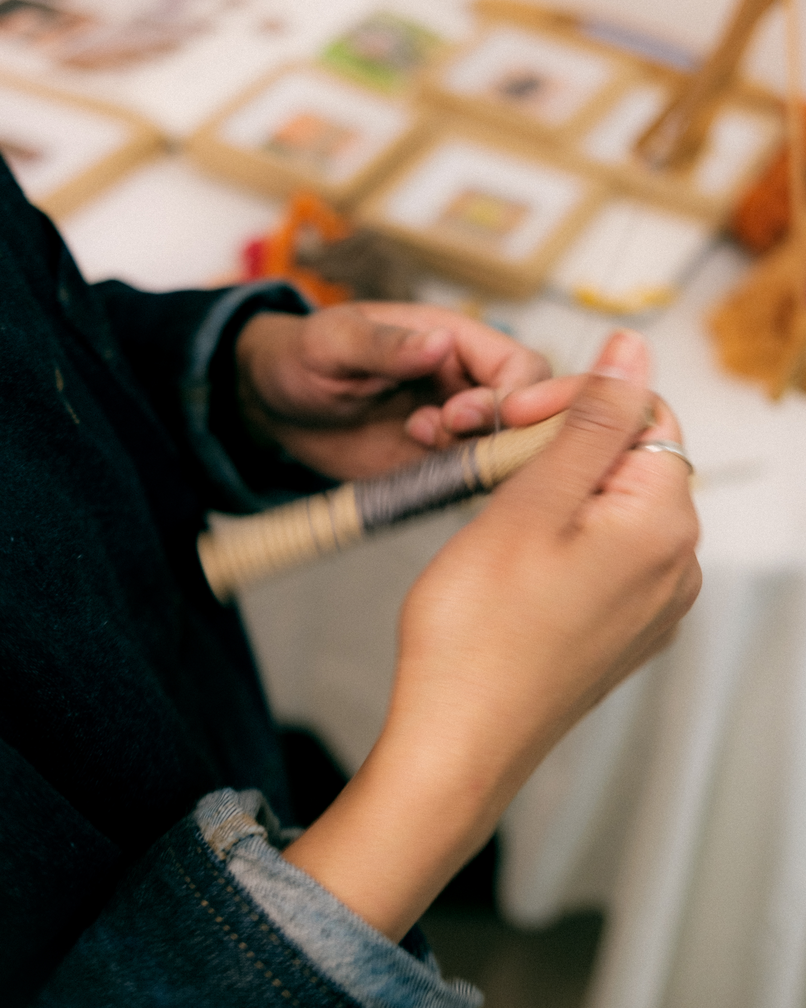
Similarly, Nowshin’s practice centres on the winding technique in weaving—a process traditionally regarded as a preparatory step before creating the final textile. For Nowshin, however, winding transcends its technical function; it is an art form in its own right, deserving of full recognition. Through winding, she intricately layers threads to explore texture, colour, and form, creating aesthetic representations of cultural narratives and personal journey.
Both artists elevate their chosen foundational materials and processes, inviting viewers to appreciate the labour and meaning woven into every layer—both literal and metaphorical.
As we settle into a corner of the studio and start recording, I ask Juliet about the origins of the archaeological quality in her work and how she views her practice as a form of excavation.
Juliet explains that the marbling effect in her work comes from combining two clays sourced from different places. The result is a rich, organic texture, with variations in colour, density, and form that echo the natural world, reminiscent of geological formations or fossilisation processes. The clay, she tells me, becomes a time capsule, preserving the essence of the present moment.
As I take in her studio, an eclectic mix of artworks, artefacts, sketches, and photographs, I am reminded of the ancient human need to create, preserve, and remember.
When textile artist Nowshin Prenon arrives with her handwoven silk pieces in tow, we are immediately captivated by their iridescent shimmer. She shares how she experiments with both acid and natural dyes to achieve her rich palette: the golden hue from avocado skin, the deep red of madder root, the warm yellow of onion peel. I learn that green emerges from a delicate mix of gardenia, indigo, and sometimes even red cabbage. Though her practice appears meticulous, there is an element of surprise, much like Juliet’s delight in the unpredictable alchemy of clay.
As we make room for several of Nowshin’s works on the central plan chest alongside Juliet’s sculptures, we find the combination of artists’ works harmonise in a surprising way. Nowshin’s textiles are colourful, precise, geometric, a striking contrast to the raw, organic nature of Juliet’s ceramics. It’s the interplay between Nowshin’s delicately crafted silk pieces and Juliet’s earthy, imperfect sculptures that, we agree, creates a satisfying visual dialogue.
As I am about to discover in our conversation, Juliet and Nowshin’s practices, though visually distinct, share a profound resonance in their exploration of heritage and materiality. Both artists approach their chosen materials not just as means for creating finished works, but as integral elements of their expression.
By layering different clays from various locations, Juliet creates textures that speak to the passage of time, place, and history. Elevating clay beyond a preparatory material to a central feature within her work, the artist challenges the conventional view of clay as merely a medium for sculpture or casting.
Similarly, Nowshin’s practice centres on the winding technique in weaving—a process traditionally regarded as a preparatory step before creating the final textile. For Nowshin, however, winding transcends its technical function; it is an art form in its own right, deserving of full recognition. Through winding, she intricately layers threads to explore texture, colour, and form, creating aesthetic representations of cultural narratives and personal journey.
Both artists elevate their chosen foundational materials and processes, inviting viewers to appreciate the labour and meaning woven into every layer—both literal and metaphorical.
As we settle into a corner of the studio and start recording, I ask Juliet about the origins of the archaeological quality in her work and how she views her practice as a form of excavation.
Juliet The forms I use are often taken from petroglyphs—cup and ring marks. These are carvings in large stones, often 4,000 to 5,000 years old, made by Neolithic people in Britain. They’re mostly found in Northumberland and South West England. For the Threshold series, I took inspiration from cup and ring marks in Northumberland. It’s thought they might represent the brightness of stars; more rings indicate a brighter star. Some of my more oval pieces reference a visit to Rome, specifically the Hippodrome on Palatine Hill near the Colosseum. The beauty of a mould is that it can be used in many ways, over and over again; they begin with one shape and then evolve to reference other architecture.
Molly I’m curious, how do you both see materiality specifically as a way to bring historical narratives into the present?
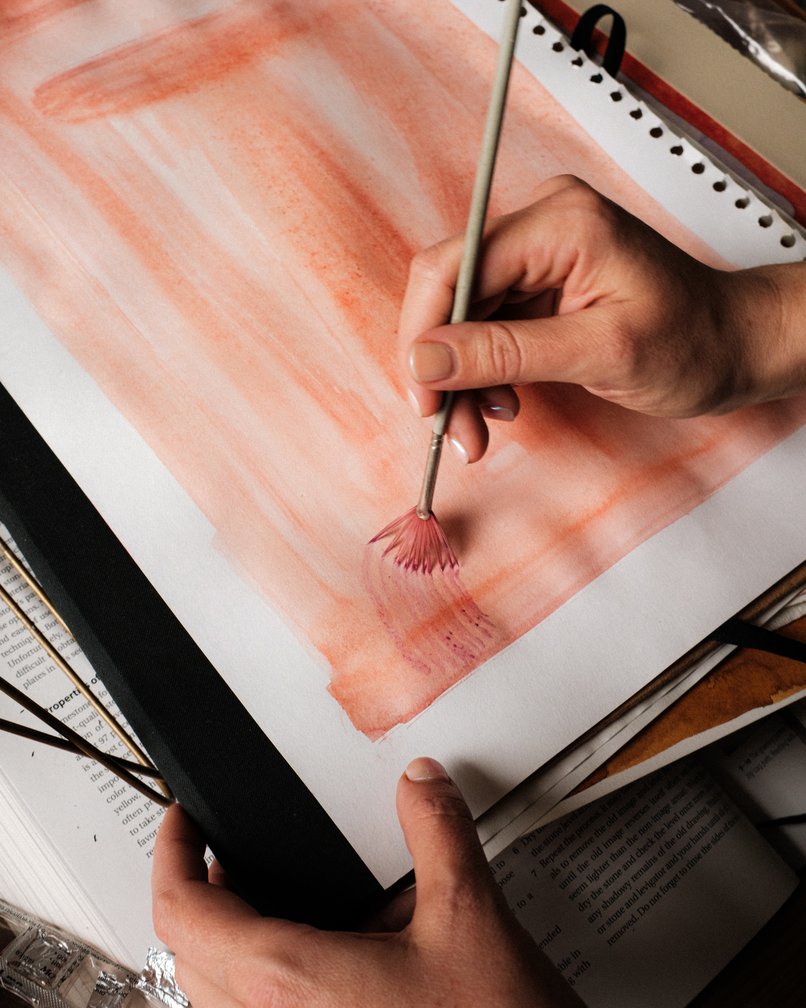
Nowshin The architectural elements in my work come from growing up in Bangladesh. My childhood memories, visiting museums every summer with my dad, really stuck with me. Everything felt so big as a child. One museum was entirely painted pink, which I remember vividly. I draw from those architectural elements. I travelled a lot with my parents, so I collected visual references from around the world. Now I find architectural inspiration everywhere, even in the city where I live. A beautiful building, a façade, or an interior, all of it filters into my work. I also draw inspiration from paintings and cultural festivals. I keep a sketchbook full of these references and draw from them to bring it all together.
Molly I’m curious, how do you both see materiality specifically as a way to bring historical narratives into the present?
Nowshin The architectural elements in my work come from growing up in Bangladesh. My childhood memories, visiting museums every summer with my dad, really stuck with me. Everything felt so big as a child. One museum was entirely painted pink, which I remember vividly. I draw from those architectural elements. I travelled a lot with my parents, so I collected visual references from around the world. Now I find architectural inspiration everywhere, even in the city where I live. A beautiful building, a façade, or an interior, all of it filters into my work. I also draw inspiration from paintings and cultural festivals. I keep a sketchbook full of these references and draw from them to bring it all together.
Juliet Sketching and collecting references is a part of my process too. As a child, I wanted to be an architect, archaeologist, or anthropologist, or some combination of those. One summer, aged 8, I took part in a week-long archaeological dig looking for Roman coins, and I loved it. I’ve always loved finding things, objects with a story. That feeling of discovery carries into my practice. When I make a piece, it’s like I’m burying it, I’m layering and squashing clay into a mould without fully seeing what I’ve made until I take it out. It’s a very maker-meets-archaeologist experience. I’m interested in creating a memory of this time, preserving bits of now for the future. We’re living through this moment together, and my work is about that.
Molly That touches on the idea of leaving a physical trace through your work. For both of you, how does your choice of material shape your conceptual direction, and in what ways does it carry forward meaning or intention?
Molly That touches on the idea of leaving a physical trace through your work. For both of you, how does your choice of material shape your conceptual direction, and in what ways does it carry forward meaning or intention?
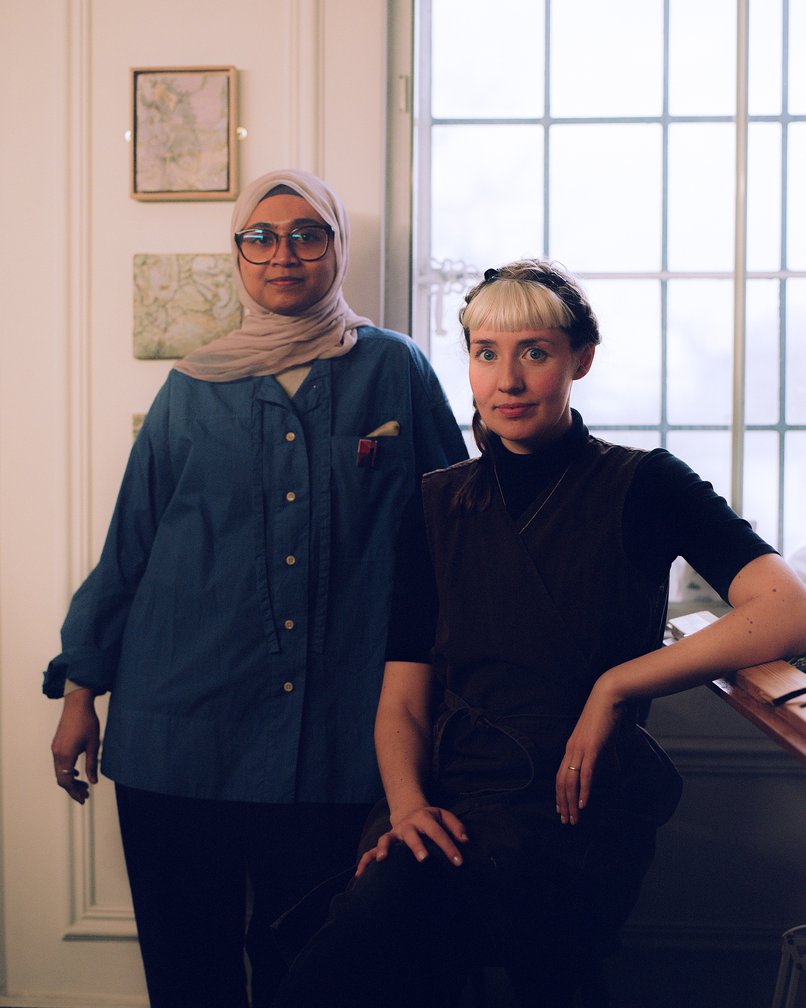
Nowshin I began with natural materials, drawing from my heritage. In Bangladesh, there are six seasons, all humid. I wanted to create fabrics that could be worn all year round. My mother always wore silk sarees, and those memories have stayed with me. I find real joy and purpose in using natural materials. I use silk, cotton, and linen, but mostly silk, because of those strong personal memories. In terms of sourcing, I aim to be as sustainable as possible. I avoid generating new waste by buying from suppliers who collect unused industrial yarns, and I dye the threads myself. For me, sustainability isn’t just about using organic or recycled materials. It’s also about shifting mindsets. Through my workshops, I try to help people understand how fabrics are made, encouraging them to value the process and make more thoughtful, conscious choices when it comes to textiles and consumption.
Juliet I work with clay, and one of clay’s beauties is that it’s endlessly recyclable. If a piece cracks, you can break it down and reuse it. Even fired pieces can be ground into grog and added to new clay which can add strength. Some of my collection pieces are made from fired fragments, creating a collage of exploration. I also set these ceramic fragments in jesmonite. I collect found objects: plastic bits from the street or mesh from fencing that sometimes is found protecting the newly discovered petroglyphs I’ve visited. I love the idea of these layers, woven textures protecting something lasting. Clay feels like an amalgam of flora, fauna, minerals, everything that’s broken down into this microcosm of life. It’s taken thousands of years to form. In that way, a little universe of its own. I’ve started collecting clay from different places too, which I process and use to layer stories from those locations.
Juliet I work with clay, and one of clay’s beauties is that it’s endlessly recyclable. If a piece cracks, you can break it down and reuse it. Even fired pieces can be ground into grog and added to new clay which can add strength. Some of my collection pieces are made from fired fragments, creating a collage of exploration. I also set these ceramic fragments in jesmonite. I collect found objects: plastic bits from the street or mesh from fencing that sometimes is found protecting the newly discovered petroglyphs I’ve visited. I love the idea of these layers, woven textures protecting something lasting. Clay feels like an amalgam of flora, fauna, minerals, everything that’s broken down into this microcosm of life. It’s taken thousands of years to form. In that way, a little universe of its own. I’ve started collecting clay from different places too, which I process and use to layer stories from those locations.
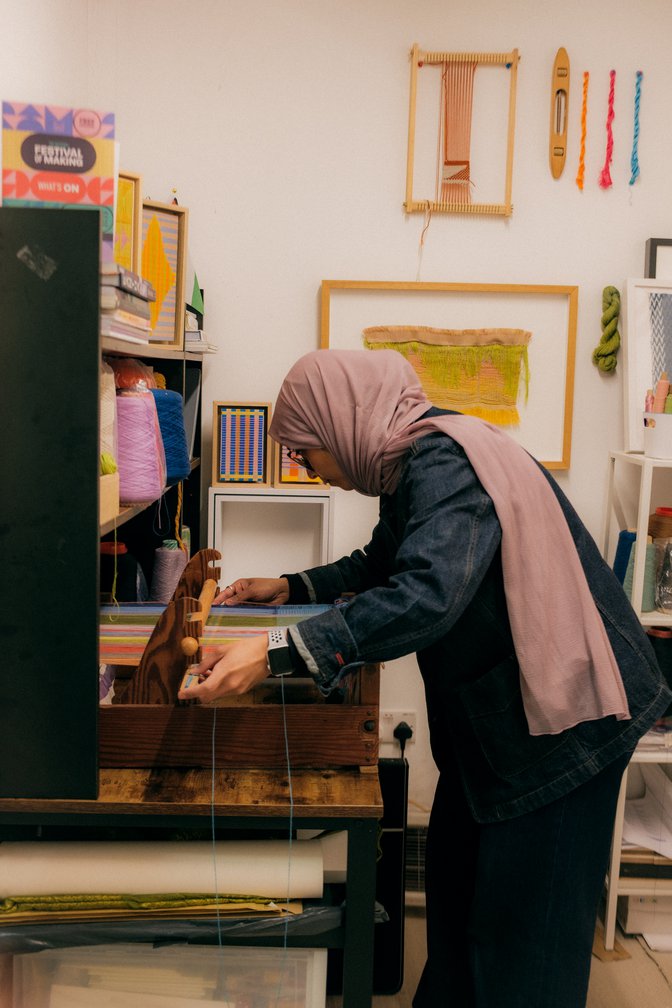
Molly Historically, textiles and ceramics have been categorised as craft, but that distinction has evolved. How do you see your work contributing to the ongoing dialogue about the distinction between craft and fine art?
Nowshin I’ve shown my work in both craft and art shows to observe the response, and found my work sits at the intersection. Craft audiences appreciate the technique. Art audiences focus on composition, colour, and precision. General audiences are just fascinated by the technique itself and want to try it. My work doesn’t sit clearly in one category, but I do see it as art. It’s handcrafted, yes, but it deserves to be considered as fine art.
Juliet I come from a fine art background. At the Royal College of Art, I studied ceramics and glass alongside people from both high craft and fine art backgrounds. We learned from each other. The boundaries are blurring. It’s more about how the work is seen in its own right. It’s not about functionality; it’s about the storytelling, the ideas. That’s where both our practices align.
Nowshin I’ve shown my work in both craft and art shows to observe the response, and found my work sits at the intersection. Craft audiences appreciate the technique. Art audiences focus on composition, colour, and precision. General audiences are just fascinated by the technique itself and want to try it. My work doesn’t sit clearly in one category, but I do see it as art. It’s handcrafted, yes, but it deserves to be considered as fine art.
Juliet I come from a fine art background. At the Royal College of Art, I studied ceramics and glass alongside people from both high craft and fine art backgrounds. We learned from each other. The boundaries are blurring. It’s more about how the work is seen in its own right. It’s not about functionality; it’s about the storytelling, the ideas. That’s where both our practices align.
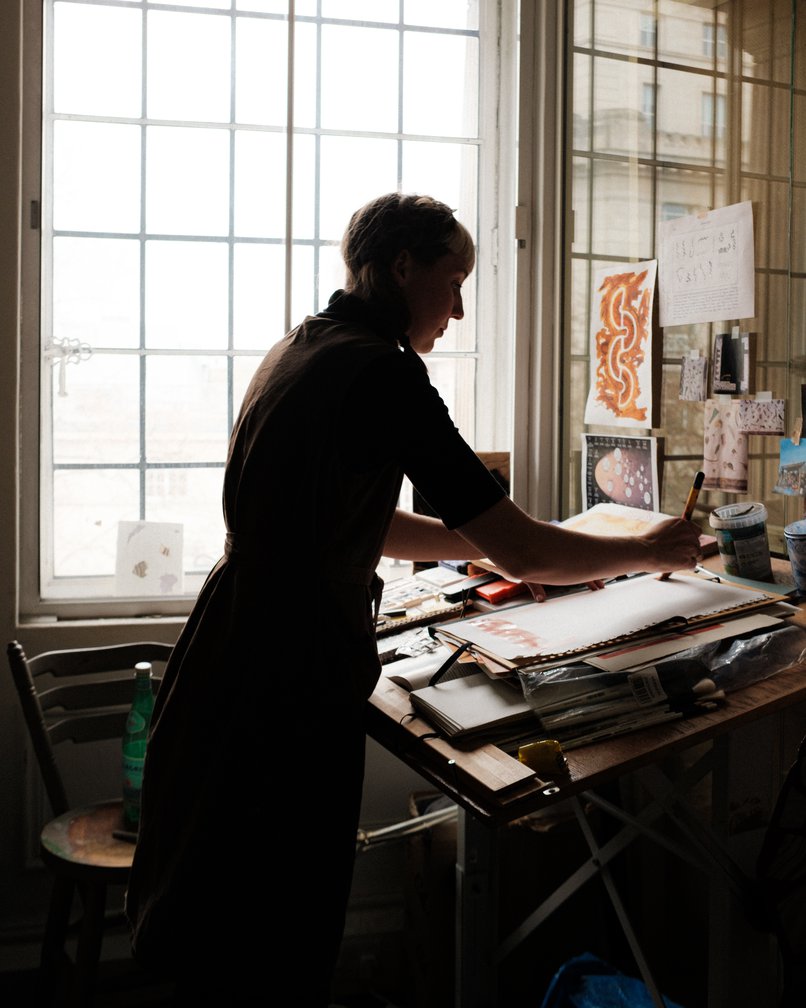
Molly In relation to clay, sculptors have always used it to model forms before casting in bronze or plaster. Clay has always been present in fine art, even if not always recognised as the final work. Your practice seems to honour that material history, Juliet.
Juliet Exactly. Clay’s been part of the process for centuries, even if it wasn’t the end result. I’m interested in letting it be the final form. That definitely resonates with how Nowshin approaches winding, not just as a preparatory technique, but as a final art form in its own right.
Molly How do you both envision your practices evolving? Are there any future directions or projects you’d like to share?
Juliet Exactly. Clay’s been part of the process for centuries, even if it wasn’t the end result. I’m interested in letting it be the final form. That definitely resonates with how Nowshin approaches winding, not just as a preparatory technique, but as a final art form in its own right.
Molly How do you both envision your practices evolving? Are there any future directions or projects you’d like to share?
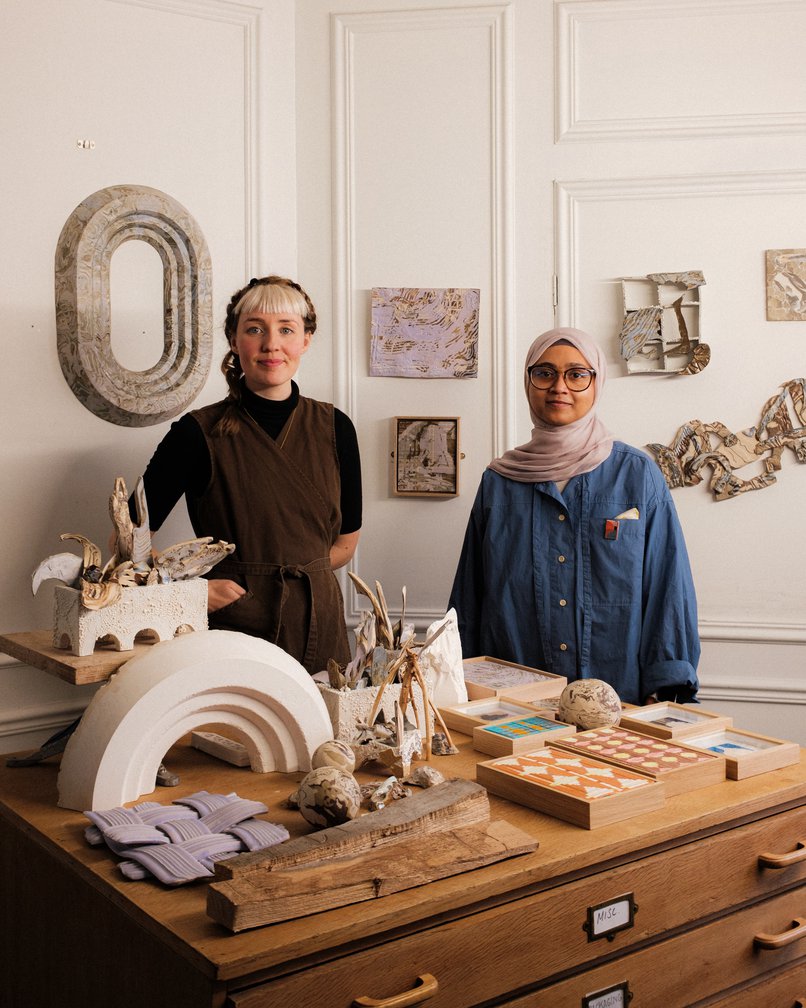
Nowshin I’m currently working on some collaborative projects and doing a residency at a textile hub. I can’t share much yet, but it’s exciting to see how my work might translate when seen through another discipline, maybe with added functionality. I want to scale up, create larger pieces, maybe installations, to see how people engage with them in different spaces. That’s my next push. It’s very labour-intensive, but I’m looking forward to the challenge. I’m also working with some architects to explore new applications.
Juliet I have a few group shows coming up this summer and I am focusing on a new body of work after my solo show Assemblage at Frestonian Gallery in June 2024. I’ve got a few group shows coming up too, but right now I’m just enjoying making. It’s all about discovery. The making informs the making. That’s what keeps me excited.
Molly Coffey, Curator
Photography by Nathan Grace
Juliet I have a few group shows coming up this summer and I am focusing on a new body of work after my solo show Assemblage at Frestonian Gallery in June 2024. I’ve got a few group shows coming up too, but right now I’m just enjoying making. It’s all about discovery. The making informs the making. That’s what keeps me excited.
Molly Coffey, Curator
Photography by Nathan Grace