article In conversation with
Georgie McEwan
In conversation with
Georgie McEwan
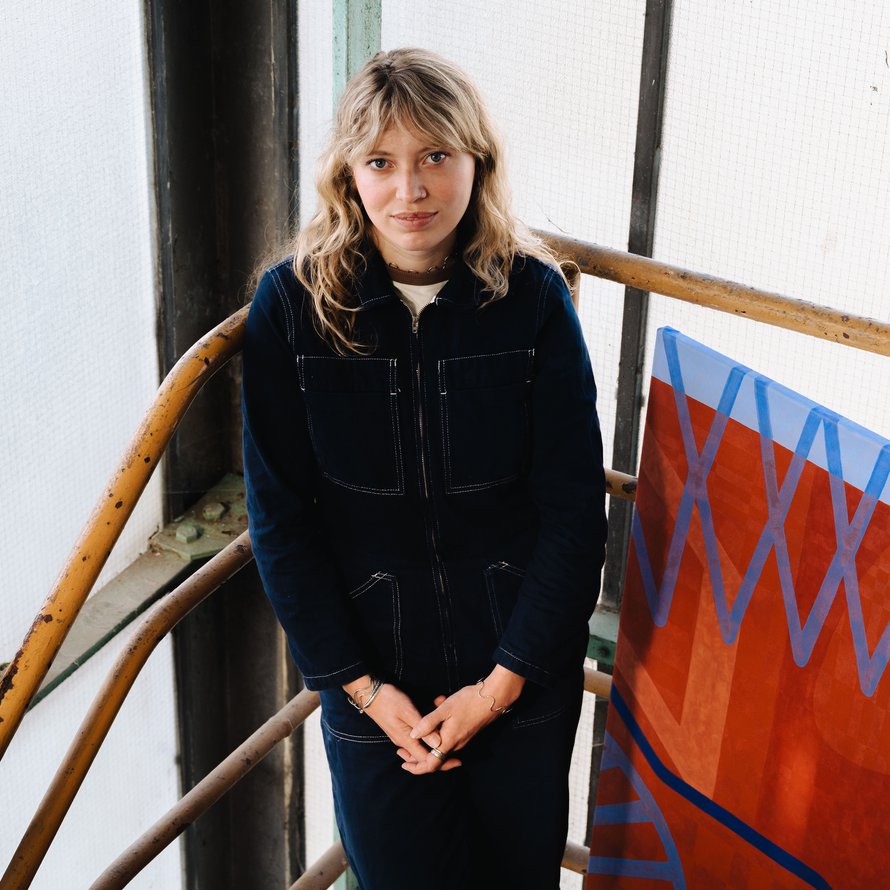
In conversation with Georgie McEwan
about collecting forms, embracing chance
and building dreamlike spaces through painting.
about collecting forms, embracing chance
and building dreamlike spaces through painting.
In conversation with Georgie McEwan
about collecting forms, embracing chance
and building dreamlike spaces through painting.
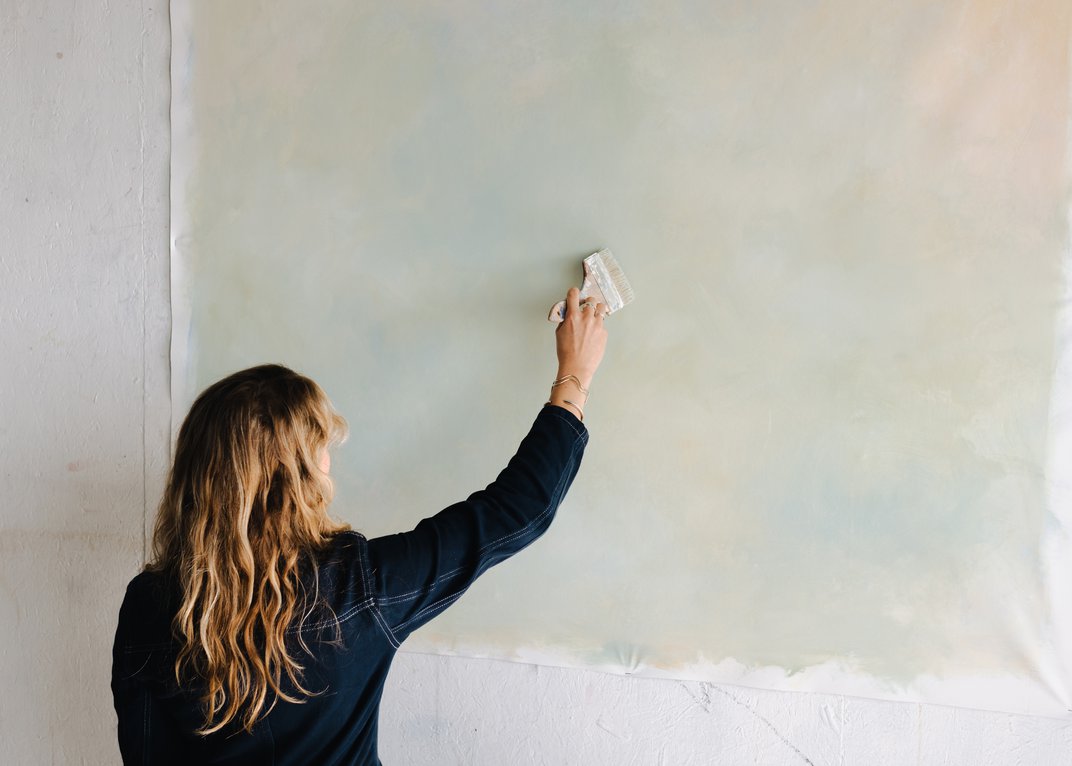
Working across painting and spatial design, Georgie McEwan’s practice begins with a curiosity for the details that surround us, collecting shapes, patterns and traces from everyday life to build surreal worlds where architecture and imagination intersect.
We visited Georgie in her London studio to discuss the archive of everyday forms that underpins her practice, the influence of architecture on her thinking, and how play, collage and chance shape her approach to making.
We visited Georgie in her London studio to discuss the archive of everyday forms that underpins her practice, the influence of architecture on her thinking, and how play, collage and chance shape her approach to making.
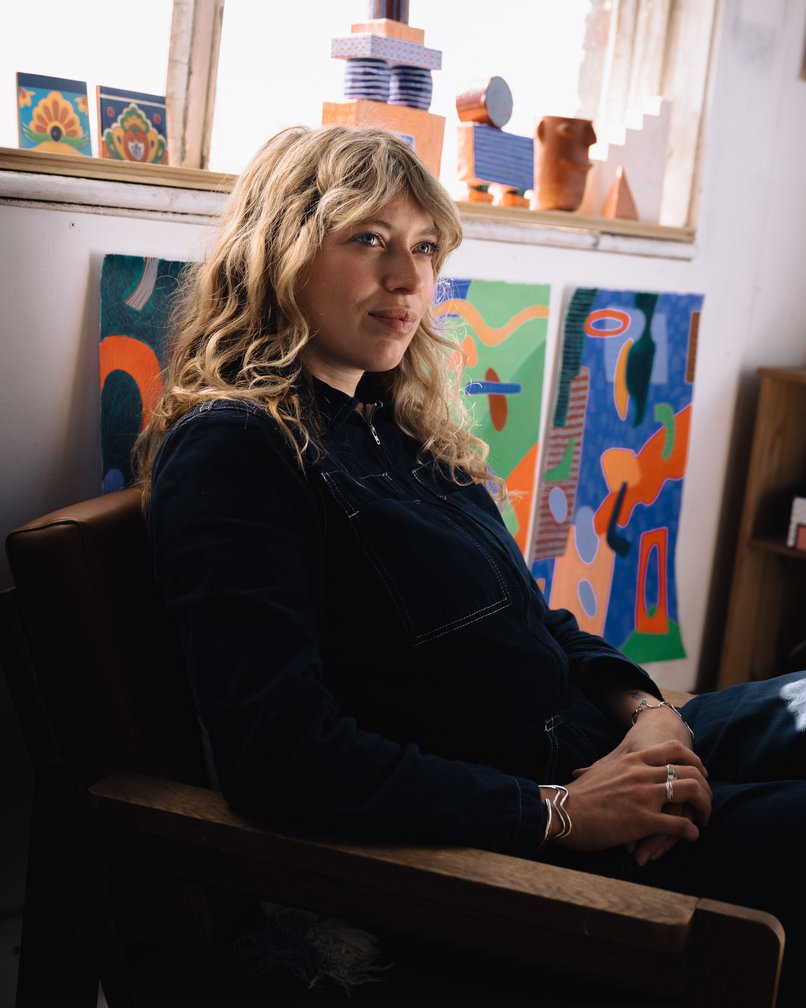
Having studied architecture before moving into painting, your practice draws on spatial design to create surreal, dreamlike worlds. Where does the process of constructing these imagined spaces begin, and how has your architectural background shaped the way you think about composition?
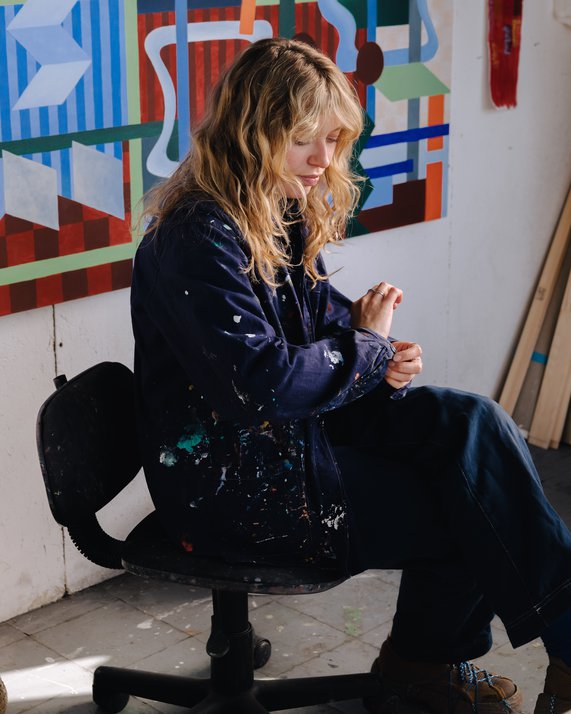
My process starts with the collection of fragments from everyday life. I’m interested in details, shapes and traces which are overlooked, forgotten and discarded. In reinterpreting these fragments in my paintings, the surreal worlds I create become an assemblage of familiarity, and a method through which to celebrate the poetry of the everyday.
In this process I’m often drawn to architectural forms, which I think will always exist as a lens I look at the world with. My approach to composition is spatially driven, with a lot of consideration given to the relationship between forms. I’m often imagining 2d shapes as 3d elements in a space, entangled or overlapping into nonsensical structures the viewer can lose themself in.
I find a lot of joy in painting this way, as I can rebel against architectural rules within a surreal landscape from warping grids, distorted perspectives, floating gravity and wobbly lines.
In our studio visit, you spoke about building an archive of shapes and form gathered from everyday life, which can be cut, arranged and combined to create your compositions. Could you tell us more about this process and how these fragments evolve into your dynamic, imagined worlds.
The archive of shapes includes anything I encounter in the world around me, from a pattern of roof tiles, the shadow of a handrail, the outline of a puddle. Recently I’ve been sketching a lot of chair details their warped shadows and tangled legs of those unloved and discarded on the street.
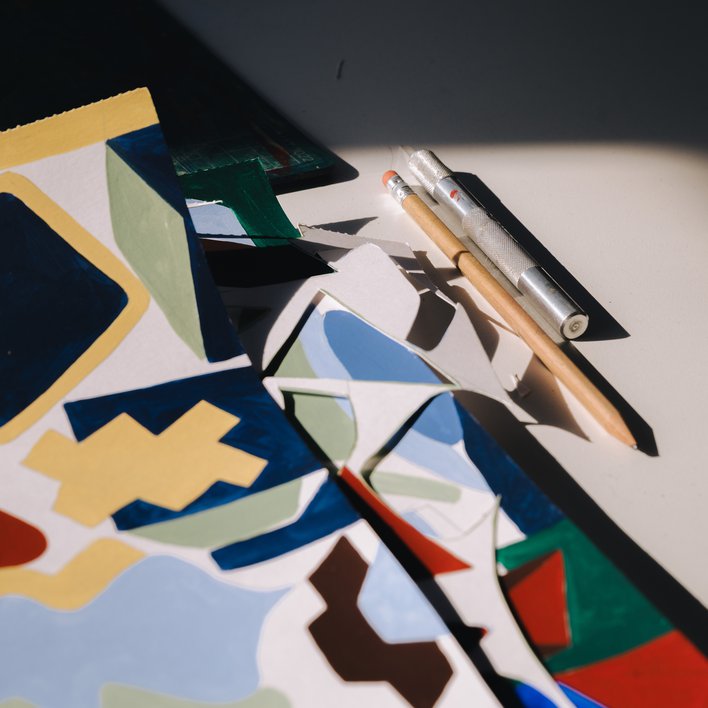
This collection is a way of working with chance encounters, a methodology that evolved through my research into Dadaist poetic methods for example constructing a poem from newspaper cuttings of words. In reassembling these elements, new meanings can be found in the fragments as a way to prioritise imagination.
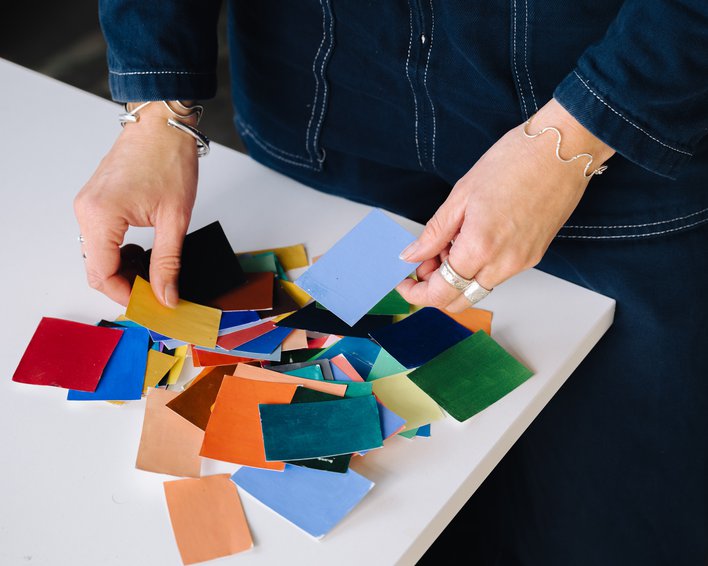
Collage uses the same approach, allowing me to test compositions in a playful way using these cut outs and a great tool for when I’m stuck for inspiration! Having these shapes as physical pieces to cut, paint and move around makes it a really enjoyable process and allows for endless experimentation before I put paint to canvas.
My process starts with the collection of fragments from everyday life. I’m interested in details, shapes and traces which are overlooked, forgotten and discarded. In reinterpreting these fragments in my paintings, the surreal worlds I create become an assemblage of familiarity, and a method through which to celebrate the poetry of the everyday.
In this process I’m often drawn to architectural forms, which I think will always exist as a lens I look at the world with. My approach to composition is spatially driven, with a lot of consideration given to the relationship between forms. I’m often imagining 2d shapes as 3d elements in a space, entangled or overlapping into nonsensical structures the viewer can lose themself in.
I find a lot of joy in painting this way, as I can rebel against architectural rules within a surreal landscape from warping grids, distorted perspectives, floating gravity and wobbly lines.
In our studio visit, you spoke about building an archive of shapes and form gathered from everyday life, which can be cut, arranged and combined to create your compositions. Could you tell us more about this process and how these fragments evolve into your dynamic, imagined worlds.
The archive of shapes includes anything I encounter in the world around me, from a pattern of roof tiles, the shadow of a handrail, the outline of a puddle. Recently I’ve been sketching a lot of chair details their warped shadows and tangled legs of those unloved and discarded on the street.
This collection is a way of working with chance encounters, a methodology that evolved through my research into Dadaist poetic methods for example constructing a poem from newspaper cuttings of words. In reassembling these elements, new meanings can be found in the fragments as a way to prioritise imagination.
Collage uses the same approach, allowing me to test compositions in a playful way using these cut outs and a great tool for when I’m stuck for inspiration! Having these shapes as physical pieces to cut, paint and move around makes it a really enjoyable process and allows for endless experimentation before I put paint to canvas.
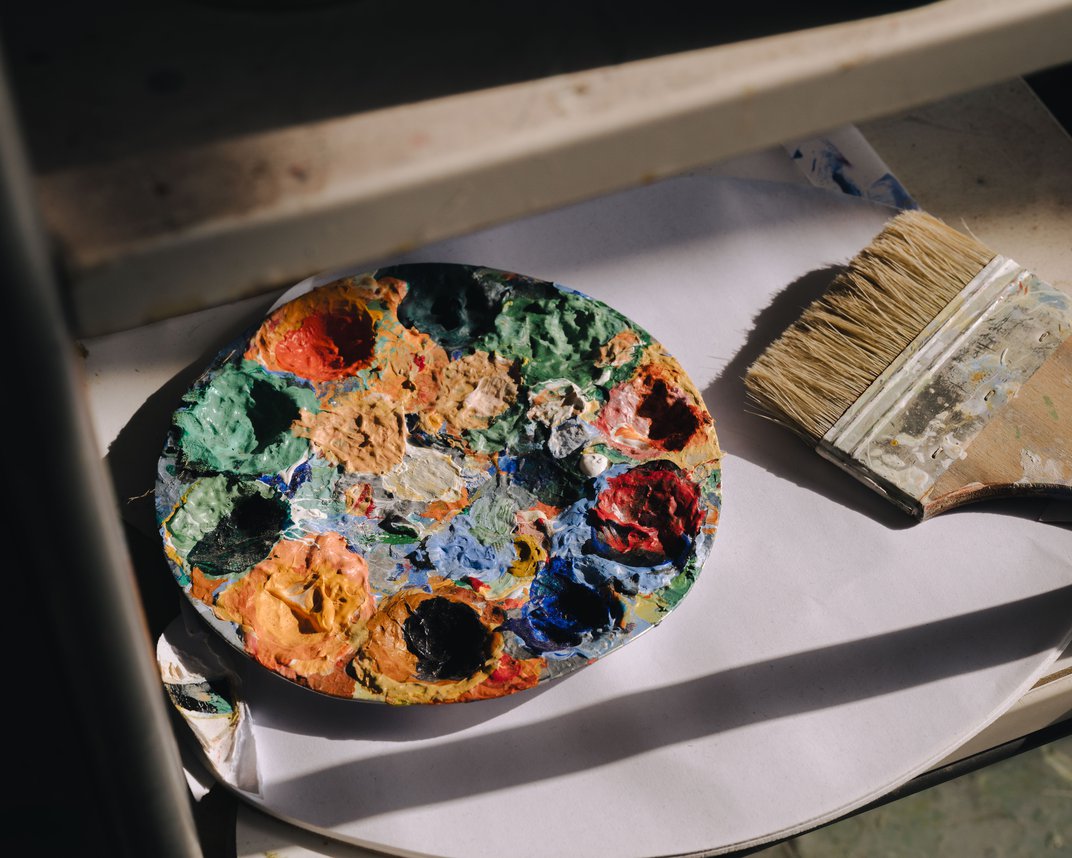
‘I’ve been really enjoying this shift in my more recent pieces with colours that feel softer, more layered and with a richer depth achieved through building up many layers of diluted paint.’
- Georgie McEwan
A sense of play runs through your work and their titles. What role does playfulness have in your creative process, and how does it influence the way you experiment with composition, materials, or ideas?
I’m often fighting against a rigidity and precision in my work that is hard to unlearn from working in architecture. Using playfulness in my practice really helps to break free from this. As well as making the process more enjoyable, it has taught me to embrace mistakes, mess and imperfections as this so often leads to new ideas and unintended directions.
Collage is one way of inviting play into my 2d work, but I also like to translate this into my 3d work, for example the assemblage of found objects into paper maché sculptural works.
In a process that is so different from architectural digital 3d modelling, the physical act of playfully rearranging and manipulating discarded objects into new works and maquettes allows me to think spatially through making and is something I’m trying to put a greater focus on in my practice going forward, alongside my paintings.
Colour plays a powerful role in shaping the atmosphere of your paintings. While earlier works often featured ultramarine blues, your recent work has shifted towards earthier tones. How do you approach colour when developing a new body of work, and what has influenced this evolution?
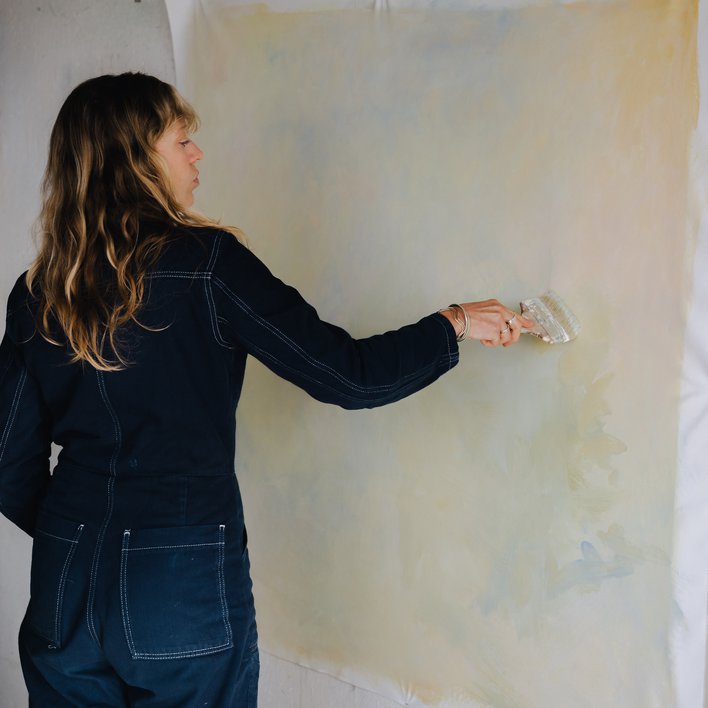
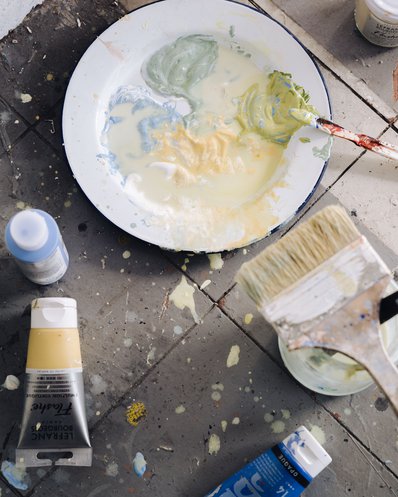
I’ve been really enjoying this shift in my more recent pieces with colours that feel softer, more layered and with a richer depth achieved through building up many layers of diluted paint. Using an earthier colour palette feels more considered and has been a useful constraint to work with given that I am an incessant maximalist and am happiest when using as many (clashing) colours as I possibly can on the canvas.
This was partly influenced by an artist residency I did last summer outside Berlin, where my studio was surrounded by forest and level with the trees. The softness of the changing dappled light and tones of green that poured into the space influenced a new series of paintings that I’m still developing. It also made me enjoy the painting process in a new way, instead of painting solid blocks of vibrant colours, this more recent layered approach adds a more spatial quality and texture to the works.
I’m often fighting against a rigidity and precision in my work that is hard to unlearn from working in architecture. Using playfulness in my practice really helps to break free from this. As well as making the process more enjoyable, it has taught me to embrace mistakes, mess and imperfections as this so often leads to new ideas and unintended directions.
Collage is one way of inviting play into my 2d work, but I also like to translate this into my 3d work, for example the assemblage of found objects into paper maché sculptural works.
In a process that is so different from architectural digital 3d modelling, the physical act of playfully rearranging and manipulating discarded objects into new works and maquettes allows me to think spatially through making and is something I’m trying to put a greater focus on in my practice going forward, alongside my paintings.
Colour plays a powerful role in shaping the atmosphere of your paintings. While earlier works often featured ultramarine blues, your recent work has shifted towards earthier tones. How do you approach colour when developing a new body of work, and what has influenced this evolution?
I’ve been really enjoying this shift in my more recent pieces with colours that feel softer, more layered and with a richer depth achieved through building up many layers of diluted paint. Using an earthier colour palette feels more considered and has been a useful constraint to work with given that I am an incessant maximalist and am happiest when using as many (clashing) colours as I possibly can on the canvas.
This was partly influenced by an artist residency I did last summer outside Berlin, where my studio was surrounded by forest and level with the trees. The softness of the changing dappled light and tones of green that poured into the space influenced a new series of paintings that I’m still developing. It also made me enjoy the painting process in a new way, instead of painting solid blocks of vibrant colours, this more recent layered approach adds a more spatial quality and texture to the works.
‘I’m often fighting against a rigidity and precision in my work that is hard to unlearn from working in architecture. Using playfulness in my practice really helps to break free from this.’
- Georgie McEwan
Do you have any upcoming projects or practice developments you would like to share with us?
Since moving to a larger studio space this year, I’ve been really enjoying painting much larger works on canvas and developing a softer painting style as I work on this new series. I’ve been putting more emphasis on the spatial design side of my practice and how my 2d and 3d works inform and relate to each other. I’ve been designing architectural installations that draw on my archive of forms, translated into large scale sculptural spaces which I hope to announce the result of next year!
Alongside this, I am launching my new wallpaper brand ‘Paste’ with my sister this autumn. The designs feature sections from my paintings that I have adapted into a range of unique repeat patterns, on a mission to bring art into the home in a more accessible (and very over the top) way.
I will also be painting a mural at We Out Here festival this August, which I’m really excited about.
Since moving to a larger studio space this year, I’ve been really enjoying painting much larger works on canvas and developing a softer painting style as I work on this new series. I’ve been putting more emphasis on the spatial design side of my practice and how my 2d and 3d works inform and relate to each other. I’ve been designing architectural installations that draw on my archive of forms, translated into large scale sculptural spaces which I hope to announce the result of next year!
Alongside this, I am launching my new wallpaper brand ‘Paste’ with my sister this autumn. The designs feature sections from my paintings that I have adapted into a range of unique repeat patterns, on a mission to bring art into the home in a more accessible (and very over the top) way.
I will also be painting a mural at We Out Here festival this August, which I’m really excited about.
Want to be part of our network? Submit your work and join Artiq's growing community of artists.