article In conversation with
Jacob Wolff
In conversation with
Jacob Wolff
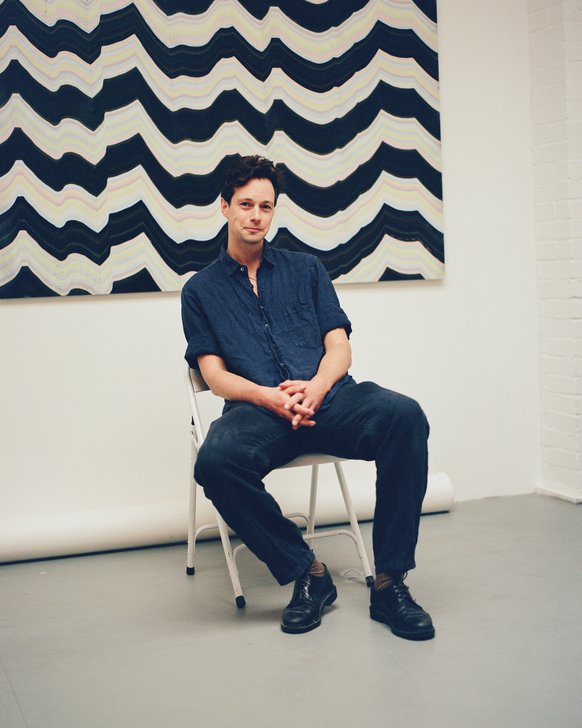
In conversation with Jacob Wolff
about materiality, scale and what
gives life to an artwork.
about materiality, scale and what
gives life to an artwork.
In conversation with Jacob Wolff
about materiality, scale and what
gives life to an artwork.
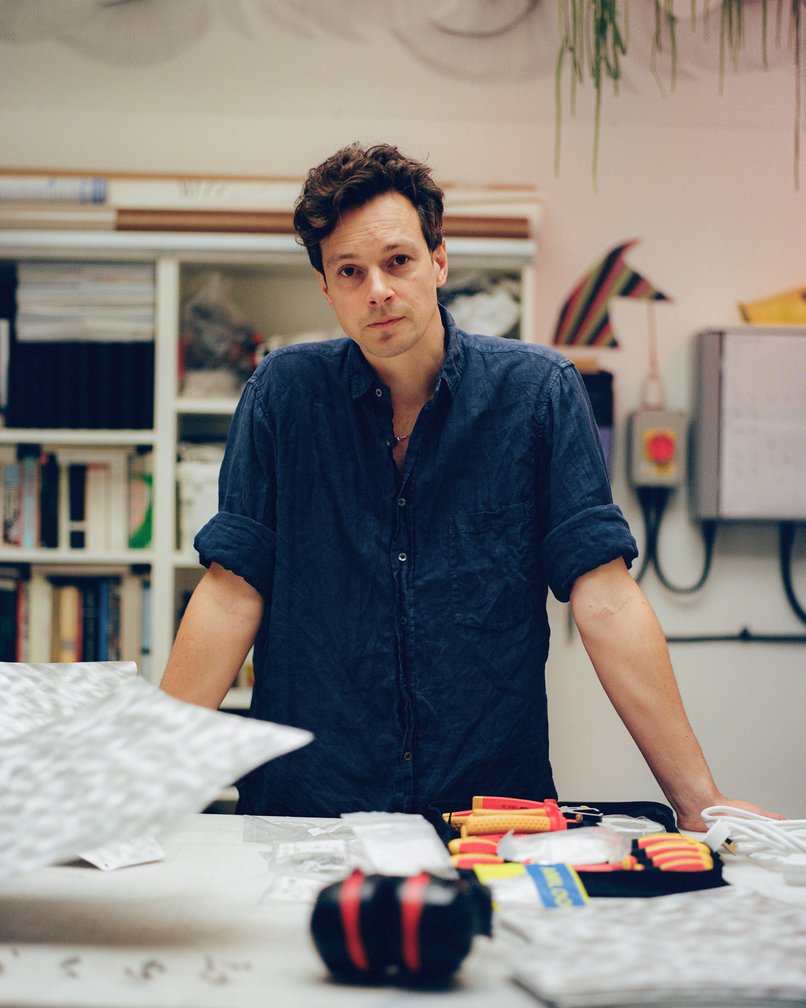
Jacob Wolff is a London based artist using shards of glass and spray paint to transfer layers of pigment from wax paper onto panel. His rhythmic, meditative process explores light, colour, and pattern to produce works that invite sustained engagement, reflection, and quiet contemplation.
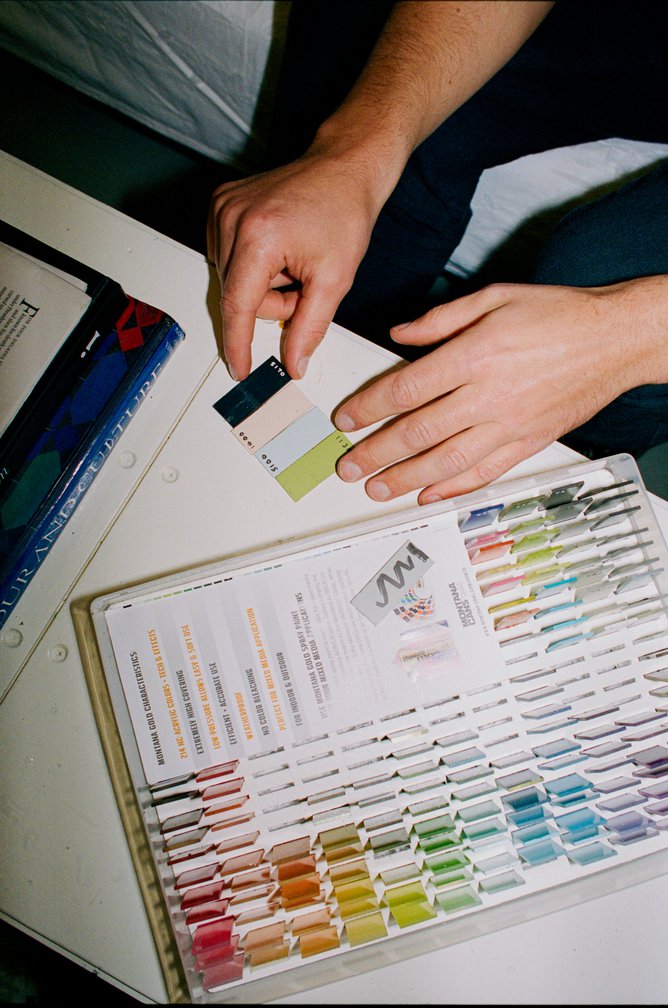
Artiq Your practice entails multiple processes of transference from your starting point with fragments of glass to spray paint on paper to panel. Could you share with us more about your approach to materiality? How do you decide which surface to use for a given piece? What specific qualities matter most to you?
Jacob Whatever material I use, I have to be able to work with it myself in an intuitive way. I need to be able to experiment otherwise it’s harder to get ideas. When I started painting on glass at art school, one of them smashed. I noticed how unique the fragments were, and they became my templates for making new paintings.
Artiq Your work balances between systems and natural chaos, both embracing elements outside of your control (such as the natural breaks of glass panels) as well as repetition, symmetry and patterns. Can you tell us more about your process and how you balance these two sides of your practice and how it informs your final work?
Jacob The unexpected, uncontrolled, chaotic element is what gives life to an artwork, but it needs a structure to reveal itself. A single shard of glass might not look significant, but if its lines are repeated its character is brought out. Over time I have developed different forms to do this in, such as nets, trees and spirals. I’m aiming for an artwork that invites contemplation because of its order, but can’t be exhausted because of that element of chaos. It’s unplanned, and therefore it offers no easy understanding.
Jacob Whatever material I use, I have to be able to work with it myself in an intuitive way. I need to be able to experiment otherwise it’s harder to get ideas. When I started painting on glass at art school, one of them smashed. I noticed how unique the fragments were, and they became my templates for making new paintings.
Artiq Your work balances between systems and natural chaos, both embracing elements outside of your control (such as the natural breaks of glass panels) as well as repetition, symmetry and patterns. Can you tell us more about your process and how you balance these two sides of your practice and how it informs your final work?
Jacob The unexpected, uncontrolled, chaotic element is what gives life to an artwork, but it needs a structure to reveal itself. A single shard of glass might not look significant, but if its lines are repeated its character is brought out. Over time I have developed different forms to do this in, such as nets, trees and spirals. I’m aiming for an artwork that invites contemplation because of its order, but can’t be exhausted because of that element of chaos. It’s unplanned, and therefore it offers no easy understanding.
Artiq Your work embraces colour and often works in high contrasts. Could you share more about how you gain inspiration for your use of colour? How does this change between your works on paper (which embrace the existing colour of the paper) and your canvases (where you are selecting colour patterns)?
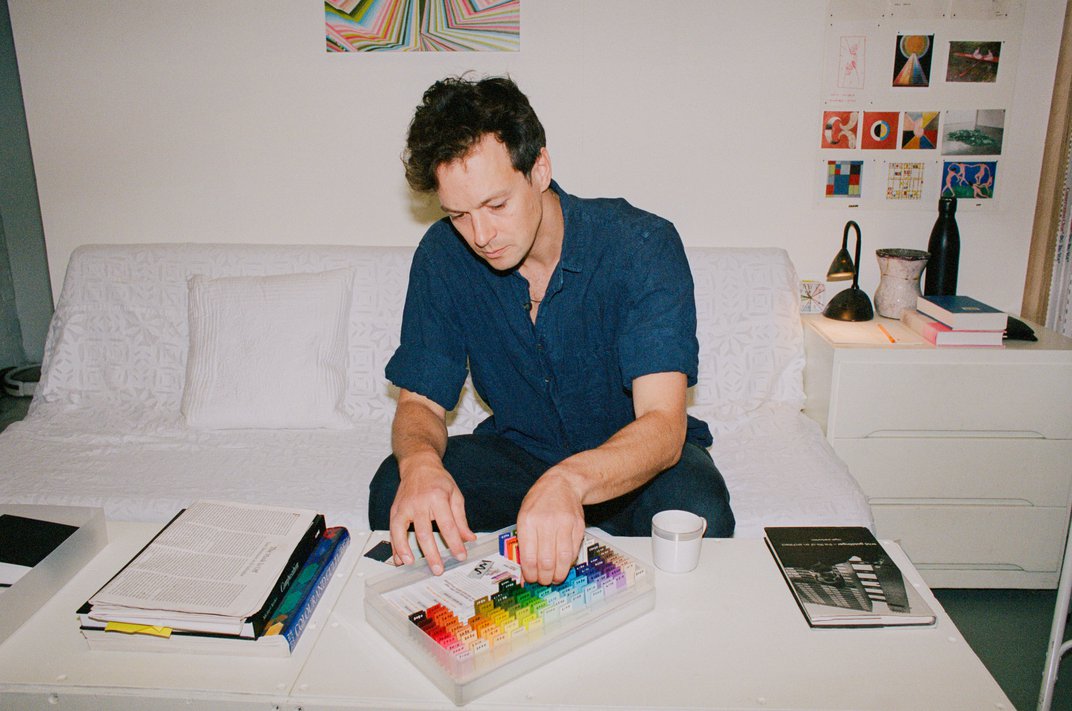
Jacob I build patterns with it in the same way I make forms with the glass shards. I have swatches with the hundred or so colours I use so I can try out different combinations and sequences. I use gradients a lot, or all the lightest and darkest tones. Often I think of them as chords, using them in groups of three.
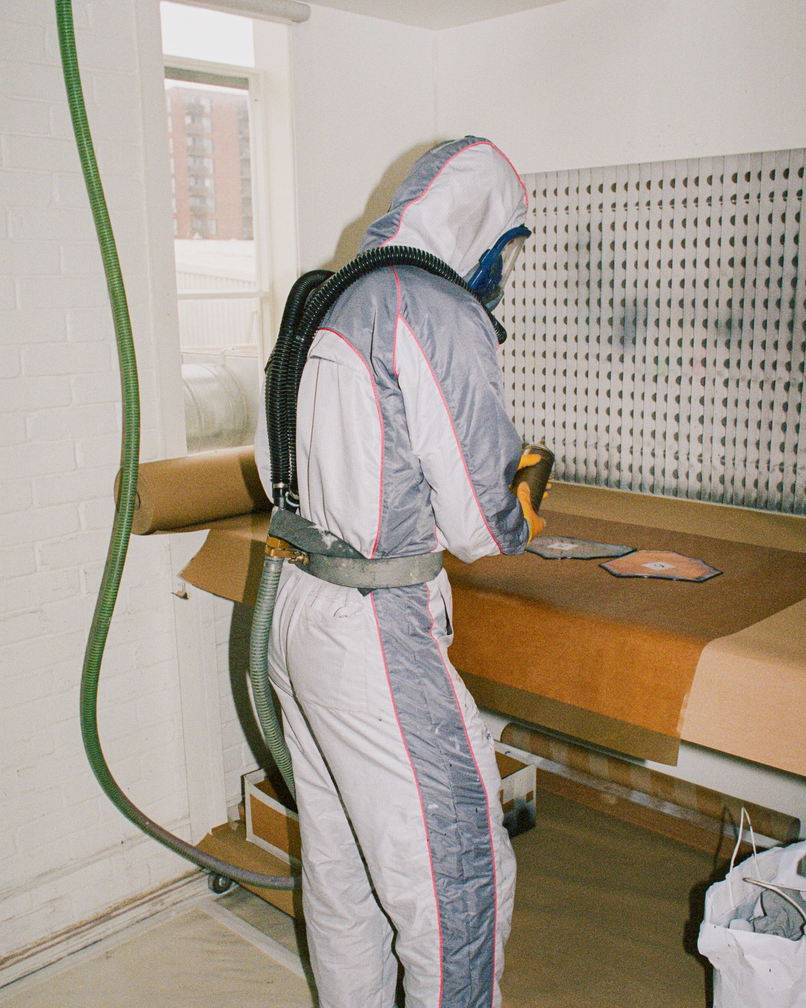
When I’ve chosen the colours I load the aerosol cans into a tray in my spray booth. They are laid out in a grid. I enjoy making my own ‘tools’ - this acts a bit like a keyboard. I can pick the cans up in different sequences - from left or right, up or down.
Sometimes I will find a readymade set of colours. For example, I recently made a painting using Van Gogh’s ‘Bedroom’ after reading his letter to Theo in which he lists all the colours he used in it. What I’m looking for is an underlying logic which might not be consciously recognised by the viewer but will hopefully be felt.
Artiq How do you think about scale, especially when you move from small works to large wall transfers or site specific installations? How do you approach interior design spaces?
Jacob Because I use aerosols instead of a brush there’s less of a distinction between small and large. The spray picks out each incremental movement, so even the biggest works will have areas of microscopic detail.
Working at large scale allows for a greater variety of experience - individual colours blur when seen from a distance and tonal gradients become sculptural.
One source for a lot of my work is a recently rediscovered mural by Giacomo Balla for a Futurist night club in Rome from the 1920s. It covers the walls and ceiling of the entrance, leading people up the staircase to the dancehall upstairs. This inspired me to work directly on the wall.
Jacob I build patterns with it in the same way I make forms with the glass shards. I have swatches with the hundred or so colours I use so I can try out different combinations and sequences. I use gradients a lot, or all the lightest and darkest tones. Often I think of them as chords, using them in groups of three.
When I’ve chosen the colours I load the aerosol cans into a tray in my spray booth. They are laid out in a grid. I enjoy making my own ‘tools’ - this acts a bit like a keyboard. I can pick the cans up in different sequences - from left or right, up or down.
Sometimes I will find a readymade set of colours. For example, I recently made a painting using Van Gogh’s ‘Bedroom’ after reading his letter to Theo in which he lists all the colours he used in it. What I’m looking for is an underlying logic which might not be consciously recognised by the viewer but will hopefully be felt.
Artiq How do you think about scale, especially when you move from small works to large wall transfers or site specific installations? How do you approach interior design spaces?
Jacob Because I use aerosols instead of a brush there’s less of a distinction between small and large. The spray picks out each incremental movement, so even the biggest works will have areas of microscopic detail.
Working at large scale allows for a greater variety of experience - individual colours blur when seen from a distance and tonal gradients become sculptural.
One source for a lot of my work is a recently rediscovered mural by Giacomo Balla for a Futurist night club in Rome from the 1920s. It covers the walls and ceiling of the entrance, leading people up the staircase to the dancehall upstairs. This inspired me to work directly on the wall.
Artiq Please tell us about your recent investigations into installations, not only on walls but also your exploration with chandeliers, tables and mirrors. How has your practice extended across mediums?
Jacob Lots of people’s most meaningful experiences of art come from the artworks they live with, whether it’s a painting or a poster. I like the idea of entering everyday life by producing functional artworks. They can make their presence felt over time.
It’s also helpful for an artist to move between mediums. A drawing might inform a sculpture and a painting might suggest a way to make a mirror. I work very methodically so this is a good way of staying fresh.
Artiq Do you have any upcoming projects or new series of work that you would like to share with us?
Jacob I am working on a public sculpture that will be installed on the site of a 19th century train factory. I am also making steel reflectors for a pedestrian underpass on the Northern Line. My research into Futurism and their obsession with speed and technology has been useful.
In the studio I am working on some big multi-panel paintings. I think of my paintings more as very thin sculptures anyway, and this is another way to play with them physically.
Jacob Lots of people’s most meaningful experiences of art come from the artworks they live with, whether it’s a painting or a poster. I like the idea of entering everyday life by producing functional artworks. They can make their presence felt over time.
It’s also helpful for an artist to move between mediums. A drawing might inform a sculpture and a painting might suggest a way to make a mirror. I work very methodically so this is a good way of staying fresh.
Artiq Do you have any upcoming projects or new series of work that you would like to share with us?
Jacob I am working on a public sculpture that will be installed on the site of a 19th century train factory. I am also making steel reflectors for a pedestrian underpass on the Northern Line. My research into Futurism and their obsession with speed and technology has been useful.
In the studio I am working on some big multi-panel paintings. I think of my paintings more as very thin sculptures anyway, and this is another way to play with them physically.