article In conversation with
Philip Maltman
In conversation with
Philip Maltman
In conversation with Philip Maltman
about poetry, process and the value of rebellion
about poetry, process and the value of rebellion
In conversation with Philip Maltman
about poetry, process and the value of rebellion
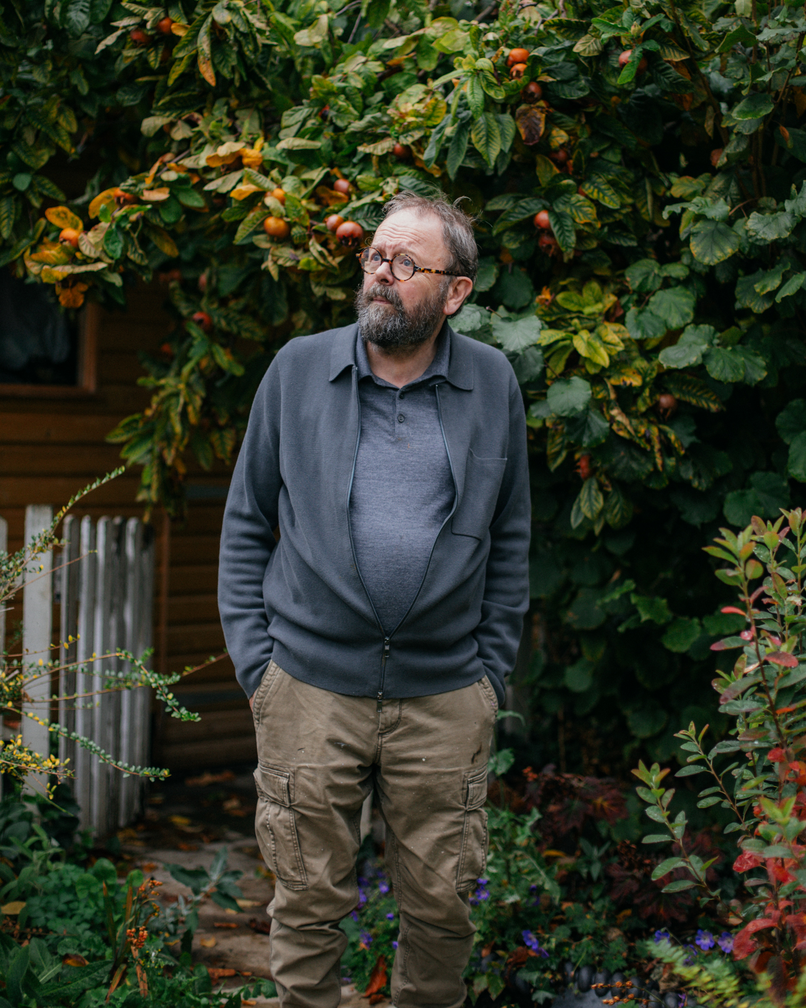
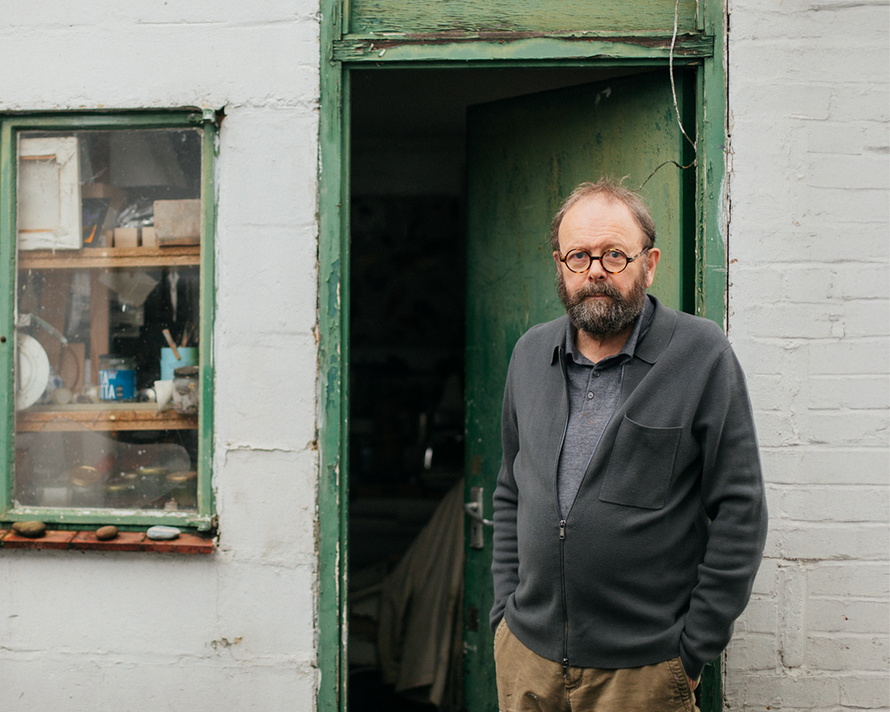
Philip Maltman is a Scottish-born, London-based artist exploring abstraction and landscape through expressive mark-making. Influenced by British Romanticism and modernism, his multidisciplinary practice reflects nature’s changeability, memory and human intervention, balancing observation with intuitive, painterly response.
Having recently curated his work for a prominent London-based capital management firm, we sat down with Philip to learn more about his practice.
Having recently curated his work for a prominent London-based capital management firm, we sat down with Philip to learn more about his practice.
Artiq What is your process for beginning a new work?
Philip As I work very quickly in series, I have to have a number of surfaces ready, and this is usually heavyweight paper or greyboard primed with a coloured oil-based primer. I also prime canvases large and small to work through a series but less of these due to storage needs. I never know when an entirely new series has begun until two or three small works have been completed. So, in a very traditional way I will tentatively sketch out an idea that will usually be resolved into a finished piece. (I don’t like waste.) With larger works I will often use elements from smaller finished paintings as a basic plan of composition. Sometimes there is text to be considered as a starting point and this would be incorporated, written words being painted out in a colour and gesture suggested by the word itself.
Artiq Many of your works feature handwritten text. How did this element develop within your practice, and how do you continue to incorporate the written word today?
Philip Coming from “Burns Country” I aspired to poetry in my teens, and this continued to art college where early influences were Don van Vliet (aka Captain Beefheart) and Robert Rauschenberg allowing me to incorporate the written word as well as mixed media. I wrote poems with black felt pens on white canvases that did not sit well with painting tutors. Hornsey ‘68 had taught me that you should rebel if you felt strongly enough. I continued writing poetry for another 20 years but did not include words on canvas very often until I found Robert Motherwell, Cy Twombly and James Joyce. I have used quotes from Joyce in painting. I write references to music and song titles on current work as well as names and numbers and I am always looking for other ways to incorporate words as they are as much a passion as painting.
Philip As I work very quickly in series, I have to have a number of surfaces ready, and this is usually heavyweight paper or greyboard primed with a coloured oil-based primer. I also prime canvases large and small to work through a series but less of these due to storage needs. I never know when an entirely new series has begun until two or three small works have been completed. So, in a very traditional way I will tentatively sketch out an idea that will usually be resolved into a finished piece. (I don’t like waste.) With larger works I will often use elements from smaller finished paintings as a basic plan of composition. Sometimes there is text to be considered as a starting point and this would be incorporated, written words being painted out in a colour and gesture suggested by the word itself.
Artiq Many of your works feature handwritten text. How did this element develop within your practice, and how do you continue to incorporate the written word today?
Philip Coming from “Burns Country” I aspired to poetry in my teens, and this continued to art college where early influences were Don van Vliet (aka Captain Beefheart) and Robert Rauschenberg allowing me to incorporate the written word as well as mixed media. I wrote poems with black felt pens on white canvases that did not sit well with painting tutors. Hornsey ‘68 had taught me that you should rebel if you felt strongly enough. I continued writing poetry for another 20 years but did not include words on canvas very often until I found Robert Motherwell, Cy Twombly and James Joyce. I have used quotes from Joyce in painting. I write references to music and song titles on current work as well as names and numbers and I am always looking for other ways to incorporate words as they are as much a passion as painting.
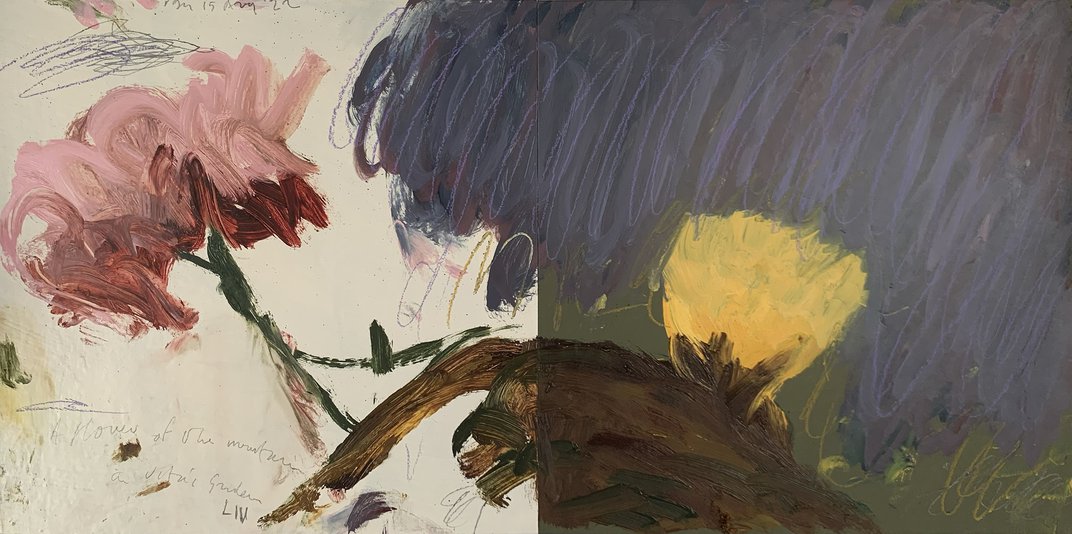
In Vita’s Garden 54 - A Flower of the Mountain
Artiq Do you use your own handwriting or adapt its style to suit each piece, and how does this choice influence the final outcome?
Philip I use my handwriting varying only between fast and slow, large and small. If I want to give a word or phrase extra meaning it might be heavily painted with decorative devices such as the titles in my “Italy” series with each region’s name painted differently. I have also used words, usually titles, to overpaint in a very loose graffiti-like way. The idea of badly written or illegible lettering is very much associated with Cy Twombly and there are volumes of literature on how and why he worked like that. However, to deliberately write in a borrowed or false style would be like painting in the same way and whilst borrowing from art history has gone on for ever deliberate copying of style without attribution would be dishonest. I have worked extensively from Aelbert Cuyp and John Constable with clear titles referring to the originals written on the paintings.
Artiq How do you balance the figurative and gestural aspects of your compositions? Where do you find inspiration?
Philip All good art aims at a synthesis between elements. Figuration without a gestural element from the start, would be prosaic. The use of coarse means such as thick brushes, cloths and hands (in gloves), in the early stages of a work, bring about various accidents that have a revelatory part to play in the process requiring modification, clarification, obfuscation and often, obliteration. Inspiration may come from a scuffed mark, or a stray word left standing. Although living and breathing painting leaves little necessity for inspiration. Subject matter may be seen as inspiring and can be a problem. At this point in my work, I can revisit many areas if in need of a subject but one is always on the lookout for new stimulation; the most recent being a hazy view across London from a hill at sunset that has led to a mainly monochrome set of paintings.
Philip I use my handwriting varying only between fast and slow, large and small. If I want to give a word or phrase extra meaning it might be heavily painted with decorative devices such as the titles in my “Italy” series with each region’s name painted differently. I have also used words, usually titles, to overpaint in a very loose graffiti-like way. The idea of badly written or illegible lettering is very much associated with Cy Twombly and there are volumes of literature on how and why he worked like that. However, to deliberately write in a borrowed or false style would be like painting in the same way and whilst borrowing from art history has gone on for ever deliberate copying of style without attribution would be dishonest. I have worked extensively from Aelbert Cuyp and John Constable with clear titles referring to the originals written on the paintings.
Artiq How do you balance the figurative and gestural aspects of your compositions? Where do you find inspiration?
Philip All good art aims at a synthesis between elements. Figuration without a gestural element from the start, would be prosaic. The use of coarse means such as thick brushes, cloths and hands (in gloves), in the early stages of a work, bring about various accidents that have a revelatory part to play in the process requiring modification, clarification, obfuscation and often, obliteration. Inspiration may come from a scuffed mark, or a stray word left standing. Although living and breathing painting leaves little necessity for inspiration. Subject matter may be seen as inspiring and can be a problem. At this point in my work, I can revisit many areas if in need of a subject but one is always on the lookout for new stimulation; the most recent being a hazy view across London from a hill at sunset that has led to a mainly monochrome set of paintings.
Artiq In what ways does sustainability influence your artistic practice?
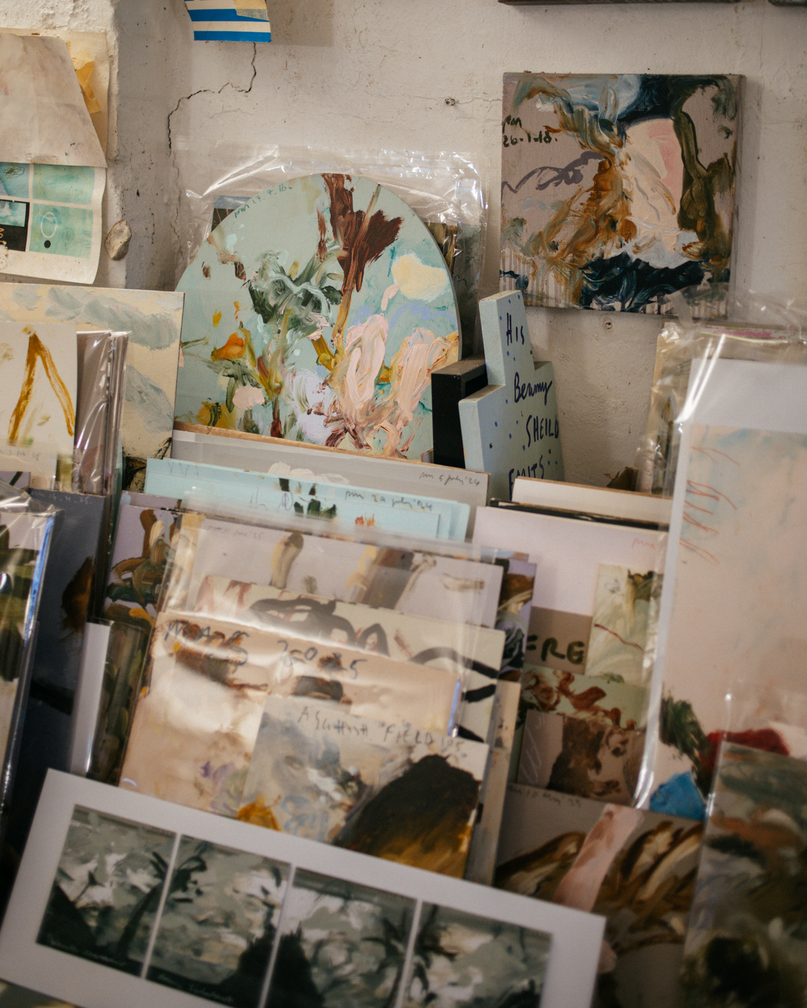
Philip Sustainability is a difficult concept when working with oils and solvents. However, very little gets thrown away and white spirit is recycled with paint sludge being re-used or disposed of responsibly. I think to be too tidy, clean and organised would take away some of the magic. My studio space is not large, and its limitations aid sustainability. As I said, I do not like waste and I use up all paper or board. I also re-use plastics and rags for mixing and cleaning paint. Whilst I produce a great deal of work and sell regularly, I do think my children and grandchildren will have a mountain to sell or dispose of when I am no longer here. For this they may curse or thank me.
Artiq Do you have any upcoming projects that you would like to share with us?
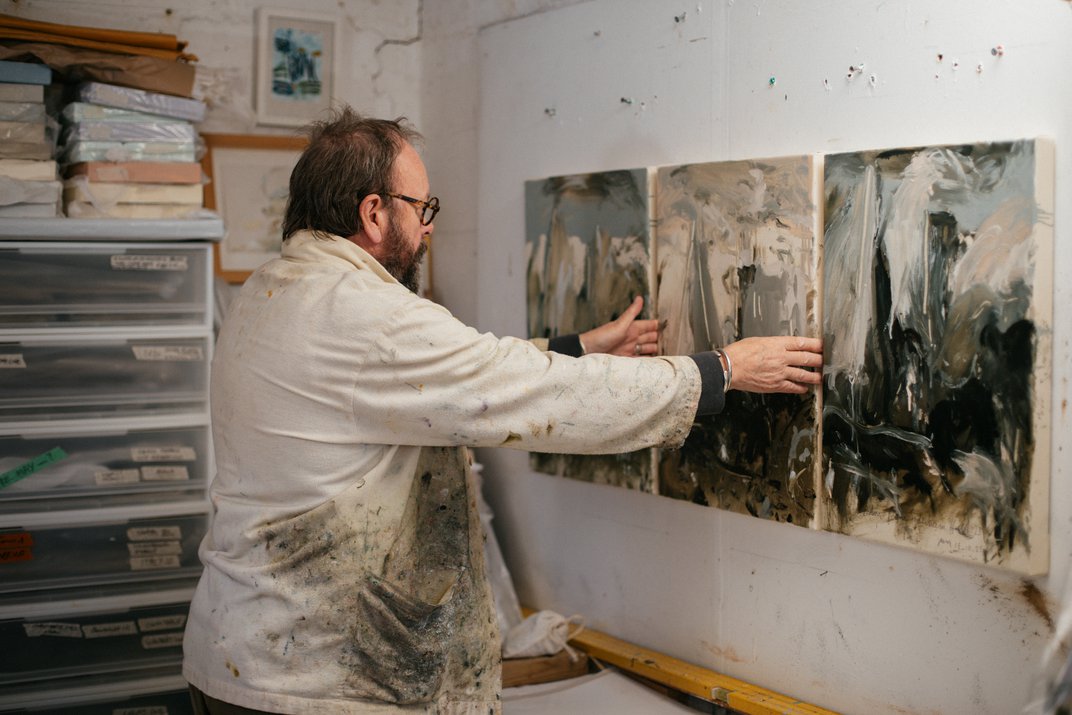
Philip The “upcoming” series of paintings has been progressing now for around three weeks. Each painting begins on a cream/ivory (white, yellow ochre, and black) dry ground, then, almost like a screen print, a second colour (white, burnt umber, Prussian blue) is blocked in for roughly, sky, middle distance and buildings. I am working on a view of “London from Sydenham Hill” and each painting is differently affected by darker tones of burnt umber, raw sienna and prussian blue mixed and painted wet into wet. In some, the buildings including the Shard are evident but not really recognisable, in others, paint takes over. Although this series stands at 36 paintings there are more to come, although its monochrome nature is beginning to push me back to more colour and possibly more “botanical” ideas, maybe a different city?
Philip Sustainability is a difficult concept when working with oils and solvents. However, very little gets thrown away and white spirit is recycled with paint sludge being re-used or disposed of responsibly. I think to be too tidy, clean and organised would take away some of the magic. My studio space is not large, and its limitations aid sustainability. As I said, I do not like waste and I use up all paper or board. I also re-use plastics and rags for mixing and cleaning paint. Whilst I produce a great deal of work and sell regularly, I do think my children and grandchildren will have a mountain to sell or dispose of when I am no longer here. For this they may curse or thank me.
Artiq Do you have any upcoming projects that you would like to share with us?
Philip The “upcoming” series of paintings has been progressing now for around three weeks. Each painting begins on a cream/ivory (white, yellow ochre, and black) dry ground, then, almost like a screen print, a second colour (white, burnt umber, Prussian blue) is blocked in for roughly, sky, middle distance and buildings. I am working on a view of “London from Sydenham Hill” and each painting is differently affected by darker tones of burnt umber, raw sienna and prussian blue mixed and painted wet into wet. In some, the buildings including the Shard are evident but not really recognisable, in others, paint takes over. Although this series stands at 36 paintings there are more to come, although its monochrome nature is beginning to push me back to more colour and possibly more “botanical” ideas, maybe a different city?