article In conversation with
Rômulo Avi winner
of Artiq's Creative
Careers Prize
In conversation with
Rômulo Avi winner
of Artiq's Creative
Careers Prize
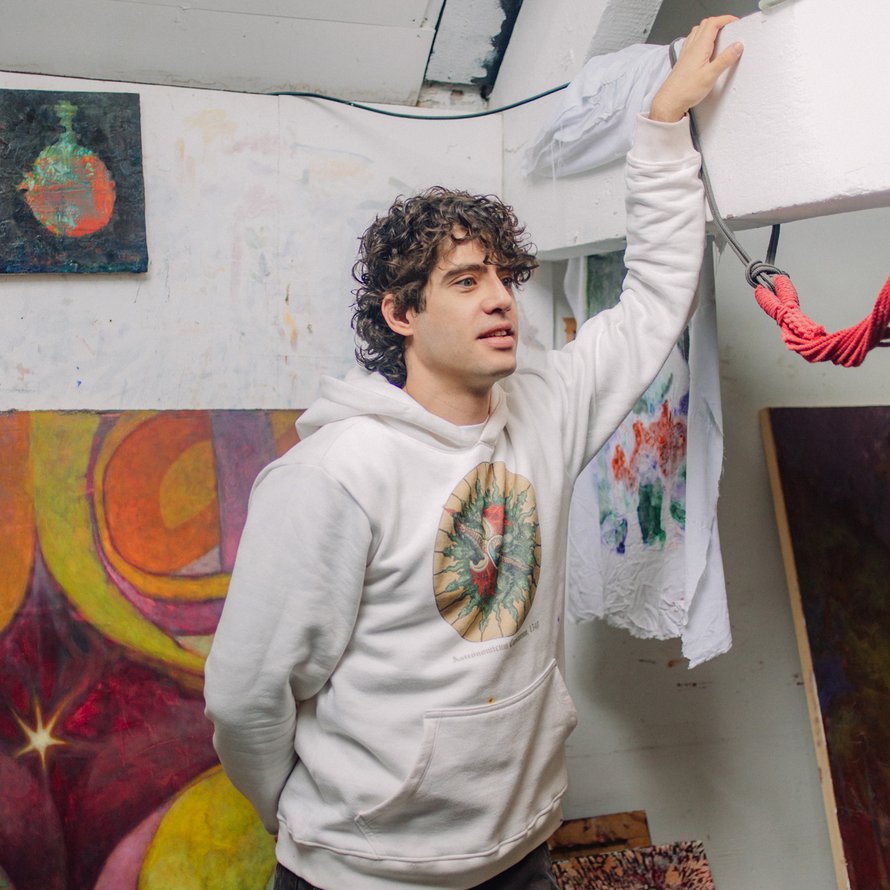
In conversation with Rômulo Avi about painting as a
process of excavation, in which images surface through
shifting layers of intuition, memory, and material change.
process of excavation, in which images surface through
shifting layers of intuition, memory, and material change.
In conversation with Rômulo Avi about painting as a
process of excavation, in which images surface through
shifting layers of intuition, memory, and material change.
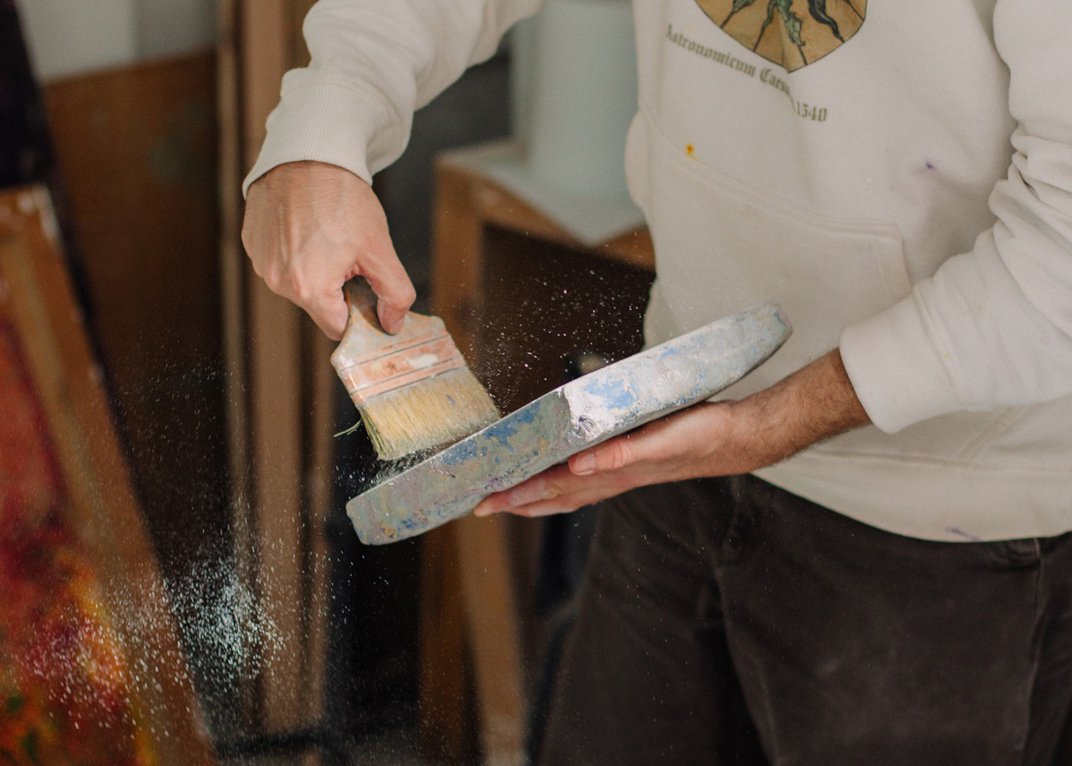
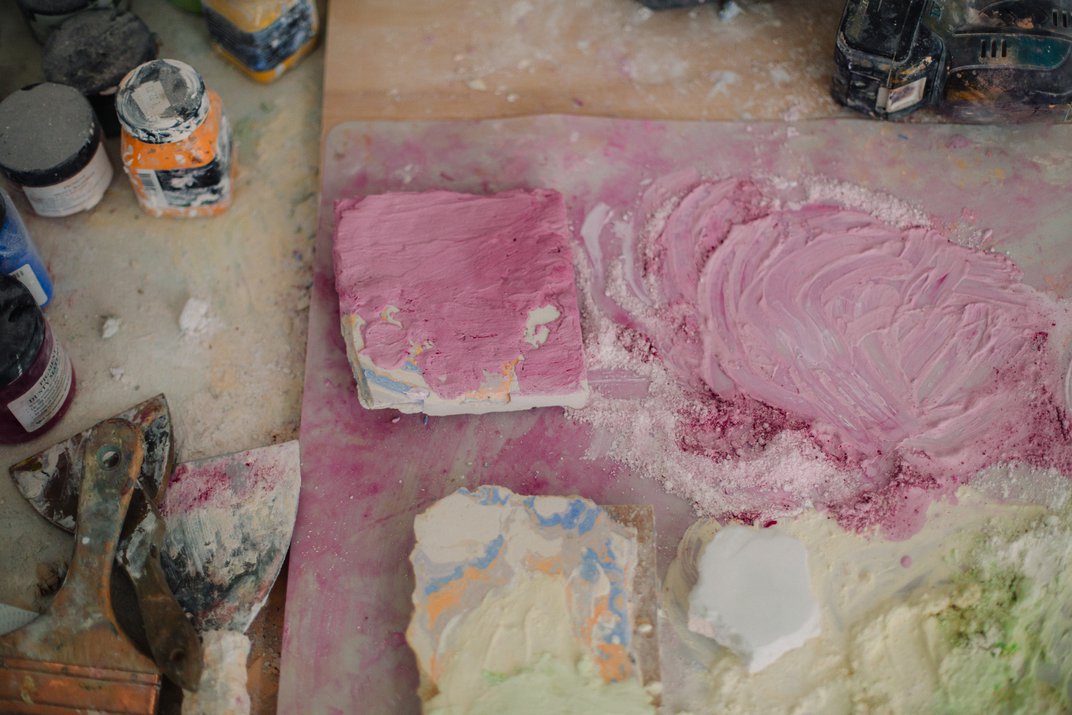
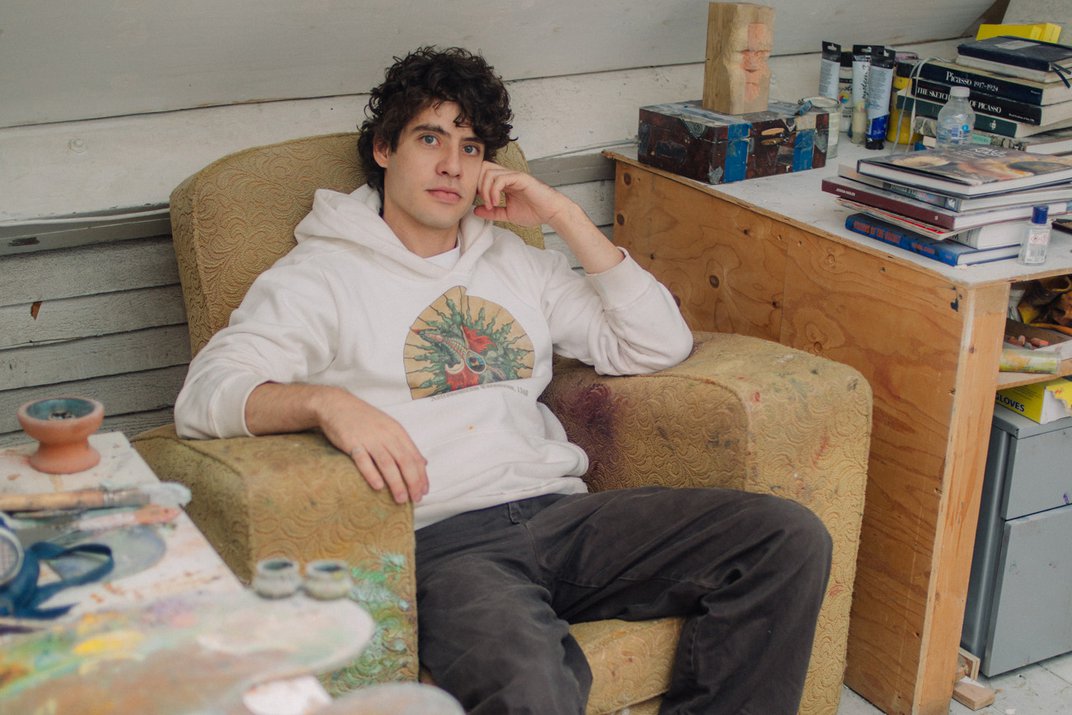
Rômulo Avi is a London-based Brazilian artist working across painting, printmaking and scagliola. Winner of Artiq’s inaugural Creative Careers Prize, his intuitive process builds and erases forms to explore memory, transience and shifting boundaries between abstraction and representation. A quarter of the way through his year-long mentorship programme we sat down with Rômulo to learn more about his experimental approach to making.
How do you begin building a foundation for a new body of work? Are there particular methods, materials, or moments of encounter that you have found will spark your process or act as points of departure for a new series?
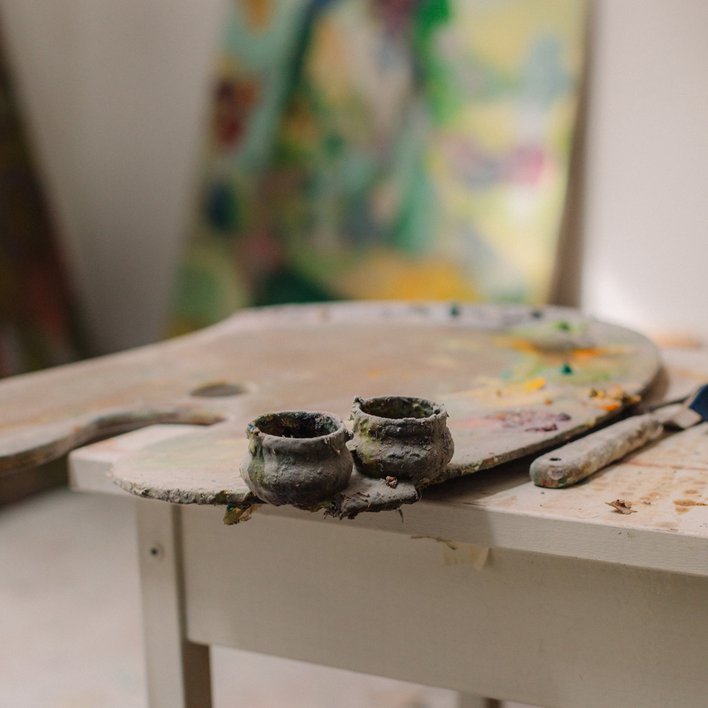
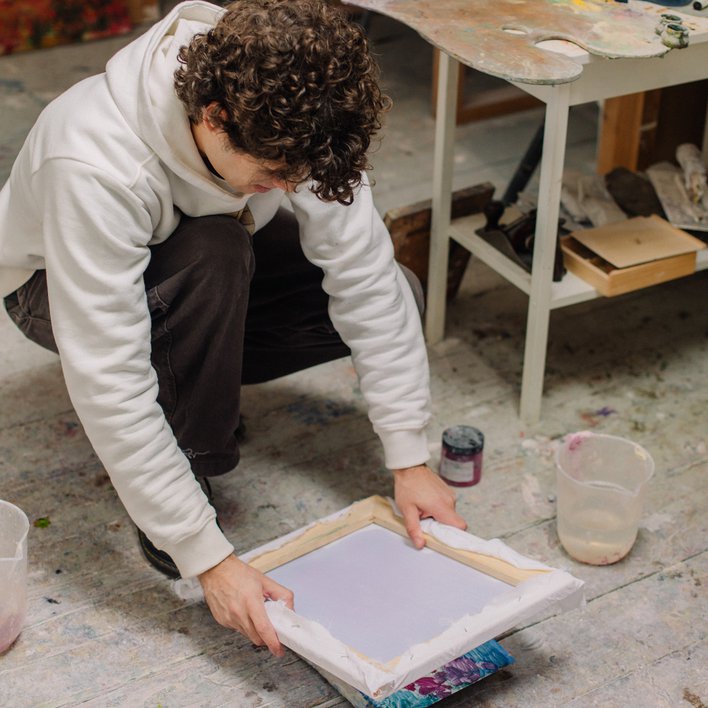
I really enjoy being surprised in painting. I think that if I start with a preconceived idea, I will only reach something I already knew. In practical terms however it usually means starting by building up layers. That has a different implication for each material, and I tend to mix and match tools and traditions. It’s very playful. I trust the process to charge the work with what I’ve been reading, dreaming, seeing or feeling. The imagery that comes later always tends to coalesce in that direction, and I’m always very curious about it.
There’s a sense of discovery in your work, almost like excavation. What does the act of revealing hidden layers mean to you conceptually?
It’s like polishing an unconscious mirror. Interests and lived experience, dreams, intention, everything gets buried, and something else comes through, almost by itself at times. And while its being unearthed it has a lot more agency, and there is a rearrangement of the parts into a new whole. The revealing, conceptually, is the coagulation of accumulated potential by looking at the surface and finding imagery or symbols to be discerned. I see it as an unveiling, but also as a descent into language. And I think that having varying degrees of control during the process allows the work to be done more fluidly, without oversteering.
I really enjoy being surprised in painting. I think that if I start with a preconceived idea, I will only reach something I already knew. In practical terms however it usually means starting by building up layers. That has a different implication for each material, and I tend to mix and match tools and traditions. It’s very playful. I trust the process to charge the work with what I’ve been reading, dreaming, seeing or feeling. The imagery that comes later always tends to coalesce in that direction, and I’m always very curious about it.
There’s a sense of discovery in your work, almost like excavation. What does the act of revealing hidden layers mean to you conceptually?
It’s like polishing an unconscious mirror. Interests and lived experience, dreams, intention, everything gets buried, and something else comes through, almost by itself at times. And while its being unearthed it has a lot more agency, and there is a rearrangement of the parts into a new whole. The revealing, conceptually, is the coagulation of accumulated potential by looking at the surface and finding imagery or symbols to be discerned. I see it as an unveiling, but also as a descent into language. And I think that having varying degrees of control during the process allows the work to be done more fluidly, without oversteering.
‘I trust the process to charge the work with
what I’ve been reading, dreaming, seeing or feeling.’
what I’ve been reading, dreaming, seeing or feeling.’
Rômulo Avi
How has your experience of moving between places shaped the emotional or visual language of your work?
I’m usually satisfied when the work feels open and ambiguous. There is a richness of experience but also a longing, which I recognize as aspects of living in between places that are far apart from one another. I believe that having airy roots, so to speak, adds a lot of perspective towards world view and the scope of painting. Constraints seem less dogmatic, although they’re definitely necessary; Eventually and because of this, the process itself gained a much larger role.
You have the unique position as an artist with two studios in two massively different locations, Brazil and the UK. How does the atmosphere of the place in which you are influence your research and making processes?
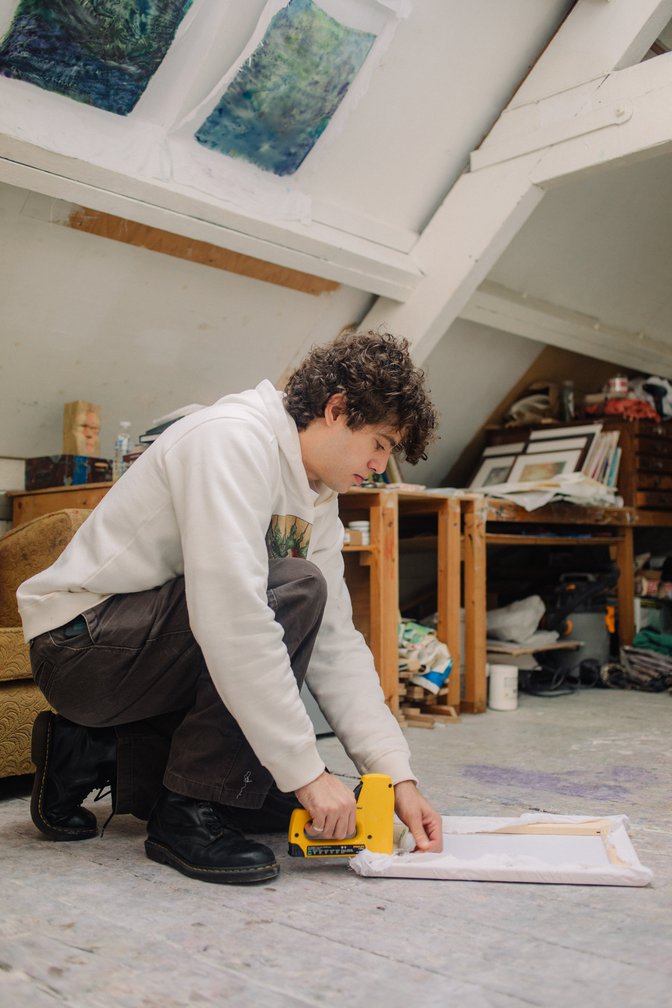
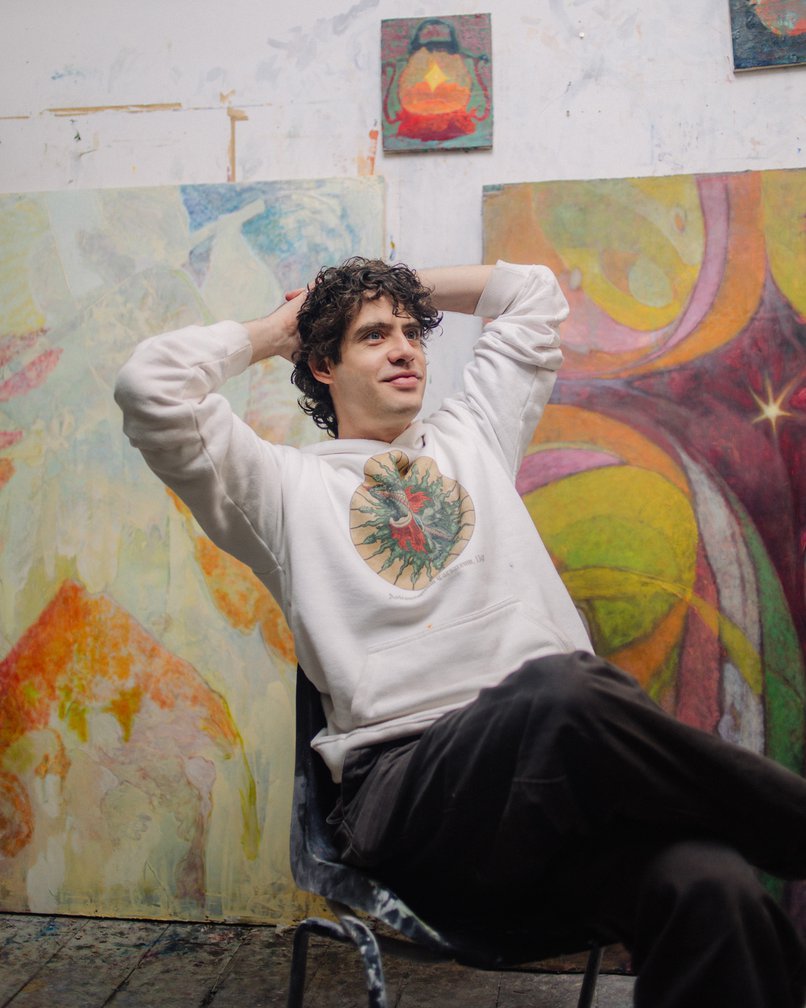
Colour and texture, driving side, weather, social dynamics, it’s all quite different. There’s a huge breadth to London, almost too much to see, so I really enjoy dipping into different ways of thinking here. I also tend to do most of my painting work in the UK. My studio is at the top of an old nunnery, and I love the fact that it’s an attic. Brings back old memories and puts me in a place of curiosity. Wizard’s tower kind of thing. Home is usually where I dive into research. I find it very grounding to spend time in the summer with family and old friends. I get to listen to the birds or read on the hammock when I’m there. It’s usually when I gather my thoughts and write for myself, make smaller work if at all. So, being there centres me a lot.
I’m usually satisfied when the work feels open and ambiguous. There is a richness of experience but also a longing, which I recognize as aspects of living in between places that are far apart from one another. I believe that having airy roots, so to speak, adds a lot of perspective towards world view and the scope of painting. Constraints seem less dogmatic, although they’re definitely necessary; Eventually and because of this, the process itself gained a much larger role.
You have the unique position as an artist with two studios in two massively different locations, Brazil and the UK. How does the atmosphere of the place in which you are influence your research and making processes?
Colour and texture, driving side, weather, social dynamics, it’s all quite different. There’s a huge breadth to London, almost too much to see, so I really enjoy dipping into different ways of thinking here. I also tend to do most of my painting work in the UK. My studio is at the top of an old nunnery, and I love the fact that it’s an attic. Brings back old memories and puts me in a place of curiosity. Wizard’s tower kind of thing. Home is usually where I dive into research. I find it very grounding to spend time in the summer with family and old friends. I get to listen to the birds or read on the hammock when I’m there. It’s usually when I gather my thoughts and write for myself, make smaller work if at all. So, being there centres me a lot.
How does your connection to Brazil and the UK influence your use of colour, rhythm, or composition? Are there any references, either cultural, visual, or spiritual which have made their way into your work?
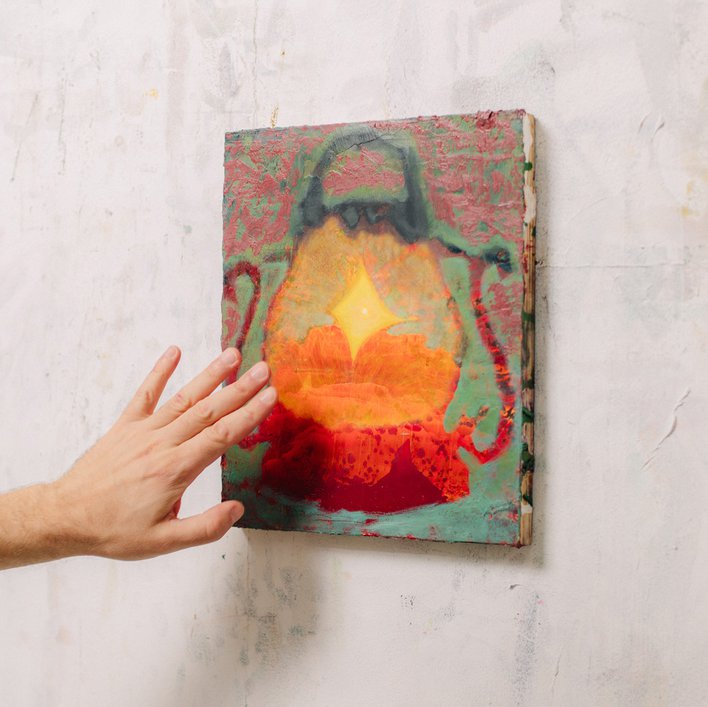
The UK has a lot of atmosphere and beautiful textures. The seasons here, especially in the countryside, feel real and cyclical. Back home, the sun gives colour a lot of depth and saturation instead. It’s a kind of perpetual summer, intense and full of life. The images that I unearth often have a pastoral aspect, which reflect a landscape present across every place I have lived in. A lot of this finds its way into the work purely through building gestural layers and colour choices. I occasionally reference mythology and folklore in the titles, but my cultural and spiritual references are usually only found within the layers of the process.
Your work sometimes draws on archetypes like The Fool, The Hermit, and The Trickster which are associated with spontaneity, self-discovery, and the spirit of chaos respectively. What draws you to these figures?
I like them for different reasons. The Hermit moves away to find truth; The fool, particularly the wanderer, moves through without commitment. The Trickster goes within the world in order to distort and rearrange it. Out of these, I think the latter is often seen as the most suspicious, as it’s an archetype which channels a characteristically amorphous aspect of humanity. Travel, trade/thievery, passage, trickery, change, transitional states, in-betweenness; crossing thresholds is its specialty, as well as the redefinition of boundaries. These are aspects of the collective psyche as well as the world, and I think I’m attracted to it because of the polarity and rigidity of the current state of affairs in both. There’s a lot of adaptability and wit to that archetype, as well as the capacity to imagine new bearings.
The UK has a lot of atmosphere and beautiful textures. The seasons here, especially in the countryside, feel real and cyclical. Back home, the sun gives colour a lot of depth and saturation instead. It’s a kind of perpetual summer, intense and full of life. The images that I unearth often have a pastoral aspect, which reflect a landscape present across every place I have lived in. A lot of this finds its way into the work purely through building gestural layers and colour choices. I occasionally reference mythology and folklore in the titles, but my cultural and spiritual references are usually only found within the layers of the process.
Your work sometimes draws on archetypes like The Fool, The Hermit, and The Trickster which are associated with spontaneity, self-discovery, and the spirit of chaos respectively. What draws you to these figures?
I like them for different reasons. The Hermit moves away to find truth; The fool, particularly the wanderer, moves through without commitment. The Trickster goes within the world in order to distort and rearrange it. Out of these, I think the latter is often seen as the most suspicious, as it’s an archetype which channels a characteristically amorphous aspect of humanity. Travel, trade/thievery, passage, trickery, change, transitional states, in-betweenness; crossing thresholds is its specialty, as well as the redefinition of boundaries. These are aspects of the collective psyche as well as the world, and I think I’m attracted to it because of the polarity and rigidity of the current state of affairs in both. There’s a lot of adaptability and wit to that archetype, as well as the capacity to imagine new bearings.
‘The images that I unearth often have a pastoral aspect, which reflect a landscape present across every place I have lived in. A lot of this finds its way into the work purely through building gestural layers and colour choices’
Rômulo Avi
How do you characterise these figures within your practice? Are there any other archetypes or figures in folklore which you have used as a source of inspiration or drawn visual references to?
So far, they have appeared to me as children, horses, fools, travellers, shepherds. I tend to bring them forth in ambiguous compositions and overlapping possibilities, so people often find different imagery that reflects their own assumptions and views. Since I’m a big believer in the irreducibility of the mysterious, I prefer the work to remain a bit open for that to happen. I think it’s where the utopianism and psychological mirroring creep in.
I’m constantly looking into mythology, utopian literature, esoterica and philosophy from different cultures, which currently means poking around into Taoism and Sufism a bit more. Being in the UK opened a lot of windows in that sense, as I enjoy meeting people from other knowledge traditions and different beliefs. There are always common threads.
Do you have any upcoming projects that you would like to share with us?
I have prepared a few works for the inaugural RSA summer exhibition, which is opening on the 9th of June. I’m also currently cataloguing an 8-year dream journal into a mind map of sorts and collaborating on some new plaster works.
So far, they have appeared to me as children, horses, fools, travellers, shepherds. I tend to bring them forth in ambiguous compositions and overlapping possibilities, so people often find different imagery that reflects their own assumptions and views. Since I’m a big believer in the irreducibility of the mysterious, I prefer the work to remain a bit open for that to happen. I think it’s where the utopianism and psychological mirroring creep in.
I’m constantly looking into mythology, utopian literature, esoterica and philosophy from different cultures, which currently means poking around into Taoism and Sufism a bit more. Being in the UK opened a lot of windows in that sense, as I enjoy meeting people from other knowledge traditions and different beliefs. There are always common threads.
Do you have any upcoming projects that you would like to share with us?
I have prepared a few works for the inaugural RSA summer exhibition, which is opening on the 9th of June. I’m also currently cataloguing an 8-year dream journal into a mind map of sorts and collaborating on some new plaster works.
Want to be part of our network? Submit your work and join Artiq's growing community of artists.