article In conversation with
Samira Addo & Emma Boittiaux
In conversation with
Samira Addo & Emma Boittiaux
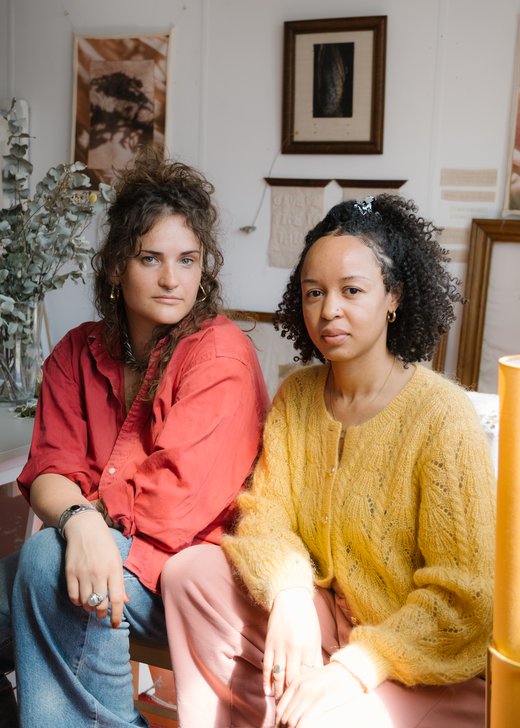
In conversation with Samira Addo & Emma Boittiaux
about materiality, portraiture, and the creative dialogue
that shapes their work
about materiality, portraiture, and the creative dialogue
that shapes their work
In conversation with Samira Addo & Emma Boittiaux
about materiality, portraiture, and the creative dialogue
that shapes their work
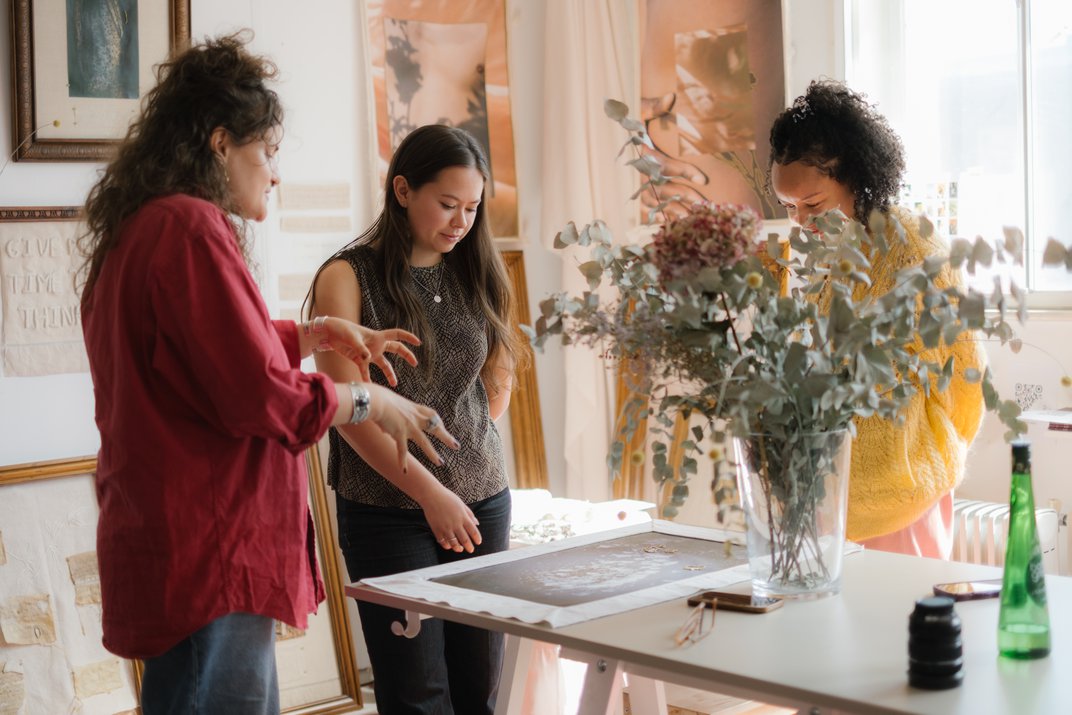
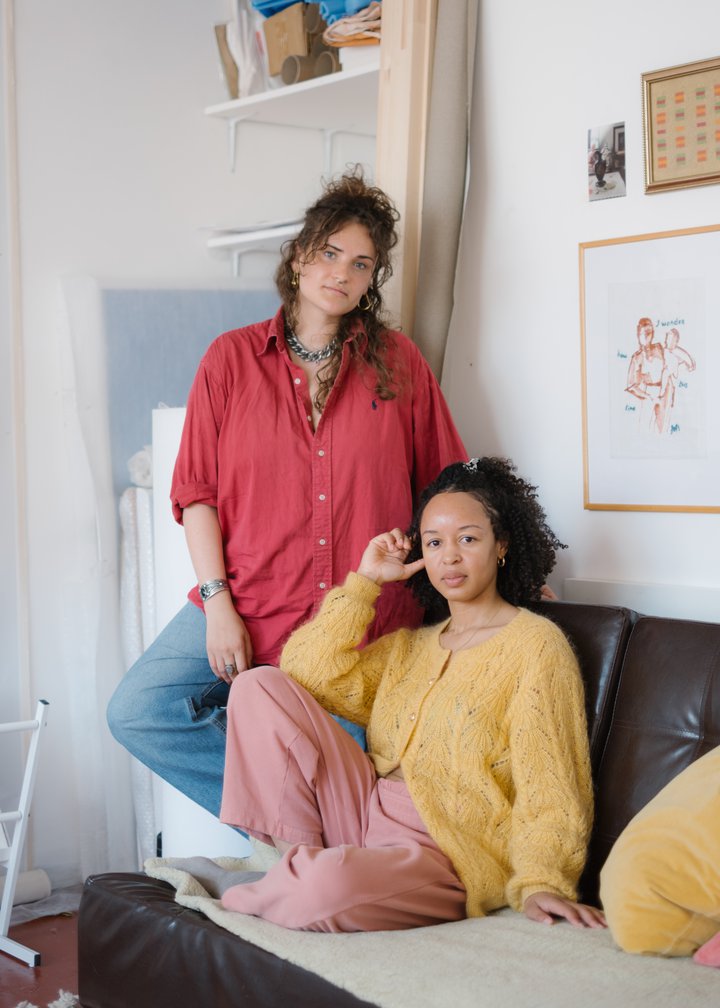
Working from a shared Brixton studio, artists Emma Boittiaux and Samira Addo have built, distinct, material-driven practices. While each follows a unique creative path, their ongoing creative exchange reflects the value of dialogue, and community in sustaining a contemporary practice. In our latest conversation, we visited their studio to explore how different materials, rhythms and approaches can coexist within the same creative space. Together, they reflect on the value of artist-to-artist exchange, the role of community in sustaining a practice, and how collaboration continues to shape the way they think, make and grow.
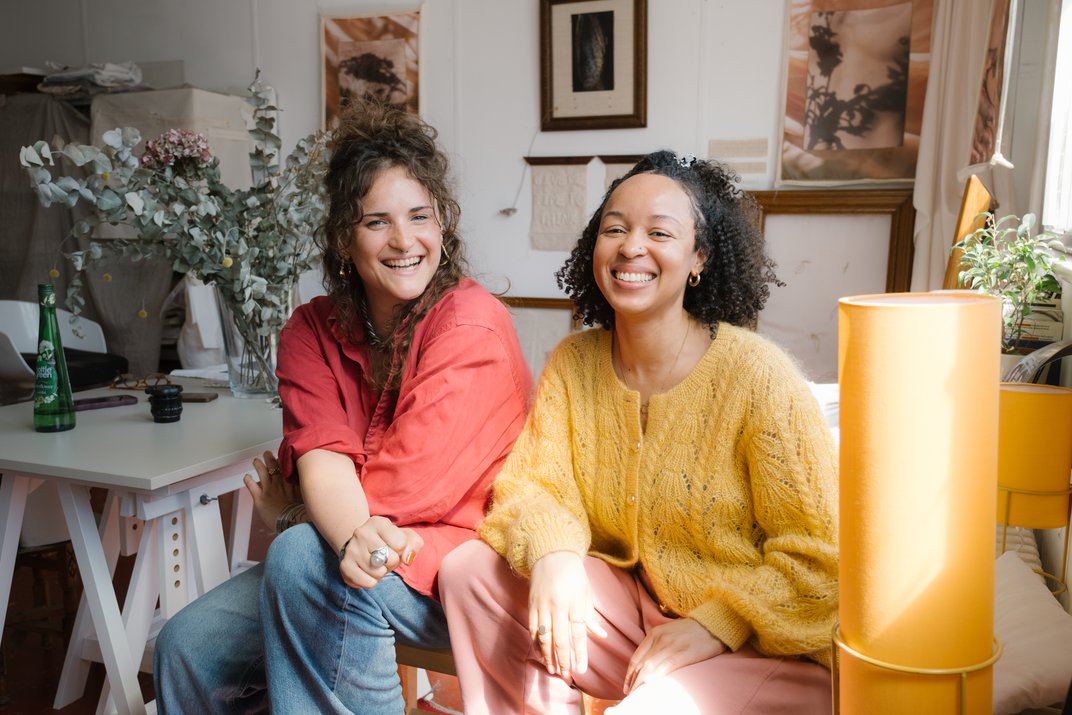
With Emma working across photography, words and textiles, and Samira working with oil paints, your practices differ in pace and process. What does a typical working day look like for each of you, and how do your different rhythms coexist or influence each other in a shared studio environment?
Emma If I am at the studio, I usually start with my admin and then get to more hands-on & creative work after. I do have quite a strict routine as a freelancer and artist; our professional life bleeds so much into our personal life that relatively strict hours help me to create boundaries. When Samira comes in, we usually have our little catch-up. I love being able to have these discussions when I have been stuck on something or just want her opinion on where a piece is going. It's a good check-in moment where I can take a step back from the work. I think we have the perfect balance of time together and each time alone; both are important.
Samira I typically get in in the early afternoon depending on what I’m working on that day – and typically work 5-6 days a week. Our schedules do tend to overlap across the week, but our practices are very different, and so we take up the space differently (except with admin work of course!). What’s great about our shared studio environment is that it’s a super comfortable space where I feel motivated to work in. Emma and I have been really intentional about curating a space that appreciates our individual needs but also recognises the intimacy of creating in a space with another.
At Artiq we believe in the value of artist-to-artist exchange. How has sharing a studio space impacted your individual practice, and in what ways has working alongside another artist shifted your thinking, approach, or discipline over time?
Emma Sharing a studio and having peer support helps on different levels. I think we created such a homely and supportive space in the studio where we can always share our highs and lows as well as ask each other thoughts on the piece we are working on, colour, composition, etc. Mentally, it’s so valuable to have someone who understands your career and to whom you can express the difficulties of rejection, for example. I know she helped me a lot with being more assertive through contracts, prices and boundaries. Having an art career requires a myriad of skills that most of the time, art school hasn't taught you.
Samira Sharing a studio space with Emma has been exactly what I needed – both in personal and in practice. Often as an artist you carve your own path which can be extremely challenging at times. Having someone else who can resonate with that journey is such a relief. We exchange feedback on work, talk about ideas and goals and encourage each other in different ways. Emma has had a tremendous impact on my ability to contextualise my work, build a network and broaden my understanding of the art world. I find myself noticing details like framing and overall curation more than I ever used to.
Emma If I am at the studio, I usually start with my admin and then get to more hands-on & creative work after. I do have quite a strict routine as a freelancer and artist; our professional life bleeds so much into our personal life that relatively strict hours help me to create boundaries. When Samira comes in, we usually have our little catch-up. I love being able to have these discussions when I have been stuck on something or just want her opinion on where a piece is going. It's a good check-in moment where I can take a step back from the work. I think we have the perfect balance of time together and each time alone; both are important.
Samira I typically get in in the early afternoon depending on what I’m working on that day – and typically work 5-6 days a week. Our schedules do tend to overlap across the week, but our practices are very different, and so we take up the space differently (except with admin work of course!). What’s great about our shared studio environment is that it’s a super comfortable space where I feel motivated to work in. Emma and I have been really intentional about curating a space that appreciates our individual needs but also recognises the intimacy of creating in a space with another.
At Artiq we believe in the value of artist-to-artist exchange. How has sharing a studio space impacted your individual practice, and in what ways has working alongside another artist shifted your thinking, approach, or discipline over time?
Emma Sharing a studio and having peer support helps on different levels. I think we created such a homely and supportive space in the studio where we can always share our highs and lows as well as ask each other thoughts on the piece we are working on, colour, composition, etc. Mentally, it’s so valuable to have someone who understands your career and to whom you can express the difficulties of rejection, for example. I know she helped me a lot with being more assertive through contracts, prices and boundaries. Having an art career requires a myriad of skills that most of the time, art school hasn't taught you.
Samira Sharing a studio space with Emma has been exactly what I needed – both in personal and in practice. Often as an artist you carve your own path which can be extremely challenging at times. Having someone else who can resonate with that journey is such a relief. We exchange feedback on work, talk about ideas and goals and encourage each other in different ways. Emma has had a tremendous impact on my ability to contextualise my work, build a network and broaden my understanding of the art world. I find myself noticing details like framing and overall curation more than I ever used to.
‘The act of creating can really take me through an emotional rollercoaster but fundamentally it’s a kind of soul calling that feels grounding and powerful.’
- Samira Addo
Emma, your practice brings together photography, a relatively immediate, responsive medium, with embroidery, which is slow and repetitive. How do these two temporalities interact in your work, and what possibilities open up when you combine such contrasting ways of making?
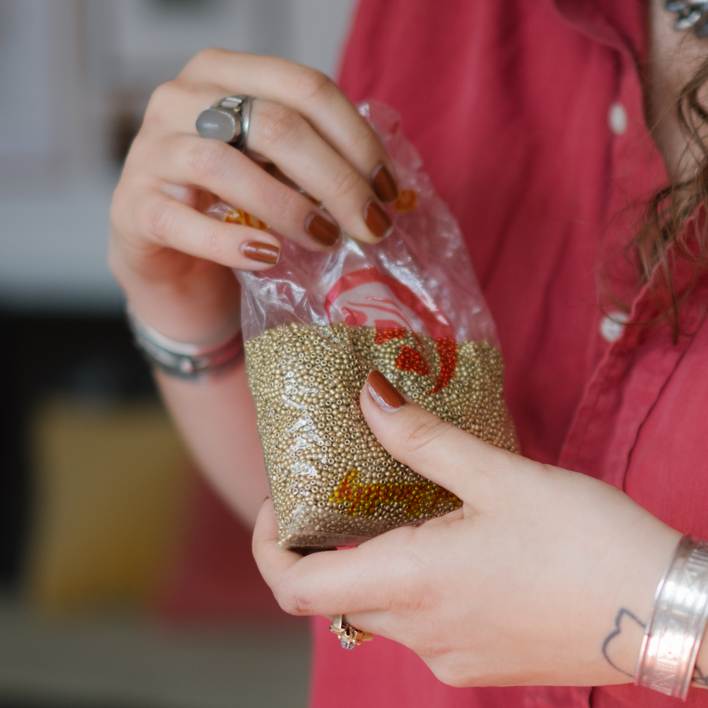
Emma This dichotomy of rhythm is at the core of my work. It echoes the rhythm of the rural area where I'm from in France, and the quickness of London. It also speaks about one of my body - living with chronic illness, I am always between being active and not being able to. Something difficult to adjust to in an ever-faster-paced society. I see the slowness of the embroidery as an act of resistance, a slowness closer to the land. It might have only taken me an instant to take the photo, but it might take up to 50 hours to sublimate it with beads.
Samira, in your paintings, areas of the canvas are often left open or minimally worked. How do you think these spaces contribute to the composition, and what role do they play in shaping the viewer’s experience of the image?
Samira I see these areas as a celebration of freedom of choice. When I’m painting, I like each mark to count, so as the piece is building, I’m continuously thinking about what is truly necessary, in achieving a sense of textural and colour balance and in the case of portraits – a likeness. Often this process can create areas where the background or underneath is exposed. These areas are also intentional in providing breathing space and with that perhaps also allows the viewer to interact with the piece filling in the gaps with their reading.
You both recently joined forces to create a workshop that combines portraiture, embroidery and memory as a shared medium. How did you arrive at this intersection of both of your practices and how has this changed how you work individually?
Emma It came from wanting to do something with the space and welcome people. We realised that when we had studio visits, people were always saying how nice the studio felt and the energy, etc. Through discussions, we came up with the workshop idea and started thinking about how we could host one together. We loved that our practices were diametrically opposite, but that at the same time, we were both working with telling people stories. From there, we extracted the most characteristic parts of our respective practices and worked on how we could create a visual language from them. I love how this workshop brought me back closer to drawing.
Samira We’re super proud of our workshop “Through Ink and Thread”. I feel it was birthed from the curiosity of what it would look like to combine our practices, and how we could welcome people into the space we worked thoughtfully on creating. Although our practices differ, we realised that they are both rooted in personal connections and this is something we decided to home in on with our workshop. It’s about sharing an approach to creating a piece with sentimental value in a space that’s also personal. In a way it’s a small behind the scenes of both of our practices.
Emma This dichotomy of rhythm is at the core of my work. It echoes the rhythm of the rural area where I'm from in France, and the quickness of London. It also speaks about one of my body - living with chronic illness, I am always between being active and not being able to. Something difficult to adjust to in an ever-faster-paced society. I see the slowness of the embroidery as an act of resistance, a slowness closer to the land. It might have only taken me an instant to take the photo, but it might take up to 50 hours to sublimate it with beads.
Samira, in your paintings, areas of the canvas are often left open or minimally worked. How do you think these spaces contribute to the composition, and what role do they play in shaping the viewer’s experience of the image?
Samira I see these areas as a celebration of freedom of choice. When I’m painting, I like each mark to count, so as the piece is building, I’m continuously thinking about what is truly necessary, in achieving a sense of textural and colour balance and in the case of portraits – a likeness. Often this process can create areas where the background or underneath is exposed. These areas are also intentional in providing breathing space and with that perhaps also allows the viewer to interact with the piece filling in the gaps with their reading.
You both recently joined forces to create a workshop that combines portraiture, embroidery and memory as a shared medium. How did you arrive at this intersection of both of your practices and how has this changed how you work individually?
Emma It came from wanting to do something with the space and welcome people. We realised that when we had studio visits, people were always saying how nice the studio felt and the energy, etc. Through discussions, we came up with the workshop idea and started thinking about how we could host one together. We loved that our practices were diametrically opposite, but that at the same time, we were both working with telling people stories. From there, we extracted the most characteristic parts of our respective practices and worked on how we could create a visual language from them. I love how this workshop brought me back closer to drawing.
Samira We’re super proud of our workshop “Through Ink and Thread”. I feel it was birthed from the curiosity of what it would look like to combine our practices, and how we could welcome people into the space we worked thoughtfully on creating. Although our practices differ, we realised that they are both rooted in personal connections and this is something we decided to home in on with our workshop. It’s about sharing an approach to creating a piece with sentimental value in a space that’s also personal. In a way it’s a small behind the scenes of both of our practices.
During our visit, we spoke about how making artwork can generate very different emotional states. How does the act of making feel for each of you, and does that experience shift depending on the material or stage of the work?
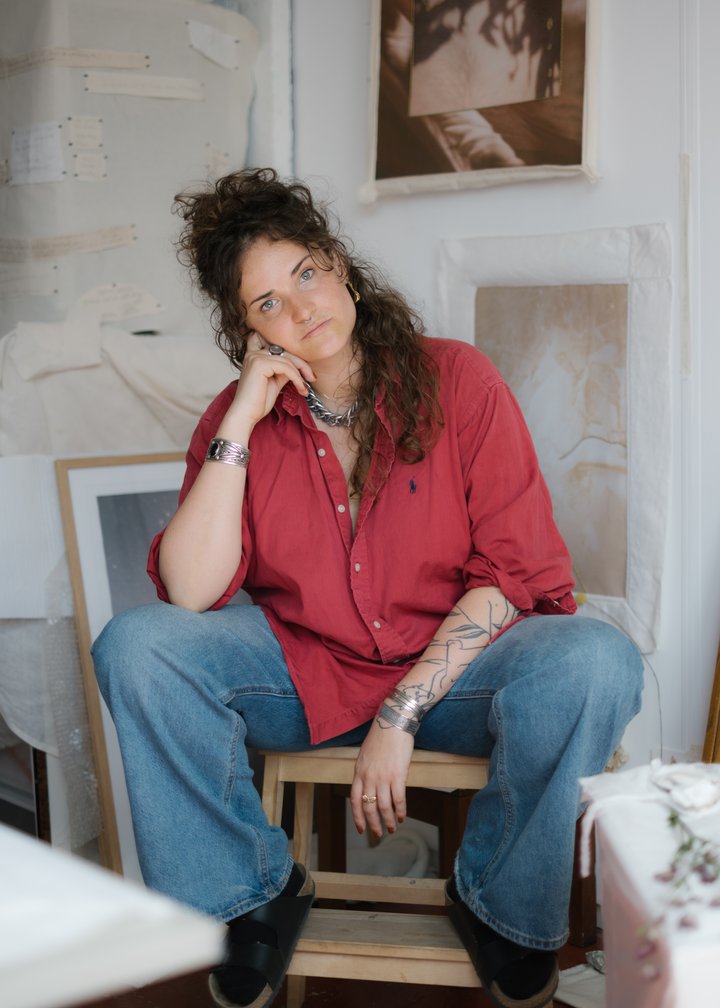
Emma It depends on the medium; embroidery, for example, is very reflective for me. It’s a time when I can get into a meditative space, and it's one of the best ways for me to sit with myself and my thoughts. The repetitiveness of it makes it a lot easier to wander, and it's usually when I deepen the reflection around my work. Writing can be more challenging; you have to fully confront these thoughts, dig and let go at the same time. It can be quite emotional. I like to balance it with editing, for example, if I have a shoot to edit after, as I switch to hyper focus on a detailed image.
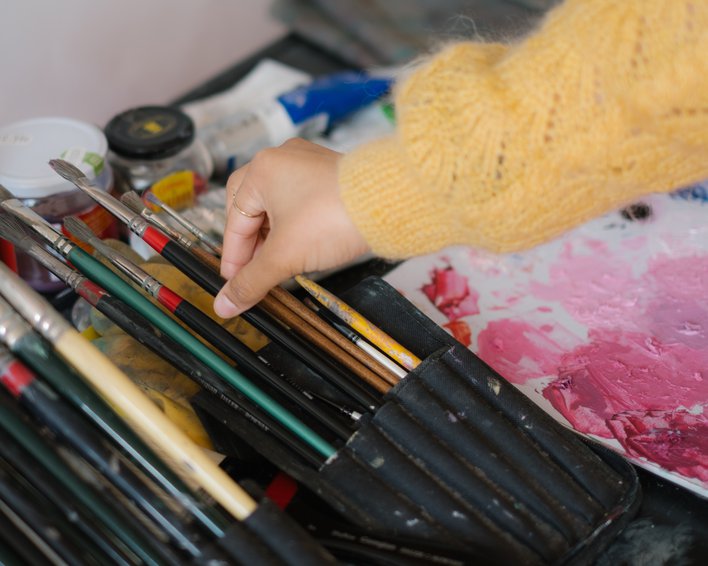
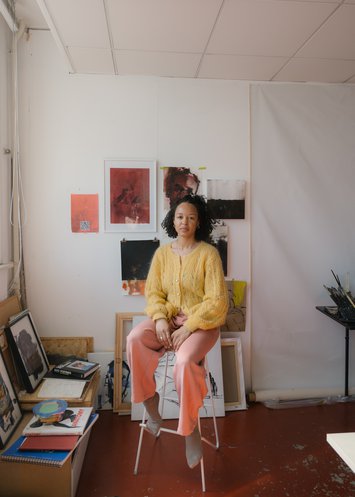
Samira The act of creating can really take me through an emotional rollercoaster but fundamentally it’s a kind of soul calling that feels grounding and powerful. There are times painting where I am my most empowered and connected to myself. I have a background in dance, and I often listen to music when I paint, and so it can truly feel like a full body experience. Listening to music can also serve as a tool for me to keep my approach light and energetic especially when I get a sense that things are getting too tight in my work.
Samira, your paintings draw on rich, often unexpected colour palettes. How do you approach the use of colour in your work, and what influences your decisions when developing your palette?
Samira Colour plays such an important role in my work – The colour palette is often derived from an internal response to the reference imagery and what energy or vibe I’d like to reflect on. I’m a self-taught artist and my relationship to colour choice has developed organically through my practice. I’ve learned over the years that choosing a limited number of colours for each palette is more accessible and more harmonious to my approach to painting and mark making.
Emma, your work has a strong sensitivity to material, often incorporating wood, linen, lace, and beads sourced in and around your home in France. What draws you to these materials, and how has their locality come to define the visual and emotional language of your practice?
Emma It started with my grandmother gifting me the linen sheets that her mother had gifted to her at her wedding. I realised how much history these sheets hold, one that is quite unknown to me. My work always stems from the personal; it talks about 'le lien' - relationships. Using materials that carry stories, another person's touch and intimacy give the work the textures from the past. It also evokes a more sustainable and durable way of making. The linen was grown, woven and hand-embroidered in Normandy 100 years ago now. This has completely disappeared for decades until very recently, when small productions have started again. This linen speaks of hope, as does the natural beeswax I use from a beekeeper who lives near my parents and who is used to giving away the fruits he grows to the community.
Emma It depends on the medium; embroidery, for example, is very reflective for me. It’s a time when I can get into a meditative space, and it's one of the best ways for me to sit with myself and my thoughts. The repetitiveness of it makes it a lot easier to wander, and it's usually when I deepen the reflection around my work. Writing can be more challenging; you have to fully confront these thoughts, dig and let go at the same time. It can be quite emotional. I like to balance it with editing, for example, if I have a shoot to edit after, as I switch to hyper focus on a detailed image.
Samira The act of creating can really take me through an emotional rollercoaster but fundamentally it’s a kind of soul calling that feels grounding and powerful. There are times painting where I am my most empowered and connected to myself. I have a background in dance, and I often listen to music when I paint, and so it can truly feel like a full body experience. Listening to music can also serve as a tool for me to keep my approach light and energetic especially when I get a sense that things are getting too tight in my work.
Samira, your paintings draw on rich, often unexpected colour palettes. How do you approach the use of colour in your work, and what influences your decisions when developing your palette?
Samira Colour plays such an important role in my work – The colour palette is often derived from an internal response to the reference imagery and what energy or vibe I’d like to reflect on. I’m a self-taught artist and my relationship to colour choice has developed organically through my practice. I’ve learned over the years that choosing a limited number of colours for each palette is more accessible and more harmonious to my approach to painting and mark making.
Emma, your work has a strong sensitivity to material, often incorporating wood, linen, lace, and beads sourced in and around your home in France. What draws you to these materials, and how has their locality come to define the visual and emotional language of your practice?
Emma It started with my grandmother gifting me the linen sheets that her mother had gifted to her at her wedding. I realised how much history these sheets hold, one that is quite unknown to me. My work always stems from the personal; it talks about 'le lien' - relationships. Using materials that carry stories, another person's touch and intimacy give the work the textures from the past. It also evokes a more sustainable and durable way of making. The linen was grown, woven and hand-embroidered in Normandy 100 years ago now. This has completely disappeared for decades until very recently, when small productions have started again. This linen speaks of hope, as does the natural beeswax I use from a beekeeper who lives near my parents and who is used to giving away the fruits he grows to the community.
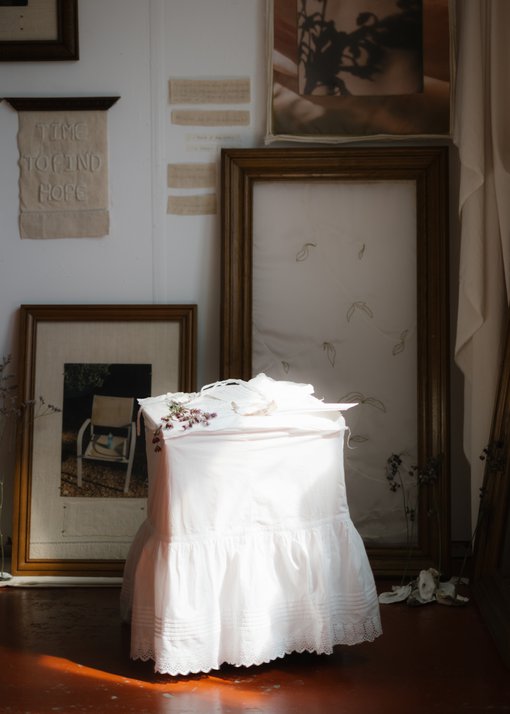
‘Using materials that carry stories, another person's touch and intimacy give the work the textures from the past. It also evokes a more sustainable and durable way of making.’
- Emma Boittiaux
Do you have any upcoming projects, shared or individual, you would like to share with us?
Emma I am developing a new and ongoing project, ‘Give Men Their Flowers’ that dives into masculinity, disconnection, love and repair. I am working on a large embroidery piece on mousseline for it, which is titled ‘The Herbarium of Their Violence’ that explores violence and repair through nature.
Samira I’m currently working through a body of work centred around how we choose to present ourselves to the world and what we choose to withhold. Two of these initial works will be in the 2026 Contemporary British Portrait Painters group show. My project explores body language, micro expressions and perceptions under the umbrella of self-imposed suppression and how it manifests. It is a longer-term project aiming to take me into the realm of complete abstraction which I’m looking forward to exploring. It'll be interesting to see how my approach to painting manifests itself when my focus is shifted away from a likeness.
Emma I am developing a new and ongoing project, ‘Give Men Their Flowers’ that dives into masculinity, disconnection, love and repair. I am working on a large embroidery piece on mousseline for it, which is titled ‘The Herbarium of Their Violence’ that explores violence and repair through nature.
Samira I’m currently working through a body of work centred around how we choose to present ourselves to the world and what we choose to withhold. Two of these initial works will be in the 2026 Contemporary British Portrait Painters group show. My project explores body language, micro expressions and perceptions under the umbrella of self-imposed suppression and how it manifests. It is a longer-term project aiming to take me into the realm of complete abstraction which I’m looking forward to exploring. It'll be interesting to see how my approach to painting manifests itself when my focus is shifted away from a likeness.
Want to be part of our network? Submit your work and join Artiq's growing community of artists.